Can tai chi help prevent falls? A balance score isn't a fall count
Table of Contents
If your parent has started grabbing the furniture on the way across the room, a tai chi class might sound like a gentle fix. A January 2026 review of tai chi trials gives you a reason to look more closely: people generally did better on balance and movement tests. But the review didn’t pool the number of times people actually fell. That’s a different question - and the one you probably meant to ask.
There is evidence about real falls from other studies. It’s just not a license to treat every class, online video or slow-moving exercise as the same intervention. And it doesn’t make a dizzy spell, a loose rug or a medication that affects alertness disappear.
A better balance test is useful, but what was measured? #
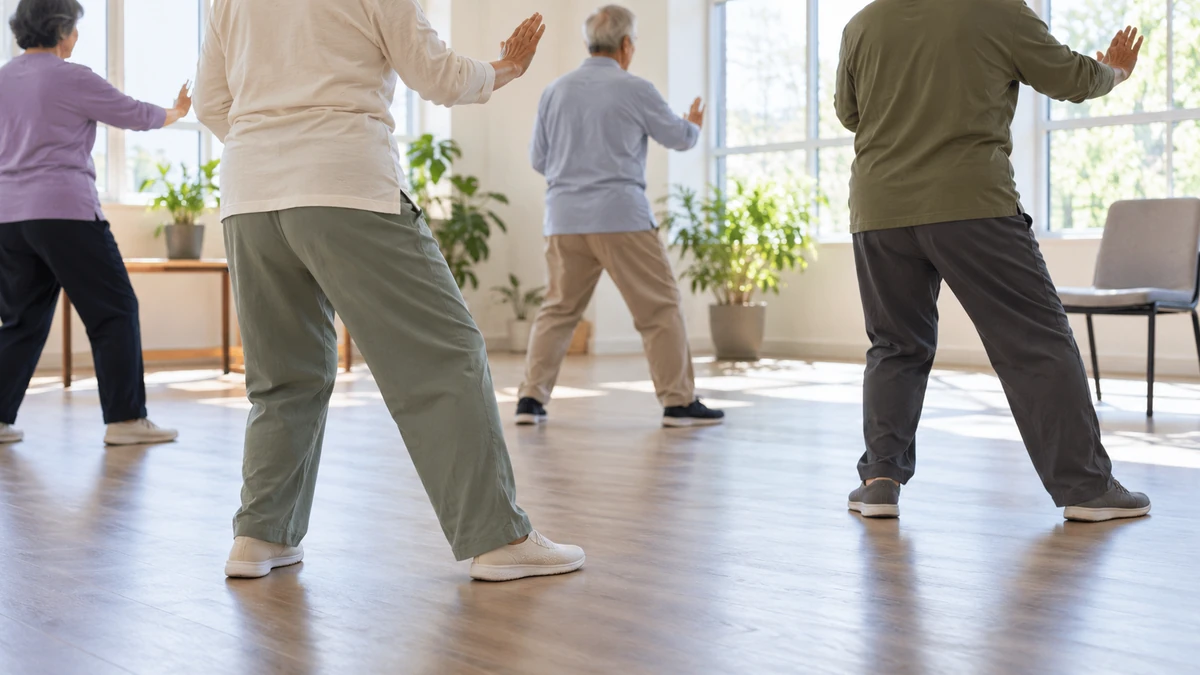
Tai chi began as a Chinese martial art and is often practiced today as slow, coordinated movement with attention to posture and weight shifts, according to NIH’s National Center for Complementary and Integrative Health (NCCIH). Its history isn’t clinical evidence. The movement itself offers a plausible way to practice balance; whether that changes fall counts has to be measured separately.
The 2026 analysis pooled 21 randomized trials involving 2,408 generally healthy older adults. Among its endpoints were the Timed Up and Go test (standing, walking a short distance and sitting again), a standing-balance scale and one-leg standing. Several results favored tai chi over comparison activities. But the trials varied substantially, and not every confidence or fear-of-falling measure gave a clear answer. The paper’s pooled outcomes weren’t a count of actual falls.
Picture someone shaving time off a clinic walking test, then getting lightheaded when they stand up at home. The test improvement matters. It doesn’t tell us whether they’ll avoid the fall on that particular afternoon. So where do we get evidence for the fall question? From studies that recorded falls, rather than treating test scores as a stand-in.
What studies counting falls found #
A Cochrane review of exercise and falls in community-dwelling older adults assessed tai chi against controls not expected to prevent falls. Its pooled trials found fewer people who fell at least once (eight trials, 2,677 people; high-certainty evidence for that outcome). It also estimated a lower rate of falls - the number of fall events over time - from seven trials involving 2,655 people, though the certainty for that estimate was low. One person can fall more than once, so a fall rate and the share of people who fall aren’t interchangeable.
That Cochrane synthesis isn’t the 2026 paper, and its certainty labels shouldn’t be smoothed into one confident percentage. It also doesn’t tell you that tai chi beats every other form of exercise. Balance and functional exercise have their own fall-prevention evidence in the same Cochrane review; estimates from separate subgroups aren’t a head-to-head contest.
One unusually concrete comparison comes from a 2018 randomized trial of 670 adults aged 70 or older who had fallen before or had impaired mobility. Participants attended a specially designed, instructor-led therapeutic Tai Ji Quan program, a multimodal exercise program or stretching classes over 24 weeks. The trial recorded 152 falls in the Tai Ji Quan group, 218 in the multimodal group and 363 in the stretching group. That’s encouraging for that tailored program in that at-risk population. It isn’t proof that an unsupervised video will outperform someone’s prescribed strength or rehabilitation plan (or that any format will prevent a fracture). The trial authors also disclosed a licensing interest in the program.
And there are gaps. The studies don’t establish that generic tai chi prevents fractures, hospitalizations or death. They don’t settle which format works best for someone who is very frail or mostly homebound, either. A class you can attend safely and stick with matters more than chasing an unsupported claim about the single best style or schedule.
Put the class inside a fall-risk conversation #
The US Preventive Services Task Force’s 2024 recommendation supports offering exercise to adults 65 and older living in the community who are at increased risk of falls. That means people living outside institutional care, not everyone who has reached a particular birthday. Its separate recommendation on multifactorial interventions calls for an individualized decision, not a fixed package of tests and home changes for every person. Tai chi can be one exercise option; it isn’t the guideline’s only endorsed activity.
After a fall, or when walking has become less steady, I’d ask about the fall itself before shopping for a class. Was there a trip, a change in vision, or lightheadedness on standing? Has a medicine caused sleepiness? Are there stairs, cords or rugs that make the usual route awkward? The Task Force, NIH’s National Institute on Aging and CDC’s STEADI approach all place exercise in a wider assessment of risk. That isn’t a claim that adding every possible intervention gives everyone extra protection. It’s a way to find the risks that actually apply.
Bring a medication list to a clinician or pharmacist if dizziness or sedation could be involved; don’t stop or change a prescription on your own. And if balance is already poor, ask a clinician or physical therapist whether a supervised, adapted class fits your mobility and whether you need other strength or gait work. A practice you enjoy can sit beside that plan, not replace it.
Gentle movement still needs a safe starting point #
NCCIH describes tai chi as generally low-risk, with activity-related aches and pains among the reported problems. But safety reporting across exercise studies is imperfect, as Cochrane notes. A person already close to losing balance can fall while practicing a supposedly gentle weight shift.
If you’ve had recurrent or recent falls, significant unsteadiness, fainting or dizziness, a recent injury, severe joint pain, or a neurologic or heart/lung condition that limits activity, talk with a qualified health professional before starting. The same goes if you use a mobility aid and aren’t sure how to move safely in a class. Ask what support, adaptation or supervision is appropriate; don’t practice alone at the edge of your balance. Pain or dizziness during a session is a reason to stop and get advice, not to push through.
A fall with a suspected serious injury, fainting, chest pain, severe breathing trouble, sudden severe dizziness or new neurologic symptoms needs prompt medical assessment. Those are reasons for care, not an expected part of learning tai chi. Medicine-related fall risk belongs in a prescriber review, not a do-it-yourself medication change.
Bottom line #
Tai chi isn’t merely a prettier balance test: older trials that counted falls offer evidence it can help some older adults, especially in structured programs. But don’t borrow a fall-prevention percentage from the 2026 balance-test review; it didn’t measure that endpoint. If falling is already a concern, I’d start with the fall-risk conversation and choose a suitable movement program from there. The class can be part of the answer. It shouldn’t have to be the whole answer.
Related
Baduanjin for balance: a better test score isn't the same as fewer falls

A Probiotic Did Not Boost COVID Booster Antibodies. That’s the Point.