Brain Supplements for Older Adults: The New Review Is Interesting - But Not a Green Light
Table of Contents
A new review of plant-based “brain supplement” ingredients sounds, at first glance, like exactly what supplement shoppers want: 25 randomized trials, 1,861 healthy adults age 50 and older, and 10 plant active substances compared across different cognitive outcomes (Frontiers in Pharmacology / PMC: https://pmc.ncbi.nlm.nih.gov/articles/PMC12864429/).
But that’s the part where the brakes matter.
The review is useful because it doesn’t treat “brain health” as one big mushy promise. It separates learning and memory from executive function, attention, language, and perceptual-motor function. And when you do that, the evidence gets more interesting - but also a lot less marketable than “take this capsule to protect your memory.”
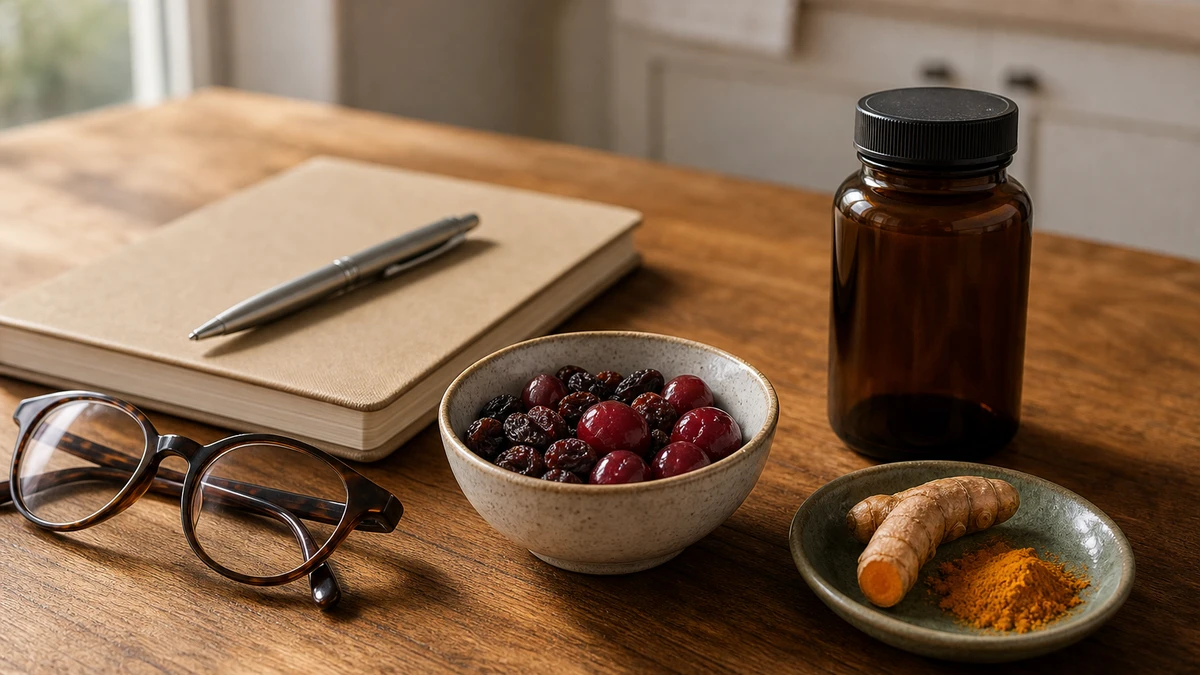
Some ingredients ranked better for some domains. Raisins and tart cherry ranked highest for learning and memory probability in the network meta-analysis. Bacopa compound, curcumin, and tart cherry ranked highly for executive function. Bacopa compound and raisin ranked highest for language, while guarana ranked highest for perceptual-motor function. Complex attention looked weaker across the review (PMC review: https://pmc.ncbi.nlm.nih.gov/articles/PMC12864429/).
That’s not nothing. It’s also not a green light for broad memory-preservation, anti-aging, or dementia-prevention claims.
What the new review actually found #
The most useful takeaway is “domain, not hype.” Memory is not attention. Executive function is not language. A supplement blend that borrows one small-trial signal from one cognitive test doesn’t automatically become a “brain booster.”
In the 2026 systematic review and network meta-analysis, the authors compared randomized controlled trials in healthy older adults, not people with dementia, Alzheimer’s disease, mild cognitive impairment, depression, traumatic brain injury, or medication-related cognitive symptoms. That distinction matters. Healthy adults in short trials are a different population from someone with new confusion, worsening memory loss, falls, personality change, or other symptoms that need a medical workup.
And the review itself is careful. The trials varied by ingredient form, dose, extract, duration, and outcome test. Some cognitive domains had sparse evidence. Many studies were short term. So the ranking tables are better read as “signals worth studying” than “shopping instructions.”
If a label turns that into “clinically proven brain support,” ask a boring question: proven for what outcome, in which people, using which exact ingredient, for how long?
“Best ranked” doesn’t mean best for your brain #
Network meta-analysis rankings can look deceptively tidy. A chart puts one intervention above another and the human brain (ironically) wants to turn that into a winner.
But the ranking is only as strong as the network underneath it. Small trials, indirect comparisons, different cognitive tests, and different supplement forms can all make the hierarchy look firmer than it is. A raisin trial, a tart cherry product, a curcumin capsule, and a bacopa compound aren’t interchangeable just because they appear in one review.
So, yes, the review found domain-specific signals. But no, it didn’t prove that raisins are the best “brain supplement,” that curcumin protects the brain from aging, or that bacopa should be used as a dementia strategy.
That last point is worth sitting with for a second. The supplement market loves a single phrase: brain health. The research paper is messier than that - and more honest.
Food, extracts, and capsules are not the same thing #
One slightly awkward feature of this topic is that “plant active substances” can mean very different things in real life.
Raisins and tart cherry products sit closer to food. Turmeric as a spice is familiar in cooking. Curcumin supplements are concentrated extracts. Bacopa products vary by extract and formulation. Guarana is often a caffeine source tucked inside energy products or “focus” blends.
Those differences are not cosmetic. A small serving of a food, a standardized extract, and a proprietary capsule blend can have different safety profiles, different active-compound exposure, and different interaction risks. The NIH National Center for Complementary and Integrative Health makes a similar distinction in its turmeric materials: turmeric in food is not the same conversation as higher-dose turmeric or curcumin supplements (NCCIH: https://www.nccih.nih.gov/health/turmeric).
And with guarana, the “natural” framing can be especially slippery. Guarana usually means caffeine, and caffeine stacks. Coffee, tea, energy drinks, pre-workouts, and a brain supplement can quietly add up, especially for someone prone to insomnia, anxiety, palpitations, high blood pressure, or arrhythmias (NCCIH energy drinks: https://www.nccih.nih.gov/health/energy-drinks).
Ginkgo, bacopa, curcumin: plausible is not the same as proven #
Ginkgo is probably the ingredient many readers already associate with memory. It has a long research history and plenty of traditional-use baggage. But NCCIH does not frame it as risk-free memory insurance, and it flags safety and herb-drug interaction concerns (NCCIH: https://www.nccih.nih.gov/health/ginkgo/). That’s especially relevant for older adults, people taking blood thinners, people preparing for surgery, and anyone with seizure history or antiseizure medications.
Bacopa is another good example of the “interesting but don’t oversell it” category. Clinical references describe small trial signals for memory or cognition, but still call for better evidence, and gastrointestinal side effects are common enough to matter (Merck Manual: https://www.merckmanuals.com/professional/special-subjects/dietary-supplements/bacopa).
Curcumin has biological plausibility - antioxidant and anti-inflammatory mechanisms get discussed a lot - but plausibility is not proof that a capsule preserves memory. High-dose supplement use can also bring GI, liver, gallbladder, and medication-interaction questions into the room (NCCIH turmeric: https://www.nccih.nih.gov/health/turmeric).
So the better question isn’t “Which herb boosts cognition?” It’s more like: which exact product, in which trial, for which cognitive domain, with what safety tradeoffs, and does that situation look anything like yours?
The safety section should come before the shopping cart #
Older adults are exactly the group most likely to be targeted by memory and brain-aging claims. They’re also more likely to be taking multiple medications.
That combination deserves a pharmacist-level pause, not a shrug. The review itself says older adults, especially those with chronic diseases or medications, should consult a doctor or clinical pharmacist before long-term use of plant-active supplements (PMC review: https://pmc.ncbi.nlm.nih.gov/articles/PMC12864429/).
Blood thinners and surgery are a big caution zone for botanicals often discussed around cognition, including ginkgo and turmeric/curcumin. Seizure history is another reason not to casually experiment with ginkgo. Liver or gallbladder disease makes concentrated turmeric/curcumin a more serious conversation. GI side effects can matter, too, even when the product is “natural.” And pregnancy or breastfeeding is not the time for brain-boosting supplement experiments without clinician guidance.
Product quality belongs in the same conversation. In the United States, dietary supplements are regulated differently from drugs. The FDA says supplements are not approved by FDA for safety and effectiveness before they are marketed (FDA: https://www.fda.gov/food/information-consumers-using-dietary-supplements). The NIH Office of Dietary Supplements also warns consumers to think about interactions, labels, and safety rather than assuming a supplement is harmless because it’s sold over the counter (ODS: https://ods.od.nih.gov/factsheets/WYNTK-Consumer/).
Not “unregulated.” Not automatically dangerous. Just not premarket-proven like a drug.
Before you buy a brain supplement, ask these questions #
Here’s the practical test I’d use before taking a label seriously. What is the exact ingredient or extract, not just the branded blend name? What dose and form were studied? Was the outcome memory, attention, executive function, language, or something else? How long did the trial last? Were the participants healthy older adults, or people with a diagnosed condition? Do you take blood thinners, antiseizure drugs, blood-pressure medication, sleep medication, antidepressants, diabetes medication, or anything else that could interact? And is there hidden caffeine from guarana, “energy,” “focus,” or proprietary stimulant blends?
A decent product page should make those questions easier to answer. If it hides behind vague “brain support” language, that tells you something.
Also, one non-supplement point: new or worsening memory problems should not be self-treated with a capsule. Confusion, personality change, falls, stroke-like symptoms, depression, severe sleep disruption, head injury, or medication side effects deserve medical evaluation. Supplements can distract from that, and that’s where harmless-sounding advice can become not-so-harmless.
Bottom line #
The new review is worth paying attention to because it makes brain supplement evidence more specific. Different plant-derived interventions showed different signals across different cognitive domains in healthy older adults.
But the evidence is still short-term, heterogeneous, and thinner than the marketing. It doesn’t justify broad claims that a supplement will preserve memory, slow brain aging, prevent dementia, or safely “boost cognition” for older adults in general.
So if you’re curious, be curious in a more demanding way. Treat brain supplements as a claim-checking and safety-checking project - not a shortcut around sleep, movement, medical evaluation, medication review, or the plain reality that “brain health” is too broad a promise for one bottle.
Related

A Probiotic Did Not Boost COVID Booster Antibodies. That’s the Point.
6 Popular Supplements That Deserve a Liver-Safety Check
Stanford's Five Supplement Myths, Turned Into a Safer Buying Checklist