Tai Chi for Better Sleep in Older Adults? The New Deep-Sleep Signal Needs Careful Reading
Table of Contents
Tai Chi is having a small sleep-research moment, and this one is a bit more interesting than the usual “people felt better” story.
A 2026 randomized trial in Frontiers in Physiology tested 12 weeks of standardized 24-form Tai Chi in adults aged 65-75 with mild sleep disturbance. The researchers didn’t just ask people how they slept. They also used polysomnography and EEG measures, including N3 sleep proportion and delta wave power (Frontiers in Physiology).
That sounds promising. It is promising, in a narrow way.
But the narrow part matters. This was one small supervised trial with 67 analyzed participants, not proof of an insomnia cure. It wasn’t a replacement for cognitive behavioral therapy for insomnia, or CBT-I. It wasn’t a sleep-apnea workaround. And because the control group kept its usual activity instead of getting a matched exercise or attention program, the trial can’t fully separate Tai Chi itself from routine, coaching, social contact, expectation, or just moving more.
So the fair read is this: Tai Chi has a cautious sleep-quality signal in some older adults. That’s useful. It’s just not the same thing as insomnia treatment.
What the 2026 trial actually did #
The trial enrolled older adults from three urban communities in Shenyang, China. Participants were 65-75 and had Pittsburgh Sleep Quality Index scores from 5 to 10, which the research pack describes as mild sleep disturbance. The study excluded people with acute sleep disorders under 3 months, drug-dependent insomnia, cognitive impairment, persistent daytime napping, extreme chronotype, severe cardiovascular, cerebrovascular, neurological, or mental disorders, and people who could not adhere to the program (Frontiers in Physiology).
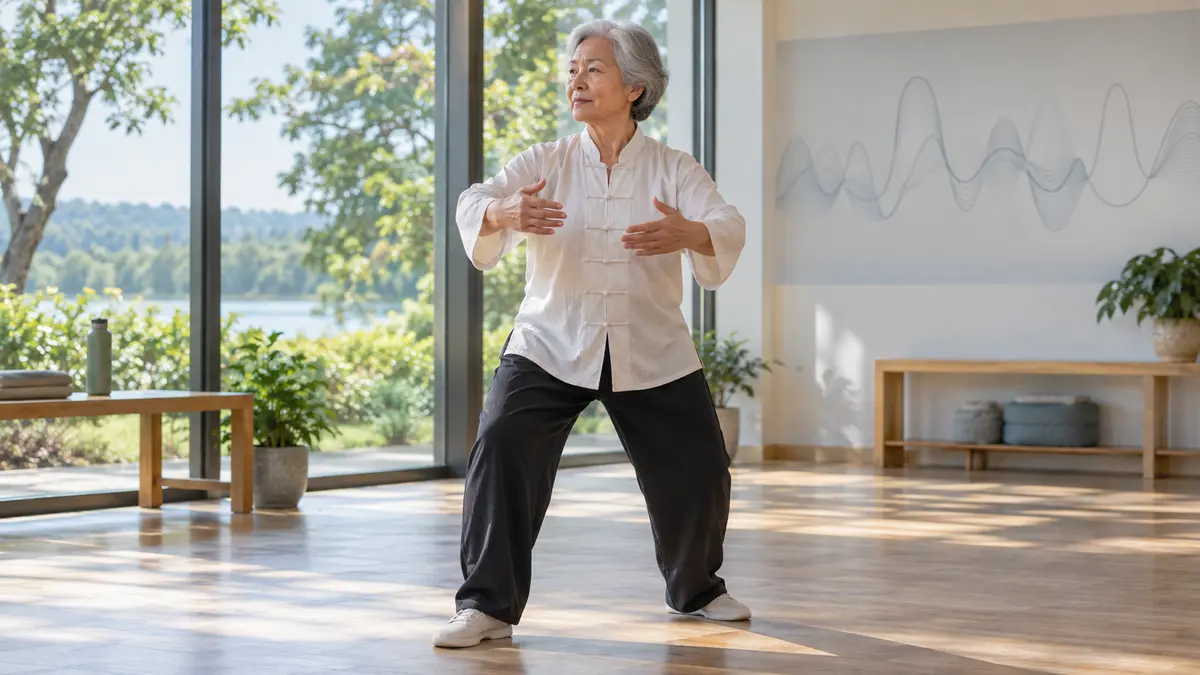
The Tai Chi group practiced a standardized 24-form routine five times a week, 60 minutes per session, for 12 weeks. Senior coaches taught the classes. Compliance was high, averaging 92.7%, with attendance checks, follow-up, community support, and WeChat reminders or videos.
That’s not a casual “try a video before bed” setup. It was a structured, supported program.
The control group, meanwhile, was asked to maintain daily living habits and avoid regular exercise or sleep interventions. Researchers followed up every 4 weeks, but the control was not exercise-matched. It was not attention-matched either. That’s one of the biggest fences around the result.
And yes, the study had blinding where it could. Questionnaire scorers and EEG analysts were single-blind, according to the paper. Participants and coaches obviously knew whether they were doing Tai Chi.
The deep-sleep signal is the hook, not the whole story #
After 12 weeks, the Tai Chi group had lower total PSQI scores, shorter sleep-onset latency, and higher sleep efficiency. On the objective side, the study reported a 23.1% increase in N3 sleep proportion and a significant increase in delta wave power. N2 spindle density increased by 6.0%, but that result was only marginally significant (Frontiers in Physiology).
That’s the piece worth paying attention to. N3 sleep and delta power are not just mood ratings on a questionnaire.
But I wouldn’t stretch it too far. One small trial in a narrow age band doesn’t prove Tai Chi changes deep sleep for everyone, or that it will help every older adult who is lying awake at 2 a.m. It also doesn’t prove the effect lasts after the supervised program ends, because the trial didn’t provide long-term follow-up.
The study’s own adverse-event note is worth keeping in the frame too. Five people in the Tai Chi group reported muscle soreness, and two reported mild dizziness. The symptoms eased with rest and adjusted intensity, and no severe adverse events were reported (Frontiers in Physiology). Still, dizziness is not a footnote for older adults. It’s a safety signal, even when it’s mild.
Sleep quality is not the same as treating insomnia #
This distinction sounds fussy until you imagine someone with loud snoring, gasping, high blood pressure, and daytime sleepiness deciding to do Tai Chi instead of getting checked for sleep apnea.
That’s the wrong move.
NCCIH’s sleep-disorders page uses the careful wording AMZ should stick with: yoga and Tai Chi may help improve sleep quality, but that doesn’t necessarily mean insomnia relief (NCCIH). The same page flags sleep apnea symptoms such as snoring, gasping or snorting, and struggling with daytime sleepiness as reasons to talk with a health care provider.
Guidelines stay more medical for chronic insomnia too. The American Academy of Sleep Medicine strongly recommends multicomponent CBT-I for chronic insomnia disorder in adults (AASM guideline). The American College of Physicians recommends CBT-I as first-line treatment for adults with chronic insomnia and says clinicians should consider secondary causes such as depression, pain, substance use, sleep apnea, and restless legs (ACP). AAFP’s 2024 review also keeps CBT-I first-line and describes exercise, mindfulness, acupuncture, and Tai Chi evidence as more limited or mixed (AAFP).
So, Tai Chi belongs in the “possibly helpful sleep-quality practice” bucket. It does not belong in the “skip evaluation” bucket.
The larger 2021 trial makes the story less hype-friendly #
A 2021 JAMA Network Open trial is useful because it puts Tai Chi next to conventional exercise, not just no intervention. That study included 320 older adults with chronic insomnia. Tai Chi and conventional exercise both improved actigraphy-measured sleep compared with no intervention, with modest absolute improvements and no significant Tai Chi-vs-exercise difference (PubMed).
That result doesn’t make Tai Chi look bad. If anything, it suggests gentle, regular movement may matter for some older adults’ sleep.
But it does make the marketing version harder to defend. If Tai Chi and conventional exercise both help objective sleep measures, and the difference between them is not significant, then you can’t honestly sell Tai Chi as uniquely superior for sleep. You can say it may be one tolerable movement option, especially for people who like slow, coordinated practice. That’s enough.
Earlier and smaller studies point in a similar general direction. A 2008 trial found Tai Chi Chih improved self-reported sleep measures in healthy older adults with moderate sleep complaints (PubMed). A 2024 PSG study in older adults also reported sleep-quality and sleep-structure improvements after Tai Chi (PMC). And reviews have found positive PSQI signals, though with heterogeneity, bias concerns, and the usual blinding problems that come with exercise trials (Frontiers in Psychiatry; PubMed).
Encouraging, yes. Settled? No.
Safety box: when sleep needs more than a new routine #
Before anyone tries Tai Chi for sleep, the boring safety screen comes first (boring, but useful).
Talk with a qualified health professional if insomnia is persistent, worsening, or interfering with daytime function. Do the same if sleepiness is creating a driving, machinery, falls, work, or caregiving risk. If loud snoring, gasping or snorting, observed breathing pauses, morning headaches, daytime sleepiness, or hypertension are part of the picture, ask about sleep apnea screening rather than experimenting with a mind-body class (NCCIH; AAFP).
Depression, anxiety, PTSD, substance use, pain, restless legs, medicines, caffeine, alcohol, stimulants, sedatives, opioids, and antihistamines can also sit underneath sleep trouble. Any suicidal thoughts, crisis signs, severe anxiety, major mood changes, or unsafe daytime drowsiness deserve professional care, not a wellness workaround (ACP; AAFP).
Then there is the movement side. Tai Chi is gentle, but it still involves standing, weight shifting, turning, and coordinated steps. People with recurrent falls, dizziness, vestibular problems, severe balance impairment, neuropathy, frailty, recent injury, severe arthritis or pain, joint instability, recent surgery, heart disease, recent stroke or TIA, uncontrolled blood pressure, chest pain, fainting, or unusual shortness of breath should use medical or physical-therapy input and supervised, adapted classes. Pregnant readers should also talk with a health care provider before starting, since NCCIH notes limited pregnancy-safety research for Tai Chi (NCCIH).
Stop or modify practice if dizziness, chest pain, falls, severe pain, unusual shortness of breath, fainting, or new neurological symptoms show up. That’s not being dramatic. That’s just not turning a low-risk practice into a dumb risk.
If you try it, keep the expectations small and practical #
The 2026 trial used 60-minute supervised sessions five times weekly for 12 weeks. That is study context, not a universal prescription. AMZ shouldn’t turn that protocol into dosage advice, and readers shouldn’t assume any app, video, weekend workshop, or local class will reproduce the same result.
A more sensible question is: can this be a safe, enjoyable, sustainable movement routine for you?
For some older adults, the answer may be yes. Tai Chi has been studied for balance and falls, and NCCIH describes it as appearing safe in broad terms when practiced appropriately, with minor aches and pains among the related adverse events reported in reviews (NCCIH). A qualified instructor can also adapt stances, depth, turns, and pace.
And if someone hates Tai Chi, that’s relevant too. A routine you resent is not much of a routine. The 2021 trial suggests conventional exercise may offer similar objective sleep benefits for some older adults, which is good news for people who would rather walk, do gentle strength work, or join another suitable movement class.
Bottom line #
The new Tai Chi trial is worth reading because it adds objective sleep data to a topic that often runs on self-report alone. In one 67-person supervised study of adults aged 65-75 with mild sleep disturbance, Tai Chi was linked with better subjective sleep scores and objective signals, including higher N3 sleep proportion and delta wave power.
But that’s where the claim should stay.
This is not evidence that Tai Chi is an insomnia cure. It is not evidence that Tai Chi replaces CBT-I, medical evaluation, medication review, or sleep-apnea assessment. It is not proof that any Tai Chi video or casual routine changes deep sleep.
Still, I can see the appeal. A low-tech, social, gentle movement practice that may help sleep quality is worth considering if it’s safe for the person doing it. The honest version is enough: Tai Chi may be a reasonable complementary practice for some older adults with mild sleep complaints, especially under qualified supervision. Persistent, impairing, suspicious, or unsafe sleep problems need guideline-level care.
Related

Corn Leaf Extract and Sleep: What One Small Trial Can and Can't Say
Essential Oils for Stress: What a Two-Week Cortisol Study Can Actually Prove