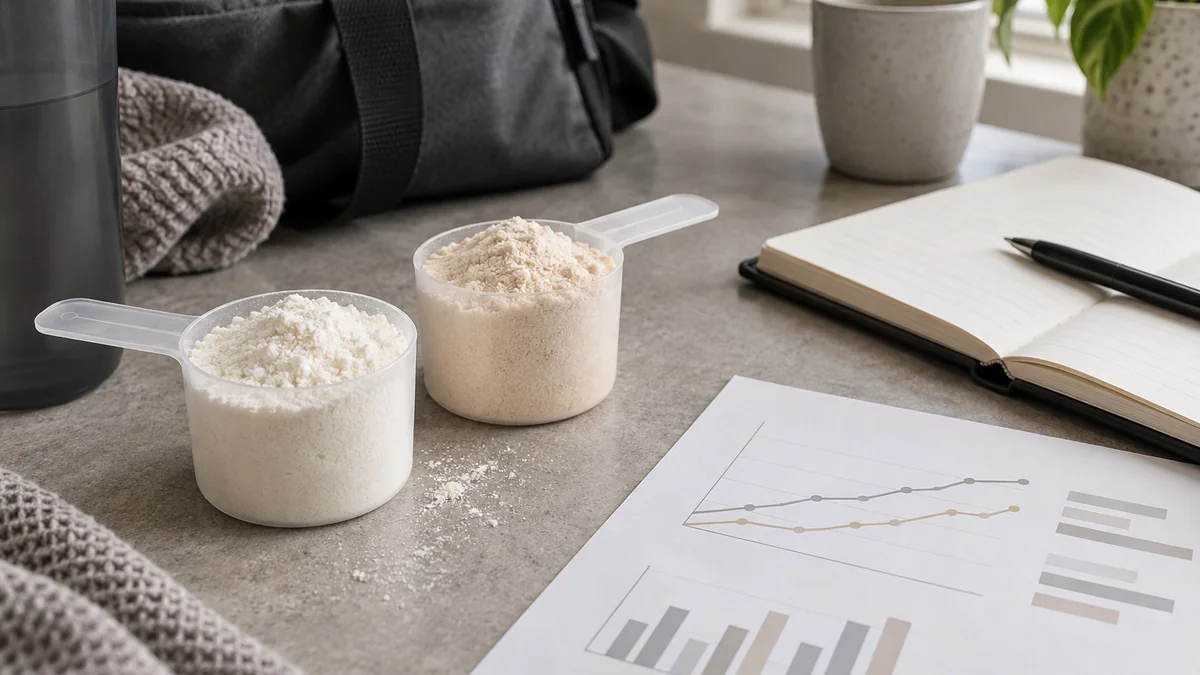
Collagen vs Whey for Strength Training: What the 2026 Protein Powder Review Actually Says
Table of Contents
A new protein-powder analysis gives supplement marketers a very clickable line: collagen and whey were the only protein types with statistically significant add-on signals for both strength and fat-free mass in healthy adults doing resistance training.
That sounds like a shopping verdict - it isn’t.
The 2026 systematic review and network meta-analysis, published in Translational Sports Medicine, pulled together 78 randomized studies, 4,755 participants, 13 protein supplement types, placebo groups, and control groups. The people studied were healthy adults doing resistance training, not people rebuilding strength after illness, not frail older adults, and not non-lifters hoping a scoop will do the job by itself (Drummond et al., 2026).
So the useful lesson here isn’t “buy collagen” or “whey is over.” It’s more practical: protein powders can be tools, resistance training is still the main signal your body is responding to, and the details matter more than the front of the tub.
What the review found #
The review compared whey, casein, soy, milk, collagen, pea, rice, bovine colostrum, beef, peanut, fish, insect, and lactoalbumin supplements as separate interventions, alongside placebo and control groups. A collagen peptide product, a whey isolate, and a plant blend don’t carry the same evidence trail.
Against placebo, collagen showed a statistically significant signal for strength, with a standardized mean difference of 0.41, and for fat-free mass, with an SMD of 0.94. Whey also showed statistically significant signals, but smaller ones: SMD 0.15 for strength and 0.16 for fat-free mass (Drummond et al., 2026).
Those SMD figures are not promised kilogram gains for you. They’re statistical estimates that let researchers compare results across different tests and studies. The paper translated them into approximate real-world units, but those are model-derived population estimates, not a guarantee that your squat or lean mass will change by a neat number.
And yes, the collagen result is the surprising part. Whey is the familiar sports-nutrition standby, rich in essential amino acids and commonly studied around resistance training. Collagen has a different amino-acid profile and lower biological value, so a headline that puts collagen ahead of whey deserves a raised eyebrow, not a victory lap.
Why collagen isn’t suddenly magic #
Here’s the catch: the review’s own discussion warns that collagen’s apparent advantage leans heavily on indirect evidence, fewer trials, and only one direct collagen-versus-whey trial.
That last point is the hinge. A network meta-analysis can compare interventions even when every possible head-to-head trial hasn’t been done. That’s useful, especially in messy supplement research. But it also means a ranking can look cleaner than the underlying evidence really is. If collagen ranks above whey mostly through indirect paths, that’s a signal worth following up, not a final consumer rule.
So if you see “collagen beats whey” in an ad, slow down. The safer read is that collagen had an interesting add-on signal, whey had a smaller but statistically significant add-on signal, and better direct trials are needed before anyone treats collagen as the default muscle-building powder.
One more thing: collagen is animal-derived and it isn’t a complete-protein replacement for all dietary needs. Whey is dairy-derived, which raises milk-allergy, lactose, and dietary-fit questions. Neither one becomes the right choice for everyone just because it appeared in a meta-analysis.
The boring part is still the most important part #
Resistance training did not become optional.
The participants in the review were doing resistance training. That’s the context in which the supplement signals appeared. Protein can support adaptation, especially when food intake or schedule leaves a gap. But a powder isn’t a separate muscle-building switch.
And this is where supplement literacy gets less exciting but more useful. If your training program is random, your sleep is wrecked, or you barely lift, switching from whey to collagen is probably not the lever you think it is. If your diet already covers your protein needs through food, a tub on the counter may add convenience, not a dramatic new effect.
The International Society of Sports Nutrition has made a similar basic point: resistance exercise and protein intake work together, and many exercising people can get enough protein from whole foods, with supplements serving as practical tools when needed (ISSN position stand). That doesn’t make powders useless. It puts them in their lane.
For the same reason, this article sits next to AMZ’s broader fitness-supplement coverage rather than replacing it. The supplement aisle already has enough shortcuts on the label; a slower read usually helps (AMZ fitness supplement myths; pre-workout and sleep loss).
Who this review does not apply to #
This article is about healthy adults in resistance-training studies. That’s a narrow lane, and it’s worth keeping the guardrails visible.
It shouldn’t be stretched to frail older adults, diagnosed sarcopenia treatment, chronic kidney disease, liver disease, gout or kidney-stone history, eating-disorder recovery, cancer cachexia, pregnancy or breastfeeding, teens, or people who aren’t doing resistance training. Those situations change the risk-benefit conversation, sometimes a lot.
For example, people with chronic kidney disease are often told to individualize protein intake with a clinician or renal dietitian, and Mayo Clinic cautions that supplements can be risky when kidney function is impaired (Mayo Clinic). Some kidney-stone histories may also require protein-source guidance from a health professional (NIDDK).
AMZ has covered kidney-related supplement caution separately, and that boundary matters here. Protein powder is not a DIY workaround for medical nutrition advice (AMZ kidney and supplement safety).
But even for healthy lifters, more powder isn’t automatically better. The review couldn’t fully examine baseline diet, training history, or total energy intake as moderators because those details were rarely reported. That’s a practical gap: the person under-eating protein and the person already eating enough may not respond the same way.
Supplement quality is part of the story #
Protein powders feel food-like, so it’s easy to treat them as low-stakes. That’s not quite right - especially when the label is doing half the persuasion.
The NIH Office of Dietary Supplements notes that supplements can’t take the place of a healthy eating routine, and that FDA doesn’t determine whether supplements are effective before they are marketed (ODS). FDA regulates dietary supplements differently from drugs; companies are responsible for safety and labeling before products reach the market, and FDA acts against adulterated or misbranded products after the fact (FDA).
NCCIH adds that products sold in stores or online may differ from products tested in studies, and supplements can interact with medicines or pose risks for people with medical conditions, before surgery, during pregnancy or breastfeeding, or in children (NCCIH).
And competitive athletes have an extra headache. USADA warns that supplement labels can be unreliable and no supplement is guaranteed 100% risk-free for banned substances. Athletes who use supplements often look for third-party certification, such as NSF Certified for Sport, to reduce contamination risk, though certification isn’t proof that a product works (USADA; NSF).
This is where label literacy becomes more useful than powder loyalty. The front of a tub can make almost anything sound precise; the evidence usually asks narrower questions (AMZ supplement-label red flags).
The better takeaway #
So where does that leave collagen versus whey?
Whey still has a longer sports-nutrition history and a complete-protein profile that makes sense in many resistance-training contexts. Collagen now has an intriguing signal from this 2026 analysis. But the collagen result needs more direct testing before it becomes a confident shopping rule.
If you’re a healthy adult who lifts, the first questions are still plain ones: Are you training progressively? Eating enough? Getting enough protein from meals? Does the label match your allergies, ethics, sport rules, and medical history?
A scoop can be convenient. It can also be unnecessary, poorly matched, overhyped, or risky for the wrong person.
The review is useful because it complicates the easy story. Collagen and whey are not interchangeable shortcuts, and neither one replaces the work of lifting, eating consistently, recovering, and reading supplement claims with a little suspicion.
And if collagen marketing brought you here from the beauty aisle, keep that lane separate too. Skin-hydration evidence and resistance-training evidence are different questions, even when the ingredient name overlaps (AMZ collagen skin evidence).
Related
Probiotics May Not Diversify a Healthy Gut the Way the Label Suggests

Akkermansia Is Interesting Microbiome Science, Not a GLP-1 Shortcut

How to Read Supplement Labels Without Mistaking Them for Safety Guarantees