Honey for Cough: What Natural Remedies Can and Can't Do
Table of Contents
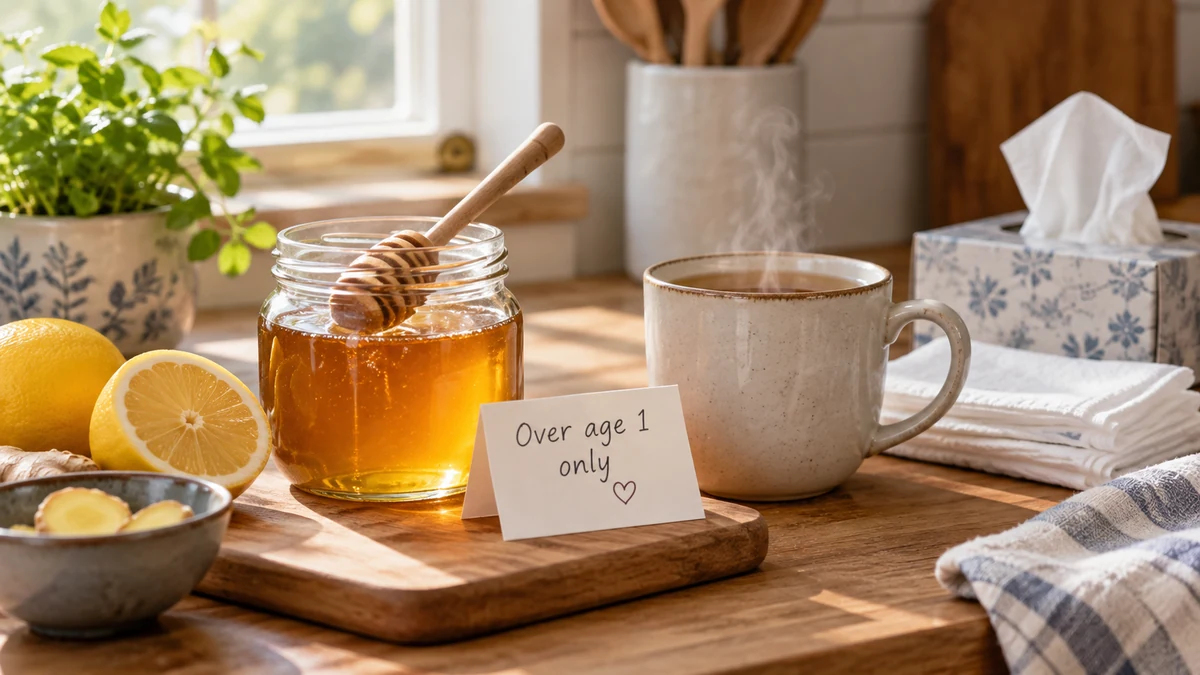
The first rule is the easy one, and it belongs right up top: do not give honey to a baby under 12 months. Not in water, not in formula, not mixed into food, and not dabbed on a pacifier. The CDC warns that honey before 12 months can cause infant botulism, and Mayo Clinic gives the same under-1 boundary (CDC; Mayo Clinic).
For everyone else, honey sits in a much narrower lane than the internet usually gives it. It may soothe an uncomplicated acute cough for a while, especially at night. It doesn’t cure a respiratory infection. It isn’t an antibiotic. And after a 2026 review of antitussive therapies framed the field as moving “beyond codeine,” honey still should not be sold as a natural codeine replacement (Frontiers in Pharmacology).
What the 2026 cough review really changes #
The 2026 Frontiers in Pharmacology review looked across conventional, natural, and emerging cough therapies. Its headline idea was that cough medicine is not just codeine anymore. But the actual findings were messier: conventional and natural antitussives had inconsistent evidence, and the strongest pooled results were for targeted P2X3 antagonist drugs in chronic or refractory cough, not for honey or herbal home remedies (Frontiers in Pharmacology; PubMed).
That distinction matters. The review discussed natural products, including botanical syrups with honey, thyme-ivy products, licorice pastilles, Pelargonium sidoides extract, Viola odorata syrup, and other product-specific formulas. But the studies used different populations, formulas, cough types, endpoints, and follow-up periods, so the reviewers did not turn them into one clean pooled estimate (Frontiers in Pharmacology).
So the fair takeaway isn’t “natural cough remedies work.” It’s closer to this: some products have trial signals, but those signals don’t prove that every honey jar, herb tea, or supplement works the same way.
Honey has its best evidence in kids over 1 with acute cough #
The best honey-specific evidence comes from a Cochrane review of acute cough in children. It included six small randomized trials with 899 children, ages 12 months to 18 years. Honey probably reduced cough frequency compared with no treatment or placebo, though the certainty was low to moderate and most children received honey for only one night (Cochrane).
And that’s the lane: children over 1, short-term symptom relief, acute cough, usually at night. Cochrane did not prove that honey treats the cause of the cough. It did not prove honey is useful for infants, chronic cough, asthma, COPD, pneumonia, COVID, flu, whooping cough, or bacterial infections (Cochrane).
Mayo Clinic’s practical framing is a little warmer. It says honey may be worth a try for cough in people older than 1, and may work about as well as some over-the-counter cough medicines for reducing cough. Mayo also notes that better-quality studies are needed and that coughing can be a protective reflex (Mayo Clinic).
A cough is annoying, but it can also help clear mucus and protect the lungs. When honey makes sense, the goal is comfort, sleep, and hydration - not automatically shutting down every cough.
Adults can use the comfort logic, but the evidence is thinner #
Adults often reach for honey for the same reason parents do: it coats the throat, tastes familiar, and may calm that dry, scratchy cough enough to sleep. For a low-risk adult with a short-lived cold and no warning signs, that comfort logic is reasonable as a food-based comfort measure.
But the evidence boundary should stay visible. The strongest honey data in the pack is pediatric and short-term. Adult chronic cough is a different problem. A cough that drags on for weeks may come from asthma, reflux, upper-airway cough syndrome, medication effects such as ACE inhibitors, smoking, COPD, environmental triggers, or other causes that need evaluation rather than a stronger spoonful of something sweet. AAFP defines chronic cough as longer than eight weeks in adults and longer than four weeks in children (AAFP 2024; Mayo Clinic).
And, yes, honey is still sugar. People with diabetes, carbohydrate targets, or honey/bee-pollen allergies should treat it as a sugar-containing food with allergy potential, not harmless medicine because it sounds natural. Mayo also notes that honey quality can vary because honey is not controlled by the FDA like an approved drug. That product-quality gap is one reason AMZ keeps circling back to supplement safety and oversight rather than treating “natural” as a guarantee (Mayo Clinic).
Where echinacea and herbal syrups fit #
Echinacea gets pulled into cough conversations because people associate it with colds. The more careful placement is a cold-supplement sidebar, not a cough-treatment claim. NCCIH says echinacea may slightly reduce the chance of catching a cold, but it is unclear whether it shortens how long a cold lasts. It also says there is not enough evidence for other uses (NCCIH).
Worth knowing: echinacea is not automatically gentle just because it’s a plant. NCCIH notes digestive side effects, possible severe allergic reactions, rash concerns in some children, possible interactions involving liver-metabolized drugs, immunosuppressants, and caffeine, plus limited pregnancy and breastfeeding safety information. If you’re taking regular medicine, AMZ’s herb-drug interaction safety check is the right mental model here (NCCIH).
Herbal cough syrups have a similar problem, only with more moving parts. A formula with honey, plant extracts, and a specific manufacturing process is not the same thing as a kitchen mixture with one shared ingredient. If a trial studied a named syrup, the result belongs to that syrup in that study population. It doesn’t float across to every ivy, thyme, licorice, or honey product.
When honey is not enough #
Use honey only in the low-risk comfort lane. Move out of that lane if the cough comes with fever, weight loss, bloody sputum, hoarseness, excessive shortness of breath, heavy sputum, recurrent pneumonia, chest pain, dehydration, wheezing, severe or worsening symptoms, a significant smoking history, or cough in an infant (AAFP 2017; Mayo Clinic; FDA).
And don’t use honey, echinacea, or herbal syrups as substitutes for antibiotics, inhalers, prescribed medicines, or clinical evaluation. FDA notes that many children with colds get better on their own and that cough and cold medicines don’t change the natural course of a cold. That same logic applies to natural comfort measures: they may make symptoms easier to tolerate, but they don’t make a viral cold disappear faster (FDA).
For young children, be extra careful with stacking products. FDA says OTC cough and cold medicines are not recommended for children under 2, and many manufacturers label these products as not for children under 4. Multi-ingredient products also raise overdose risk. That doesn’t mean “just use herbs instead.” It means caregivers should slow down and check with a clinician when age, symptoms, or product labels are unclear (FDA consumer update; FDA OTC medicine guidance).
Bottom line #
Honey is a reasonable comfort option for many adults and for children over 1 with an otherwise uncomplicated acute cough. It may help a cough feel less disruptive for a night or two, especially when throat irritation is part of the problem.
But it is not a codeine replacement, not an antibiotic alternative, not a chronic-cough treatment, and never safe for babies under 12 months. Once the cough is persistent, severe, bloody, breathless, or attached to a vulnerable age group, the question changes. At that point, you’re trying to work out why the cough is there.
Related


Tart Cherry Extract, Uric Acid, and the Gout Claim That Needs a Brake

Corn Leaf Extract and Sleep: What One Small Trial Can and Can't Say