Probiotics May Not Diversify a Healthy Gut the Way the Label Suggests
Table of Contents
The bottle says gut diversity. The review asked whether that promise shows up in healthy people.
And the short answer was not really. A 2026 BMC Medicine systematic review and meta-analysis found no statistically significant probiotic effect on Shannon diversity, observed OTUs, Chao1, or Simpson diversity compared with controls in healthy populations. Those are common ways researchers describe richness, evenness, or related patterns in a gut-microbiome sample. They are not a home gut-health score. Still, if a product is leaning on “supports microbiome diversity” as the big consumer promise, this review makes that promise look weaker than it sounds (BMC Medicine; PubMed).
That doesn’t mean every probiotic is useless. It means one popular healthy-person claim - take this probiotic and diversify your gut - needs a lot more fine print.
What the 2026 review actually tested #
This was not one tiny probiotic trial dressed up as a trend piece. The authors searched MEDLINE, Embase, and Cochrane databases, screened 9,217 records after duplicates were removed, and included 47 randomized controlled trials in healthy populations. For Shannon diversity, the most commonly pooled measure, the meta-analysis used 22 studies with 1,068 subjects (BMC Medicine).
The pooled Shannon result was not statistically significant. The same basic story held for observed OTUs, Chao1, and Simpson diversity. The review also ran subgroup and sensitivity analyses, and the main result did not appear to flip based on probiotic taxonomic family, risk of bias, or intervention duration (BMC Medicine).
But here is the part that needs to stay attached to the headline: the certainty was not perfect. The review rated the evidence low for Shannon, observed OTUs, and Chao1, and moderate for Simpson diversity. Low-to-moderate certainty is enough to challenge confident label language. It is not enough to turn into “case closed, probiotics never do anything.”
Diversity is not the same thing as health #
“Gut diversity” sounds wonderfully concrete, doesn’t it? More kinds of microbes, better gut, healthier person. Nice and tidy.
Except the microbiome does not work like a reward-points program. The BMC authors noted that microbiota diversity alone should not be treated as a direct indicator of health. A probiotic could, in theory, affect metabolites, immune signaling, gut-barrier behavior, or transient microbial activity without producing a broad diversity shift in a stool sample (BMC Medicine).
So, yes, the null diversity finding matters. It just matters in a narrower way than supplement marketing usually invites. It says healthy adults should be cautious about buying a product mainly because it promises a more diverse microbiome, not that diversity metrics capture every possible probiotic effect.
AMZ has covered the broader “probiotics beyond gut health” conversation before. This piece is narrower on purpose: it is about healthy-person diversity claims and label literacy, not a full verdict on every probiotic use case (AMZ probiotic evidence guide).
“Probiotic” is not one ingredient #
One reason probiotic marketing gets slippery is that the word looks singular. But a probiotic is a living organism, usually identified by genus, species, and strain, and different strains can behave differently.
That strain detail is not nerdy fine print, though it sure looks like it on a label. NIH ODS says probiotic effects can be strain-specific, and clinical recommendations need to be strain-specific too. NCCIH makes the same practical point: a finding for one Lactobacillus product does not automatically apply to another Lactobacillus product, another Bifidobacterium product, or a multi-strain blend with a similar-looking front label (NIH ODS; NCCIH).
The 2026 review ran into the same real-world mess. Strains, doses, age groups, study methods, and reporting were not consistent enough for a neat strain-level meta-analysis. That is a limitation, and also the consumer lesson. If the evidence is strain- and endpoint-specific, then “contains probiotics” is not the same as “shown to diversify healthy guts.”
Keep disease-specific evidence in its own lane #
This is where the conversation can go wrong fast. A review that challenges healthy-person diversity claims does not wipe out every condition-specific probiotic question.
For example, Cochrane’s 2025 review on probiotics for preventing Clostridioides difficile-associated diarrhea in people receiving antibiotics found probiotics may offer a small reduction in risk, though confidence varied and the studies used different probiotic products. That is an antibiotic and C. difficile-associated diarrhea question, not proof that a retail probiotic improves microbiome diversity in a healthy adult who bought it for general wellness (Cochrane).
Same for IBS, ulcerative colitis, infant colic, or vaccine-adjacent immune claims. Those topics need their own evidence by condition, strain, population, outcome, and safety profile.
And if you are dealing with symptoms, antibiotics, inflammatory bowel disease, immune problems, an infant, or a clinician-managed condition, this article is not a treatment plan. Do not swap medical care for a supplement because a label used friendly gut language.
How to read a probiotic label without getting dazzled #
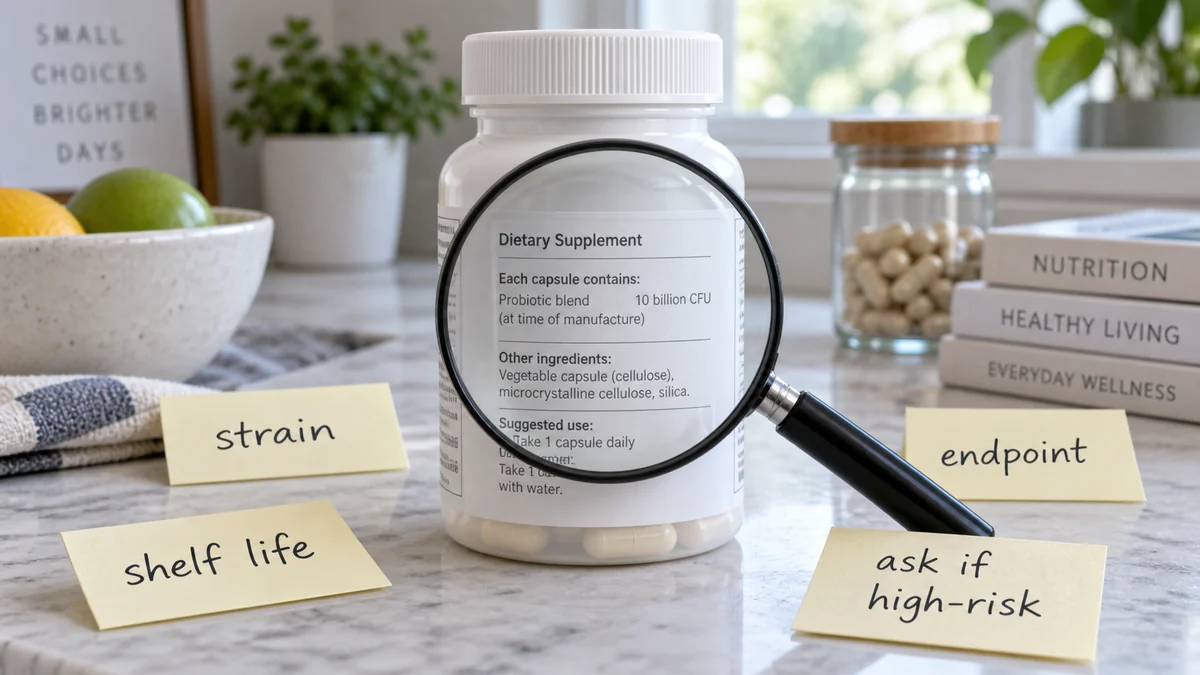
Start with the claim. Is it saying “supports gut health” in a vague way, or is it making a specific claim about an endpoint that was actually studied? The first is marketing language. The second is at least something you can check.
Then look for the full strain designation, not just Lactobacillus or Bifidobacterium in large type. Look for CFUs at the end of shelf life, not only at manufacture. Check storage instructions, because viability matters for live organisms. And do not assume a higher CFU number is automatically better. NIH ODS says higher counts are not necessarily more effective than lower counts, which is awkward for labels that make big numbers feel like the whole story (NIH ODS).
One more thing: dietary supplements are not preapproved by the FDA for safety and effectiveness before they reach shelves. FDA says live microbials commonly called probiotics can be dietary supplement ingredients, and FDA generally does not approve dietary supplements or their labeling claims before marketing. The label is not the same as a drug approval (FDA dietary supplement Q&A).
That is why supplement labels deserve a slower read. A good claim should tell you what was studied, not just borrow science-flavored words from the microbiome aisle. The same basic caution applies across AMZ’s supplement safety coverage.
Safety is not just a tiny-print issue #
Most healthy adults who try a probiotic are thinking about ordinary side effects: gas, bloating, cramping, nausea, softer stools, flatulence, or maybe a taste they do not love.
But live microbial products are not automatically risk-free. Immunocompromised readers, people with severe illness, recent hospitalization, ICU exposure, central venous catheters, cancer treatment, transplants, immunosuppressive therapy, or major chronic disease should talk with a clinician before using live probiotic products. CDC’s Emerging Infectious Diseases review discusses Saccharomyces fungemia risk situations in critically ill, enterally fed, or central-line patients (NIH ODS; CDC Emerging Infectious Diseases).
Premature infants are a separate high-risk group. FDA has warned that probiotic products containing live bacteria or yeast can cause invasive, potentially fatal infections in hospitalized preterm infants, and it says no probiotic is approved as a drug or biologic for infants of any age. Pregnancy and breastfeeding deserve clinician guidance too, and children should be handled through a pediatrician or qualified health professional rather than adult supplement logic (FDA preterm-infant warning; NCCIH).
Because supplements can interact with medicines or create risks in chronic disease, FDA advises talking with a doctor, pharmacist, or other health professional before using dietary supplements. That advice fits probiotics especially well when the user is pregnant, breastfeeding, immunocompromised, on regular medication, caring for a child, or recovering from serious illness (FDA dietary supplement Q&A).
And no, this does not mean the answer is to panic over yogurt or assume every probiotic capsule is dangerous. It means the “natural” frame is too blunt. Live microbes, vulnerable bodies, and vague labels deserve more care than that.
Bottom line #
The 2026 BMC Medicine review does not make probiotics disappear. It makes one familiar retail promise harder to defend.
If you are healthy and buying a probiotic mainly to “increase gut diversity,” the pooled randomized-trial evidence did not show statistically significant improvements in Shannon diversity, observed OTUs, Chao1, or Simpson diversity versus controls. That is the take-home point.
But the more useful habit is broader: ask what strain was studied, in whom, for what endpoint, and with what safety caveats. A vague gut-health label can make probiotics sound interchangeable. The evidence says they are not.
Related

Akkermansia Is Interesting Microbiome Science, Not a GLP-1 Shortcut

A Probiotic Did Not Boost COVID Booster Antibodies. That’s the Point.

Honey for Cough: What Natural Remedies Can and Can't Do

Stanford's Five Supplement Myths, Turned Into a Safer Buying Checklist