Medicinal Mushroom Blends for Stress and Sleep: What One Small Trial Can and Can't Tell You
Table of Contents
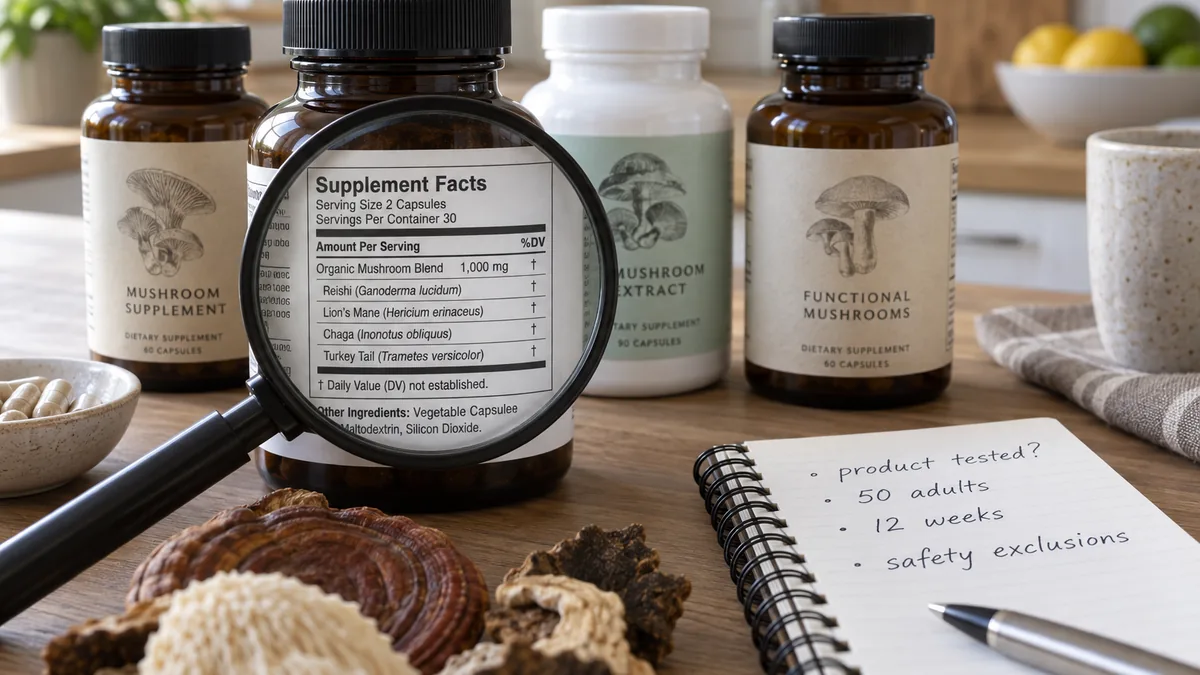
A new mushroom-blend trial gives supplement marketers a tempting headline. But the useful story is smaller, and honestly more helpful: one proprietary Restake product was tested for 12 weeks in 50 screened adults, with sponsor funding and product supply attached.
That doesn’t make the study worthless. It was randomized, double-blind, and placebo-controlled, which is a stronger setup than a lot of wellness-product evidence. Still, it doesn’t mean lion’s mane, reishi, cordyceps, shiitake, maitake, or any random “adaptogen mushroom” label can borrow the result (Brain and Behavior; PubMed).
So the real question isn’t “do medicinal mushrooms fix stress and sleep?” It’s this: what did this one study find, and where does the consumer leap get too big?
What the Restake trial actually tested #
The product was Restake, a five-mushroom blend containing Hericium erinaceus, better known as lion’s mane, Cordyceps militaris, Ganoderma lucidum, or reishi, Lentinula edodes, or shiitake, and Grifola frondosa, or maitake. The capsules used a proprietary mushroom blend extract standardized to beta-glucans and polysaccharides, and the study described a specific 12-week regimen. That’s study context, not AMZ dosage advice (Brain and Behavior).
And the participants weren’t a broad slice of tired, stressed, real-world adults. They were 22 to 55, had moderate-to-severe stress and fatigue symptoms, and passed screening rules. The trial excluded pregnancy and breastfeeding, diagnosed sleep disorders such as obstructive sleep apnea and restless legs syndrome, significant cardiac, hepatic, renal, neurological, or gastrointestinal disorders, high caffeine or alcohol intake, and medications or supplements that could interfere with the study.
That matters because exclusions don’t just make a study cleaner. They also shrink who the results can safely speak for.
What changed in the study #
By 12 weeks, several questionnaire scores moved more in the Restake group than in placebo. Anxiety scales changed more: STAI-S fell 8.7% with Restake versus 4.9% with placebo, and HAM-A fell 33.5% versus 13.1%. Perceived stress and BDI depressive-symptom scores also shifted more in the Restake group (Brain and Behavior).
But that’s not the same as saying a mushroom blend belongs in anxiety or depression treatment. These were symptom scores in a screened stress-and-fatigue sample, not a treatment trial for diagnosed mental-health conditions. AMZ has made the same line explicit in its herbal anxiety evidence guide: anxiety care is not a supplement-shopping shortcut.
Physical fatigue was the clearest fatigue signal: down 9.2% with Restake versus 2.1% with placebo. Yet the broader fatigue picture was messier, which is often where the useful caution lives. VAS-F, mental fatigue, and general fatigue didn’t show statistically significant between-group differences at 12 weeks.
Sleep quality, measured by PSQI, also improved more with Restake: down 11.1% versus 1.0% with placebo. But the trial didn’t prove insomnia treatment, and morning melatonin showed only a non-significant between-group difference. The authors themselves noted that evening melatonin sampling would have been more accurate for that question. That’s why this belongs near AMZ’s broader natural sleep-aids evidence ladder, not in a miracle sleep-product bucket.
The biomarker results are interesting too. Cortisol and ACTH decreased more in the Restake group, and CRP decreased modestly compared with placebo. Still, biomarker movement isn’t a green light to say the blend “balances cortisol,” acts as inflammation treatment, or fixes the stress system in everyday consumers.
Why the label problem is the whole point #
Mushroom products are easy to overread because the front label makes them sound interchangeable. A lion’s mane capsule isn’t the same as a five-mushroom blend. A reishi powder isn’t the same as a microencapsulated proprietary extract. And a retail blend with similar species names isn’t automatically the Restake product used in the trial.
NCCIH gives the broader supplement warning: products sold in stores or online can differ from products used in research, supplements can interact with medicines, and many have not been tested well in pregnancy, nursing, or children. FDA also says dietary supplements generally aren’t approved before marketing for safety and effectiveness, and disease-treatment claims belong to drugs, not ordinary supplement labels (NCCIH; FDA dietary supplement Q&A).
So, yes, a small trial can be a signal. But it can’t turn a shelf of mushroom products into one evidence-backed category. The same slower-label habit belongs across AMZ’s supplement safety coverage.
What the study didn’t prove #
It didn’t prove medicinal mushrooms treat anxiety disorders, depression, insomnia, chronic fatigue syndrome, inflammation, diabetes, autoimmune disease, cancer, or any diagnosed condition. It didn’t show long-term safety. It didn’t test children, pregnant readers, breastfeeding readers, people with major liver or kidney disease, or people with sleep disorders.
It also didn’t erase the sponsor context. The study was funded by NexusWise Sdn Bhd, Restake and placebo were supplied or manufactured by Nexus Wise, and several authors had Nexus Wise affiliations, according to the article and PubMed record. That doesn’t automatically invalidate the data. But it does mean the product-specific fine print belongs near the front, not buried after the upbeat findings (Brain and Behavior; PubMed).
And one more thing: the analysis was per-protocol, with 50 completers, and the study looked at many questionnaires and biomarkers. Multiple endpoints in a small sample can generate useful leads. They don’t give consumers a predictable “this will work for me” promise.
Safety deserves more than a shrug #
Anyone allergic to mushrooms should avoid mushroom supplements or get medical advice first. People taking blood thinners or antiplatelet drugs, including aspirin in some contexts, should be cautious too, especially before surgery, because supplement effects on bleeding and anesthesia can matter. Mayo’s reishi trial protocol excluded mushroom allergy, anticoagulation or aspirin use, bleeding disorders, diabetes medication use, pregnancy and nursing, and several medication-metabolism concerns, which is a useful safety flag even though it’s not the Restake trial itself (Mayo Clinic; NCCIH).
Diabetes medications deserve a clinician conversation because some mushroom products may have metabolic effects, and because trial screening doesn’t answer real-world medication-mixing questions. Readers with autoimmune disease, transplant history, cancer treatment, or immunosuppressive therapy should also ask a qualified clinician first. MSKCC describes reishi as biologically active and discusses immune-related cautions and limited human evidence (MSKCC).
But the caution list doesn’t stop there. Liver or kidney disease, scheduled surgery, pregnancy, breastfeeding, children, diagnosed sleep disorders, psychiatric care, CPAP use, fatigue workups, and prescription medications all change the risk calculation. Product quality matters as well: supplements can vary in strength, identity, testing, and contamination risk, and “standardized” or “verified” on a label doesn’t make a product equivalent to the one studied. That medication-and-supplement list is especially important if you’re already taking prescriptions (AMZ medication-interaction guide).
If you’re dealing with persistent insomnia, heavy fatigue, panic symptoms, depression symptoms, or loud snoring and daytime sleepiness, don’t turn this into a mushroom experiment first. Get evaluated. Supplements can sit in a wellness conversation. They shouldn’t replace care.
Bottom line #
The Restake trial is a signal worth reading, not a shortcut worth buying on impulse.
In 50 screened adults over 12 weeks, one proprietary five-mushroom product was linked with better scores on some stress, anxiety, fatigue, sleep-quality, and biomarker measures than placebo. That’s interesting. It’s also small, product-specific, sponsor-funded, and full of applicability limits.
So the practical takeaway is narrow: don’t let a mushroom label borrow more certainty than the evidence earned. Ask what exact product was studied, in whom, for which outcomes, for how long, and with which safety exclusions. If the answer is vague, the claim probably is too.
Related
Probiotics May Not Diversify a Healthy Gut the Way the Label Suggests
Essential Oils for Stress: What a Two-Week Cortisol Study Can Actually Prove
Honey for Cough: What Natural Remedies Can and Can't Do