How to Read Supplement Labels Without Mistaking Them for Safety Guarantees
Table of Contents
A Supplement Facts label is useful. It is not a magic shield.
That distinction gets lost easily, especially when a bottle looks official, the product page is polished, and the wording sounds just medical enough to feel reassuring. Dietary supplements are regulated in the U.S., but they are not approved by FDA for safety and effectiveness before they reach the market in the way prescription drugs are. FDA says manufacturers and distributors are responsible for making sure products are not adulterated or misbranded before sale, and FDA can take action after problems are found (FDA).
So the right question is not, “Can I prove this supplement is safe from the label?” You usually can’t.
The better question is more practical: “Can I spot the obvious problems, understand what the label is really saying, and know when this needs a pharmacist or clinician?”
That won’t eliminate risk. But it can reduce the odds of buying something sketchy, duplicating ingredients by accident, or missing a red flag that was sitting in plain sight.
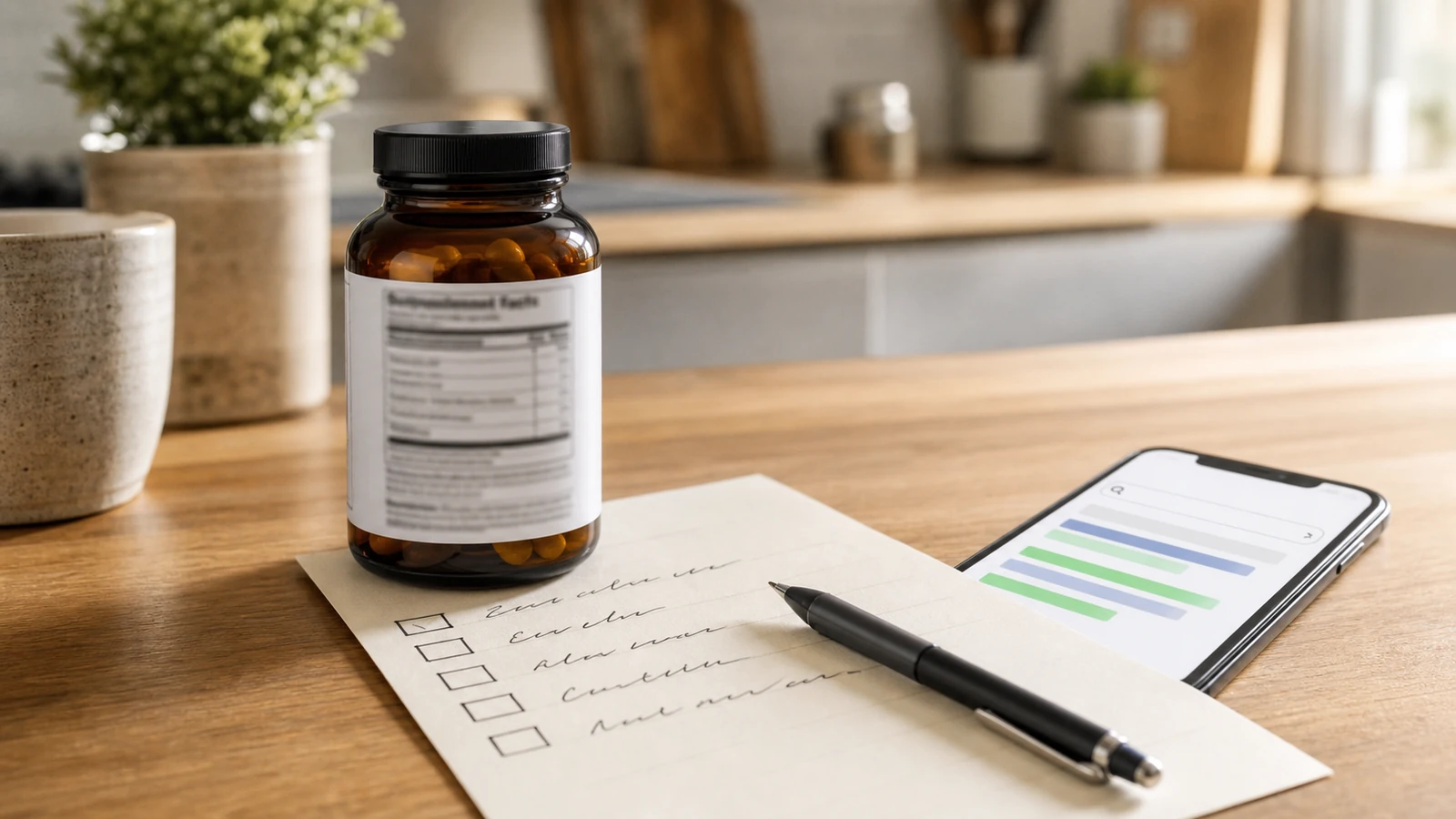
Start with the Supplement Facts panel #
First, make sure the product is labeled as a dietary supplement and has a Supplement Facts panel, not just a front label full of wellness language. FDA’s consumer guidance says supplement labels should identify the product as a dietary supplement and list serving size, servings per container, dietary ingredients, amount per serving, and other required label information (FDA Q&A).
Then slow down on the serving size.
A serving size on a supplement bottle is the company’s suggested use, not a personalized medical dose. That matters because two gummies, three capsules, a scoop, a dropper, and a “packet” can all feel casual until you compare the actual amounts. And if you take more than one supplement, the same ingredient can appear twice without making much noise about it.
Look for the active ingredients, amount per serving, and daily value where one exists. Check for proprietary blends too. A blend may list a group of ingredients under one combined amount, which can make it harder to know how much of each ingredient you’re actually taking.
And don’t skip the “other ingredients” line. Colorings, fillers, sweeteners, capsules, allergens, and excipients may matter for some people. Not always. But enough that the tiny print deserves a look before the bottle lands in the cart.
The front label is where marketing does its best work #
The front of the bottle is usually not where the careful details live.
Words like “supports,” “promotes,” and “helps maintain” can be legal structure/function language when used properly. They are not the same as proof that the product treats a disease. NCCIH’s consumer guidance makes the same basic point from another angle: evidence for supplements varies widely, and a product sold in stores or online may not be the same preparation studied in research (NCCIH).
So if a label says “supports immune health,” read that differently from “treats infections.” If it says “supports joint comfort,” read that differently from “replaces arthritis medication.”
A product claiming to diagnose, cure, treat, mitigate, or prevent disease has crossed into drug-claim territory. FDA and FTC warning letters around supplements sold for diabetes are a blunt reminder of why this matters: disease-treatment claims can steer people away from effective care (FDA/FTC).
The consumer version is simple: if the bottle sounds like it treats diabetes, cancer, arthritis, infection, chronic pain, sexual dysfunction, sleep disorders, or another medical condition, treat that as a major warning sign. Not a reason to experiment.
Red flags that deserve extra caution #
Some warning signs are about wording. Others are about the category.
FDA’s tainted-products materials and Health Fraud Product Database repeatedly point to hidden ingredients in products marketed for sexual performance, weight loss, bodybuilding, joint pain, diabetes, sleep, and similar quick-result promises (FDA handout, FDA database). That does not mean every product in those categories is adulterated. It does mean the category deserves a colder eye.
Be wary of immediate-result promises, especially for sexual performance or weight loss. Watch for claims that a supplement can replace a prescription, replace a treatment plan, or work “like” a drug without being one. Be suspicious of prescription-style warnings or directions on a product that is supposed to be a supplement. And yes, FDA-logo misuse is a red flag too - the agency does not let supplement companies use the logo as a private stamp of approval.
Vague company information is another one. FDA’s Q&A notes that labels should include the name and place of business of the manufacturer, packer, or distributor, and product labels are supposed to include contact information for reporting serious adverse events (FDA Q&A). If you cannot figure out who stands behind the product, that is not a small detail.
And if a label is in a foreign language but says “Made in the USA,” slow down. FDA flags that mismatch in retailer and distributor guidance as one possible warning sign, not proof by itself, but worth noticing.
Third-party testing helps, but it has limits #
A reputable third-party testing mark can be a useful quality signal. It may mean an outside organization reviewed label claims, tested for certain contaminants, or screened for specific substances. NIH ODS and NCCIH both point consumers toward third-party organizations as one way to reduce uncertainty about contents and quality (NIH ODS, NCCIH label tips).
But don’t make the seal do more work than it can do.
Third-party certification does not prove the supplement works for your goal. It does not prove it is safe for your body, your medications, your pregnancy, your surgery date, your liver, or your heart rhythm. OPSS puts it plainly: third-party certification can help verify what is in a product, but only testing can speak to the product tested, and certification is not the same as a medical green light (OPSS).
For athletes, military service members, and anyone subject to banned-substance testing, sport-specific certification can matter even more. NSF describes certification that includes label-claim review, formulation and contaminant review, and sport screening for banned substances or undeclared ingredients (NSF). Still, that is risk reduction, not risk removal.
Search FDA’s database, then remember what it cannot tell you #
FDA’s Health Fraud Product Database is worth checking before buying a suspicious supplement, especially if the product is sold online, makes aggressive claims, or sits in one of the higher-risk categories. It can show public notifications, warning letters, recalls, and products found with undeclared drug ingredients (FDA database).
But here’s the catch, and it’s an important one: FDA says the database includes only a small fraction of potentially hazardous products marketed to consumers.
So “not listed” does not mean “safe.” It means FDA has not listed that product there. Different thing.
That caveat lines up with older warning-data research too. A JAMA Network Open analysis of FDA warnings from 2007 through 2016 identified 776 adulterated dietary supplements, most marketed for sexual-performance, weight-loss, or muscle-building uses. Common hidden ingredients included sildenafil, sibutramine, and synthetic steroids or steroid-like ingredients (PubMed, full text).
Useful finding. But not a current market prevalence estimate, and not a way for shoppers to inspect a capsule by eye.
Bring medications, surgery, pregnancy, and kids into the decision #
The label checklist gets more serious if you take medications or have a medical condition.
Supplements can interact with prescription drugs, over-the-counter medicines, other supplements, surgery and anesthesia, pregnancy and breastfeeding, and chronic conditions. NIH ODS and NCCIH both advise discussing supplement use with a health professional, especially in those higher-stakes situations (NIH ODS, NCCIH).
This is where “natural” becomes a terrible shortcut. Natural does not mean safe, gentle, or interaction-free. St. John’s wort and goldenseal, for example, are not obscure lab chemicals, but AAFP’s review flags them as herbal supplements with clinically important drug-interaction concerns (AAFP).
And surgery changes the rules. Some supplements may affect bleeding risk or anesthesia response, so tell the surgical team what you take and follow their instructions instead of picking a stop date from a web article. Pregnancy, breastfeeding, trying to conceive, and giving supplements to children also deserve professional guidance because many products have not been tested well in those groups.
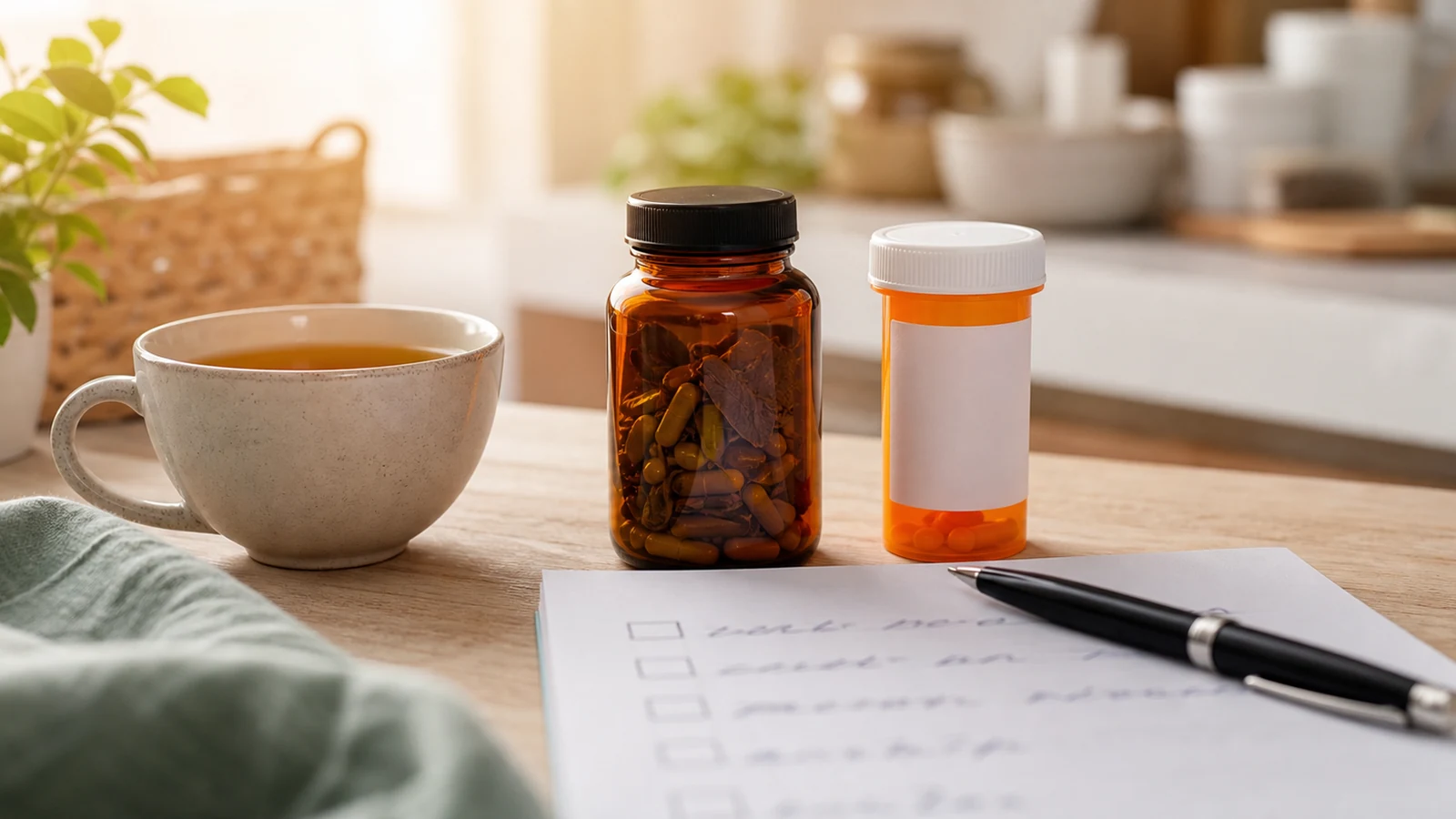
If you take anticoagulants, heart or blood-pressure drugs, diabetes medicines, seizure medicines, psychiatric medications, transplant drugs, HIV medicines, cancer treatments, or anything with a narrow safety margin, bring the actual bottle or a label photo to a pharmacist. The details matter. Ingredient, extract, amount, brand, and the rest of your list can change the answer.
When to seek medical care or report a problem #
Most supplement doubts can start with a pharmacist call or a message to your clinician.
But severe symptoms are not label-reading homework. Seek urgent medical care for chest pain, fainting, trouble breathing, severe allergic symptoms, severe dizziness, confusion, severe agitation, fast or irregular heartbeat, black stools or unusual bleeding, yellowing skin or eyes, dark urine, severe abdominal pain, or any reaction that feels serious or fast-moving.
If you suspect a supplement caused harm, stop taking it and contact a health care professional. FDA also accepts reports of serious adverse events or product problems through its Safety Reporting Portal and related MedWatch pathways (FDA Q&A, NIH ODS).
That reporting piece can feel bureaucratic, I know. But hidden-ingredient and contamination problems are often found because enough signals get noticed.
Bottom line #
Read the Supplement Facts panel first. Then read the marketing claims with more suspicion than the pretty label wants you to bring.
FDA-regulated does not mean FDA-approved for safety and effectiveness before sale. A Supplement Facts label does not prove the contents are accurate or safe for you. A third-party seal can help with quality questions, but it does not prove the product works. And FDA’s Health Fraud Product Database is useful, but absence from the database is not a clean bill of health.
So use the checklist, but don’t worship it.
If the product promises fast results, disease treatment, prescription-like effects, or a replacement for medical care, back away and ask better questions. If medications, pregnancy, children, surgery, chronic disease, liver or kidney problems, cancer care, transplant drugs, seizure medicines, psychiatric medications, diabetes treatment, or blood thinners are part of your life, bring the bottle to someone qualified.
A careful label read won’t make every supplement safe. But it can keep a bad purchase from becoming a bad medical surprise.
Related

Berberine in 2026: What the Evidence Actually Shows (and What It Doesn’t)

The Supplement Question Your Doctor May Forget to Ask