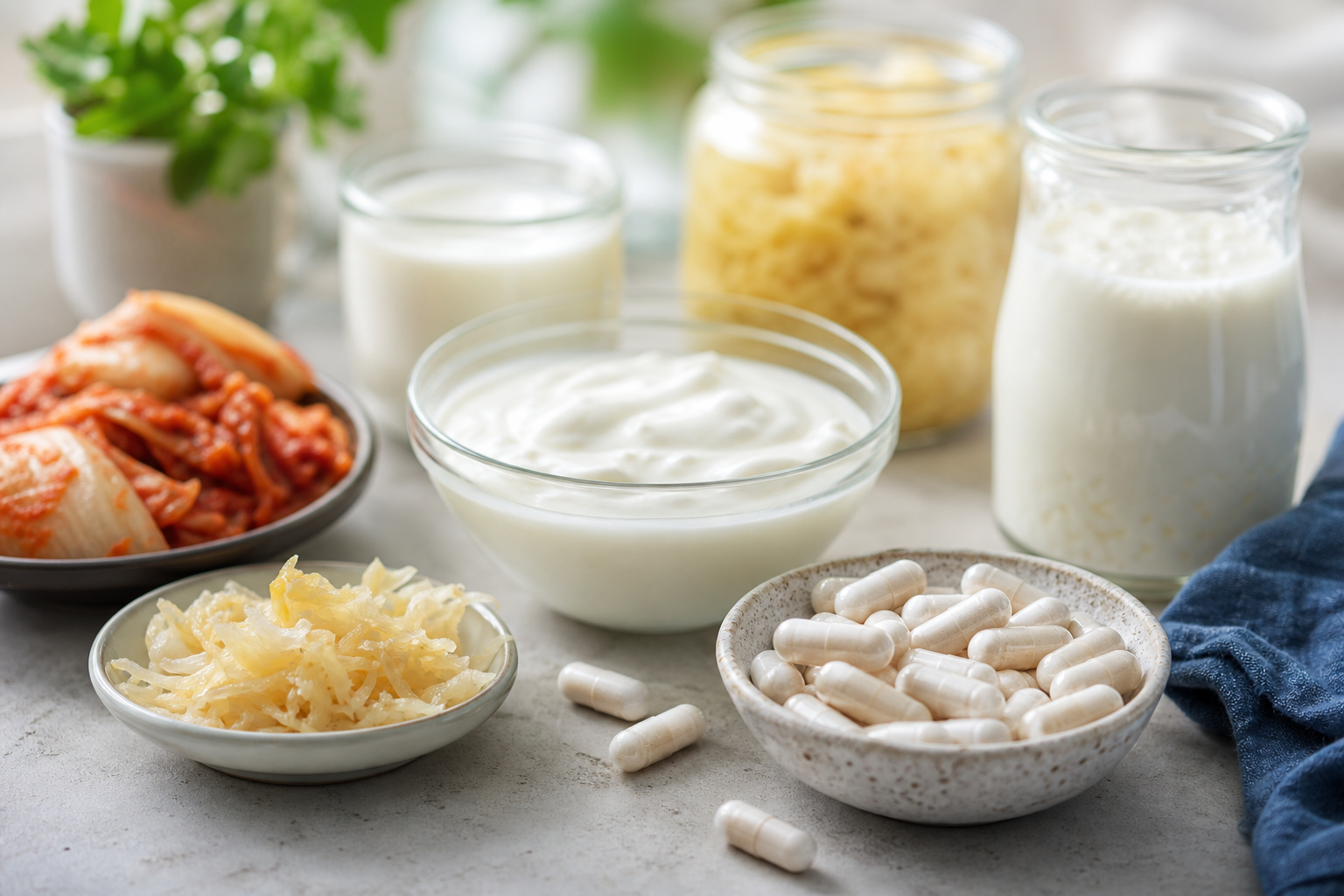
Probiotics Beyond Gut Health - What the Evidence Actually Says About Immune Function, Mood, and Skin
Table of Contents
Walk into any drugstore supplement aisle and you’ll find probiotics positioned as a kind of all-purpose wellness product. Gut health, immunity, mood, skin - the marketing covers a lot of ground. But probiotics aren’t one thing. The organisms, the strains, the doses, and the purposes all differ, and a product labeled “probiotic” doesn’t automatically deliver the effects that specific strains have shown - or haven’t shown - in clinical research.
The National Center for Complementary and Integrative Health (NCCIH) puts it directly: different probiotics may have different effects, and the strain and the use case matter NCCIH. That distinction isn’t a technicality. It’s the difference between a responsible conversation about probiotics and the overgeneralized “good bacteria” story that sells a lot of bottles without telling buyers what the evidence actually supports. (And if you’ve ever stood in that aisle trying to pick one, you know how little the label actually helps.)
Why Researchers Look Beyond the Gut #
Probiotics are live microorganisms. When consumed or applied, they’re intended to have health benefits - but those benefits depend on which organisms, in what amount, for what purpose. Researchers study them beyond digestion because the gut doesn’t operate in isolation. It communicates with the immune system, affects systemic inflammation, and connects to the brain through the gut-brain axis. That’s not a metaphor - it’s a set of biological pathways that researchers are actively trying to map.
NCCIH notes that probiotics may help maintain or restore microbial communities, produce substances with desirable effects, and influence immune response NCCIH. Those mechanisms are real. But mechanism isn’t the same as proven disease prevention. “May influence immune signaling” is a research pathway, not a consumer guarantee. So the practical question - the one this article keeps coming back to - is a simple one: what do the human studies actually show?
Immune Function and Upper Respiratory Tract Infections #
This is the strongest beyond-gut area of evidence. But “strongest” still comes with caveats you should know about.
A 2022 Cochrane systematic review looked at 24 studies involving 6,950 people to assess whether probiotics could prevent upper respiratory tract infections (URTIs), such as the common cold Cochrane. The review found that probiotics may reduce the number of people diagnosed with at least one URTI by about 24%, and likely reduce the number who experience three or more URTIs by about 41%. Probiotics also likely reduced antibiotic use for URTIs by roughly 42%.
Those numbers sound promising - and they’re worth paying attention to. But the Cochrane reviewers themselves rated the certainty of the evidence as low to moderate, and they called for larger, better-designed studies. The effects weren’t uniform across different probiotic strains and products. Because the studies used different organisms at different doses in different populations, you can’t just grab any bottle and assume the same results.
A separate systematic review and meta-analysis of randomized controlled trials in adults, published in 2020, found fewer URTI episodes with probiotics compared to placebo across six trials involving 1,551 adults PubMed, PMID 33293995. And yet the authors explicitly concluded that the quality of the evidence was low. Worth knowing.
So the immune picture looks like this: some probiotic strains may modestly reduce the likelihood of common-cold-type infections in some populations. That’s a real finding. It’s not the same as “probiotics boost your immune system,” and it doesn’t mean any probiotic product will keep you from getting sick. Are the numbers interesting? Yes. Are they a guarantee? No, and the Cochrane reviewers would be the first to say so.
Mood: The Weakest and Most Sensitive Claim Area #
If there’s one category where the marketing has run well ahead of the evidence, it’s mood. The gut-brain axis is a legitimate and active area of research. Researchers have studied whether probiotics - sometimes called “psychobiotics” in this context - can influence depression, anxiety, and quality of life through inflammatory pathways and changes in brain-derived neurotrophic factor (BDNF) and C-reactive protein. And honestly, the idea is compelling: if the gut talks to the brain, maybe changing what’s in the gut changes how the brain feels. But that’s the hypothesis, not the finding.
A 2023 systematic review and meta-analysis of 20 randomized clinical trials looked at probiotics as a tool for regulating molecular mechanisms in depression and reported changes in BDNF, CRP, and nitric oxide in some depressed or comorbid groups PubMed, PMID 36834489. But the same review stated that firm conclusions can’t be drawn for healthy people with subclinical symptoms. So the signal is there in some markers, in some populations - and missing in others.
Other findings are even more cautious. A meta-analysis of 35 placebo-controlled studies on probiotics for irritable bowel syndrome (IBS) found that quality of life improved slightly compared to placebo - but anxiety and depression scores were similar between the probiotic and placebo groups PubMed, PMID 34441793. In other words: probiotics may help some people with IBS feel a bit better day to day, but they didn’t seem to shift mood symptoms in a measurable way. That’s a distinction worth holding onto.
The pregnancy and postpartum evidence is similarly restrained. A 2022 systematic review and meta-analysis of seven clinical trials examining probiotics for maternal depression during pregnancy and the postnatal period found no statistical difference in depression scores - measured by the Edinburgh Postnatal Depression Scale - between the probiotic and placebo groups in the pooled analysis PubMed, PMID 35742022. Seven trials, no clear signal.
So the mood conversation has to be handled with care - more care than most probiotic marketing gives it. The gut-brain research is scientifically interesting, and some depression-related biomarker signals are worth watching. But probiotics aren’t a treatment for depression, anxiety, or postpartum mood symptoms, and they shouldn’t be positioned as one. Anyone experiencing persistent low mood, anxiety, or postpartum depression symptoms should talk to a qualified clinician. Not reach for a supplement aisle fix. Those are two different categories of action, and confusing them has real consequences.
Skin: Condition-Specific, Not a General “Clear Skin” Solution #
The skin evidence follows a pattern you’ll recognize by now: some signals exist, but they’re tied to specific conditions and specific study populations.
Atopic dermatitis - eczema - has the most review-level evidence. A 2023 systematic review and meta-analysis of nine randomized controlled trials in 1,000 pediatric patients found some continuous improvement in SCORAD (a scoring system for atopic dermatitis severity), but no significant difference in the dichotomous outcome measure - meaning the evidence was limited and the authors couldn’t draw broad treatment conclusions PubMed, PMID 37488736. For adults, a separate 2025 meta-analysis of seven RCTs found reduced SCORAD scores in the pooled analysis, but described the adult evidence as limited and heterogeneous PubMed, PMID 40740395. Nine trials in kids, seven in adults - and still the reviews read like “promising but not there yet.”
Acne is an emerging gut-skin-axis research area - emphasis on emerging. A 2023 systematic review on oral nutraceuticals for acne included probiotics and prebiotics among the interventions studied, but the evidence isn’t strong enough to support a broad acne treatment recommendation PubMed, PMID 37878272. This isn’t the place to tell a teenager to swap their dermatologist-prescribed regimen for a probiotic capsule. And yet if you spend five minutes on skincare TikTok, you’ll find exactly that advice being thrown around.
So where does that leave the skin question? Some eczema studies show symptom-score movement that researchers consider worth investigating further. Acne evidence is preliminary - closer to “interesting idea” than “established approach.” Neither category supports the claim that probiotics will clear your skin or replace dermatology care. They might play an adjunctive role someday. They might not. The evidence isn’t settled enough to say with confidence either way.
Safety: Not “Safe Because It’s Natural” #
This section isn’t optional. Probiotics are often described as generally well-tolerated by healthy adults - and the adult URTI meta-analysis did report mainly mild gastrointestinal symptoms with no significant difference in adverse-event rates compared to placebo PubMed, PMID 33293995. But “generally well-tolerated” isn’t the same as “safe for everyone.” And for some groups, the gap between those two things is medically significant.
NCCIH warns that harmful effects from probiotics are more likely in people with severe illness or compromised immune systems NCCIH. Possible harms include infections, harmful substances produced by the microorganisms themselves, and transfer of antibiotic resistance genes. None of those are theoretical - they’re documented.
A 2014 systematic review on probiotics in people with cancer found case reports of probiotic-related bacteremia, fungemia, and positive blood cultures, and noted that probiotics may rarely cause sepsis PubMed, PMID 24618152. That’s not a footnote. That’s a finding that belongs in the safety conversation, not buried at the bottom of a label.
The FDA has specifically warned about probiotic products used in hospitalized preterm infants, linking them to invasive, potentially fatal infections and - in a 2023 adverse event report - one reported infant death FDA. The FDA states clearly: no probiotic product is approved as a drug or biological product for infants of any age. Preterm infant use isn’t a wellness decision. It’s a medical decision, period.
Here are the groups that should approach probiotics with particular caution - and ideally with clinician guidance. Preterm infants, for the reasons the FDA has made clear - this isn’t a consumer product for them and shouldn’t be treated as one. Immunocompromised people: live microorganisms carry infection risk that a healthy immune system might handle but a weakened one might not. People with cancer, especially those with central lines or undergoing treatment that affects immunity - the cancer review above is the evidence for that caution. Seriously ill or hospitalized patients, where the risk-benefit calculation changes in ways that need clinical judgment, not supplement-aisle guesswork. Pregnant or postpartum people considering probiotics for mood: available trials don’t show a clear pooled benefit, and mental health care during this period should involve a qualified professional, full stop. And children, where pediatric supplementation should happen under clinical guidance, not through consumer self-selection - the FDA’s infant warning sets the tone here.
NCCIH also notes that few studies have examined probiotic safety in detail NCCIH. The long-term safety data are thin. And that matters, because millions of people take these products every day without necessarily knowing how little long-term safety surveillance exists.
What This Means for Supplement Shopping #
Here’s a reality most probiotic marketing doesn’t highlight: the supplement you buy at the store isn’t generally FDA-approved before it goes to market. FDA explains that dietary supplement manufacturers and distributors are responsible for evaluating safety and labeling, and that the agency generally doesn’t approve dietary supplement claims before use FDA, Q&A on Dietary Supplements. A product on a shelf isn’t the same as an FDA-approved treatment. And “contains probiotics” tells you nothing about whether the specific strains, doses, and product quality match what was used in any clinical study.
NCCIH reinforces this: the effects of one probiotic strain don’t automatically transfer to another strain or product NCCIH. The probiotic that showed a modest URTI benefit in a Cochrane-reviewed trial may be completely different from the blend in the bottle you’re holding. (This is the part where strain names on the label actually matter, and “proprietary blend” usually means you can’t verify what you’re getting.)
So what should you do with all this? If you have a specific reason for taking probiotics - say you’ve read the Cochrane URTI data and want to try a product with a studied strain - look for products that name the specific strains and CFU counts, not just “probiotic blend.” If you have a compromised immune system, are undergoing cancer treatment, or are seriously ill, ask your care team before adding live-microbe products. If you’re considering probiotics for a child, talk to the child’s pediatrician - this isn’t a consumer decision. If you’re pregnant or postpartum and struggling with mood, see a qualified clinician; probiotics aren’t a replacement for perinatal mental health care. And remember that “natural” and “live cultures” are marketing language, not safety guarantees. Live microorganisms can cause harm in the wrong circumstances, and the supplement category doesn’t require FDA pre-approval for the claims on the front of the bottle.
Bottom Line #
Probiotics are an active and legitimate area of research. The gut’s connections to immune function, the brain, and the skin mean scientists will keep studying them for more than digestive health - and that’s a good thing. But right now, the evidence is most encouraging for upper respiratory tract infections, and even there the certainty is moderate at best and the effects are strain-specific and modest. The mood evidence is scientifically intriguing but doesn’t support broad claims that probiotics improve depression or anxiety - and the pregnancy/postpartum null result should give anyone making those claims serious pause. The skin evidence is condition-specific, with the most data behind atopic dermatitis and very little behind general acne or “clear skin” claims.
The safety picture isn’t optional reading. It’s load-bearing. Probiotics aren’t universally harmless, and the populations that face the most serious risks - preterm infants, immunocompromised patients, people with cancer - aren’t edge cases. They’re precisely the groups that supplement marketing should be most careful about, and often isn’t.
If you’re a healthy adult looking at probiotics with a specific, evidence-informed purpose, a product that names its strains, and you’ve talked to a clinician where relevant, the research suggests there may be modest benefits in some areas. But the larger story here isn’t that probiotics fix everything. It’s that strain matters, the evidence is uneven, and the bottle doesn’t tell you what the studies actually found. The person who understands that before they buy is ahead of most of the market.
Related
Fish Oil for Heart and Brain Health: What the Cochrane Evidence Really Says