Alcohol Alternatives Aren't Just for Dry January Anymore
Table of Contents
Alcohol-free drinks used to feel like a January punishment: soda water, a lime wedge, and the quiet sense that everyone else got the interesting glass.
That has changed. Not completely, and not everywhere, but enough that the alcohol alternatives aisle now says something bigger about wellness culture. People aren’t only looking for a way to avoid alcohol. They’re looking for ritual without the hangover, a weeknight drink that still feels adult, or something more interesting than another canned seltzer.
And that’s where the trend gets tricky for AMZ readers. Non-alcoholic spirits, adaptogenic drinks, and mushroom beverages are all being pulled into one wellness conversation, even though they do different jobs. One sells the cocktail ritual. One sells the wind-down. One sits somewhere between coffee replacement, supplement culture, and curiosity about medicinal mushrooms.
The grounded read: moderation is becoming a market, but the health proof hasn’t caught up with every label.
The real shift is moderation, not mass abstinence #
Non-alcoholic beer, wine, and spirits are no longer a tiny beverage niche. NIQ reported U.S. off-premise non-alcohol beer, wine, and spirits sales of $925 million, up 22% year over year, and said the category was on pace to pass $1 billion by the end of 2025 (NIQ).
But here’s the more useful number: NIQ also found that 92% of non-alcohol buyers still buy alcohol. So the core story isn’t that everyone has quit drinking. It’s that more people want an option between “having alcohol” and “not participating.”
IWSR data points the same way. Across 10 markets, no- and low-alcohol drinks grew 13% by volume in 2024, while no-alcohol products are forecast to grow at a 7% volume CAGR through 2028. IWSR also expects the no-alcohol category to add more than $4 billion by 2028 (IWSR moderation trend; IWSR no-alcohol growth forecast).
You don’t have to turn that into a grand generational theory. Circana and NCSolutions reported that 49% of U.S. adults planned to drink less alcohol in 2025. Among Gen Z, 65% planned to drink less, and 39% said they planned to adopt a dry lifestyle (Circana/NCSolutions). The practical point is simpler: drinking less has become socially easier to say out loud.
Non-alcoholic spirits sell the ritual #
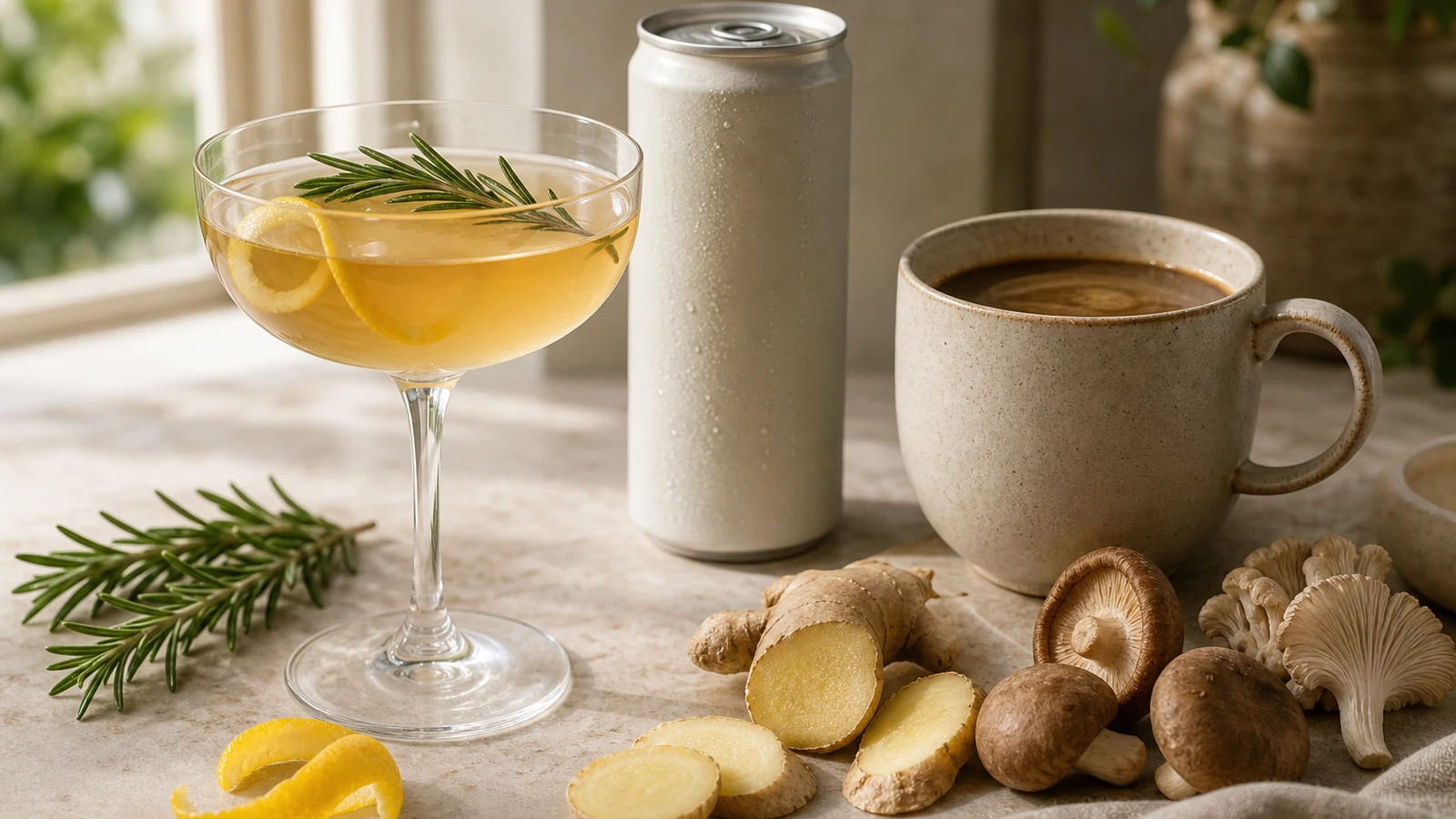
Non-alcoholic spirits are the most cocktail-adjacent part of the trend. They’re built for the glass, the garnish, the bartender language, the “I’m still having something” feeling. And that matters, because alcohol is rarely just about ethanol. It’s often about pause, ceremony, taste, and being part of the table.
For some people, a non-alcoholic gin-style or amaro-style drink solves a very specific problem: they don’t want alcohol tonight, but they also don’t want to be handed a child’s option. That’s a real use case.
But the category has to survive after the first novelty purchase. IWSR has warned that taste, availability, and brand become more important as no-alcohol categories mature, especially outside beer (IWSR). Which tracks with ordinary human behavior, frankly. A drink can be virtuous once. If it tastes flat, it probably won’t get a regular spot in the fridge.
So the better non-alcoholic spirit brands don’t just say “zero alcohol.” They try to sell complexity: bitter notes, botanicals, heat, acidity, texture, and a sense of occasion.
Adaptogenic drinks sell the wind-down #
Adaptogenic drinks answer a different need. They’re not trying to imitate a martini as much as replace the emotional function of one: the end-of-day exhale, the social can in hand, the signal that work is over.
These drinks are often marketed around relaxation, stress support, mood, focus, or “unwinding.” Yale Center for Customer Insights describes the sober-curious shift as “wellness over sobriety,” with consumers weighing mental and physical wellbeing along with taste, packaging, sugar content, and functional ingredients (Yale CCI).
And beverage companies are paying attention. TechSci estimates the global adaptogenic drinks market at $1.88 billion in 2025, rising to $3.07 billion by 2031 at an 8.52% CAGR (TechSci). Global Market Insights puts adaptogenic beverages at $1.4 billion in 2025 and forecasts $2.7 billion by 2035, with ready-to-drink formats leading by share (Global Market Insights).
Worth being picky here: market growth doesn’t prove the ingredients do what the front of the can suggests. It proves consumers are interested in drinks positioned around stress, relaxation, and wellness rituals.
Ashwagandha is a good example. NCCIH says some preparations may help with stress or insomnia, but also notes that studies are often small and use varying preparations. In plain terms, you can’t assume one canned drink with a little herbal extract performs like a clinical study product, if a study product was even involved (NCCIH).
Mushroom beverages sit between coffee and supplement culture #
Mushroom drinks have their own lane: mushroom coffees, cocoa-style blends, sparkling mushroom beverages, and the occasional mocktail-adjacent product with reishi or other fungi in the ingredient list.
This feels less like “make me a sober negroni” and more like “give me a functional ritual I can drink every day.” Or at least that’s the pitch.
Market.us estimates the mushroom drinks market at $4.0 billion in 2024 and forecasts $7.4 billion by 2034, with a 6.4% CAGR, led by mushroom coffee and North America (Market.us). That doesn’t make every mushroom drink meaningful, but it does explain why the category keeps showing up in cafes, wellness shops, and grocery aisles.
It also shows the editorial trap. Traditional use, mechanistic interest, and consumer demand are not the same as proven benefit in a ready-to-drink beverage. Reishi, for instance, has a long traditional-use history and is biologically interesting. Still, MSKCC and MSD Manual safety notes include nausea, insomnia, possible liver toxicity, bleeding risk with anticoagulant or antiplatelet drugs, possible blood-pressure and blood-sugar interactions, immunosuppressant concerns, and lack of pregnancy and lactation safety data (MSKCC; MSD Manual).
So, no, “mushroom” on a label doesn’t automatically mean gentle. Natural ingredients can still be active, poorly standardized, or simply not well studied in the form being sold.
Safety box: functional drinks are still functional #
A non-alcoholic drink can still contain ingredients that matter medically. Be careful with adaptogenic or mushroom beverages if you’re pregnant or breastfeeding, have liver disease or a history of supplement-related liver injury, have autoimmune or thyroid disorders, are preparing for surgery, are in cancer treatment, or take medications such as immunosuppressants, anticoagulants, antiplatelet drugs, diabetes drugs, blood-pressure drugs, sedatives, anti-seizure drugs, or thyroid medication. Ashwagandha has been linked with drowsiness, stomach upset, rare liver injury, pregnancy cautions, several medication interactions, and an NCCIH warning that people with hormone-sensitive prostate cancer should avoid it because it may increase testosterone levels. Reishi has safety concerns around bleeding risk, liver toxicity, blood pressure, blood sugar, immunosuppression, and limited pregnancy/lactation data (MSKCC; MSD Manual). If you’re using these drinks regularly - not just trying one at a party - check the label and ask a qualified health professional whether the ingredients make sense for you.
That’s not meant to scare people away from every botanical beverage. It’s just a reminder that “alcohol-free” and “risk-free” are not the same phrase.
How to think about the aisle #
Ask what job the drink is doing.
If it’s a non-alcoholic spirit, the job is probably ritual: flavor, social participation, and a grown-up drink without intoxication. If it’s an adaptogenic drink, the job is usually a promised feeling: calmer, more settled, maybe less dependent on alcohol for the end-of-day switch. If it’s a mushroom beverage, the job may be coffee replacement, wellness experimentation, or a daily functional habit.
Those are legitimate reasons to buy a drink. But they’re not the same as evidence that a product treats anxiety, improves immunity, supports cancer care, detoxes the body, or is safe for everyone every day. The supplement labels may blur that line. Readers shouldn’t.
And, yes, some people will use these drinks as part of a real reduction in alcohol intake. That’s probably the most grounded health-adjacent benefit here: if a decent-tasting non-alcoholic option helps someone drink less alcohol, sleep better after social events, or avoid another round they didn’t actually want, that’s practical. It just doesn’t require pretending the replacement beverage is medicine.
Bottom line #
Alcohol alternatives are growing because they fit the wellness movement’s favorite middle ground: not abstinence for everyone, not old-school drinking culture either, but moderation with better packaging.
Non-alcoholic spirits give people ritual. Adaptogenic drinks sell the wind-down. Mushroom beverages bring the functional-wellness crowd into the same cooler.
But the more a drink leans on herbs, adaptogens, or medicinal mushrooms, the more readers should slow down and read it like a supplement-adjacent product, not a harmless soda. That’s the sane version of the trend: enjoy the better choices, stay skeptical of the bigger claims, and don’t let a beautiful can do your medical thinking for you.
Related
6 Popular Supplements That Deserve a Liver-Safety Check
Stanford's Five Supplement Myths, Turned Into a Safer Buying Checklist