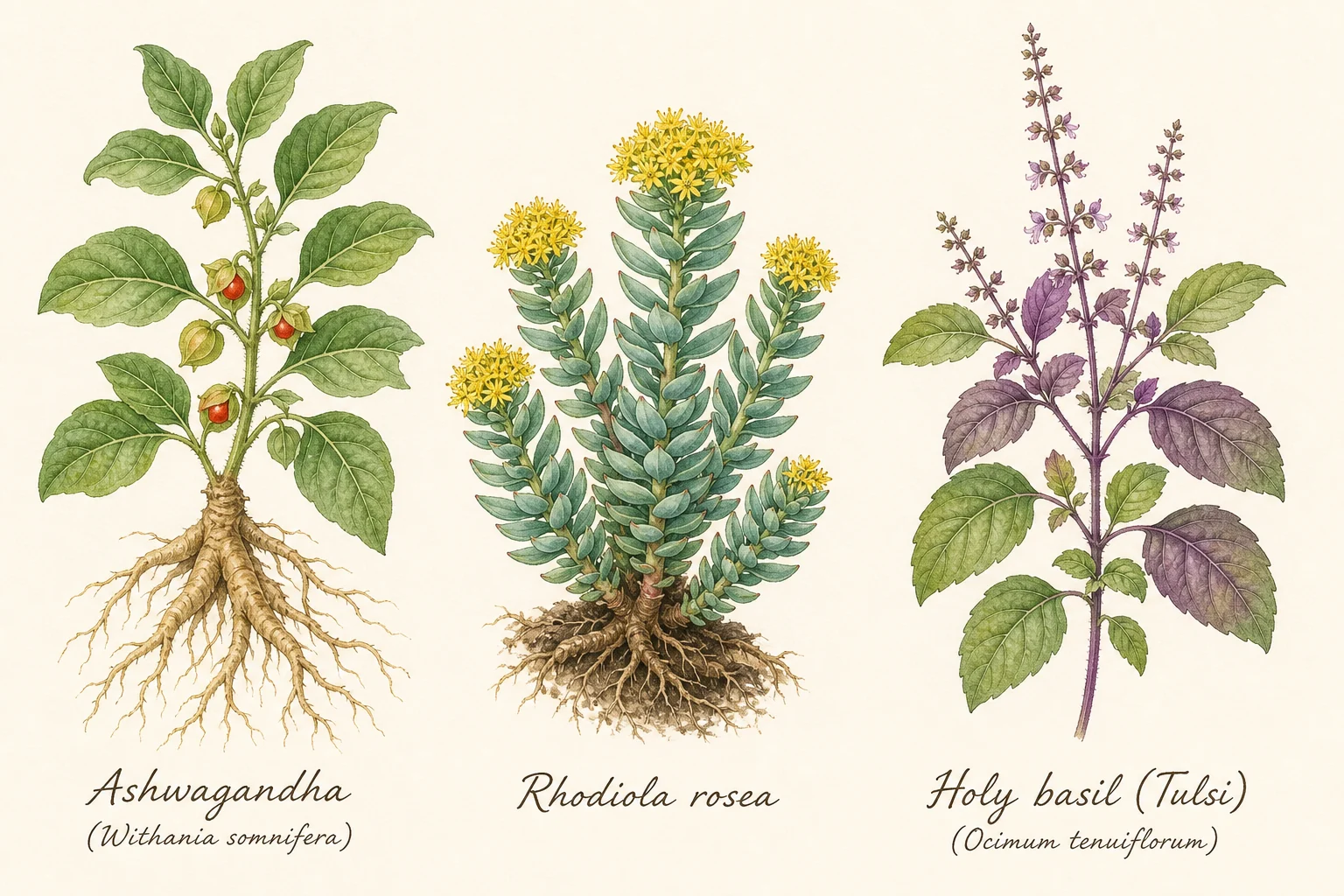
Which Adaptogen Has the Best Evidence for Stress? Ashwagandha vs Rhodiola vs Holy Basil
Table of Contents
If you’ve spent any time looking at stress supplements, you’ve seen the word “adaptogen.” Ashwagandha. Rhodiola. Holy basil. They’re stacked in stress formulas, sold as cortisol balancers, and pitched as natural alternatives for the burnout era.
But the evidence isn’t equal across herbs - and “adaptogen” is a marketing and traditional-use category, not a guarantee that a supplement does anything for your stress levels.
So which one actually has the best evidence in 2026? Here’s what the research says, ranked by how much we know - and what safety concerns come with each one. (And yes, there are safety concerns. All three have them.)
Ashwagandha: The strongest evidence - but imperfect #
Ashwagandha (Withania somnifera) is the most studied of the three for stress outcomes, and the evidence direction - while not flawless - is pretty consistent. Multiple systematic reviews and meta-analyses, including a 2024 review of nine randomized controlled trials with 558 participants and a 2026 dose-response meta-analysis, have found that some ashwagandha preparations improve scores on stress and anxiety measures compared to placebo, with corresponding drops in cortisol levels.
That’s the headline people like to quote.
The catch - and there are a few - is that the certainty isn’t always high. A 2022 meta-analysis covering 12 studies and over 1,000 participants found reduced anxiety and stress scores compared to placebo, but rated the certainty of evidence as low. The 2026 dose-response meta-analysis, while positive, still called for higher-quality trials to sort out exactly which dose and duration work best, because heterogeneity between studies remains substantial.
Translation: the signal is real enough to pay attention to, but you can’t assume any ashwagandha product from any brand will deliver the same results. Trials used specific extracts at specific doses; your supplement may not match. (Worth checking the label, if you go that route - but even then, there’s no guarantee the extract matches what was studied.) If you want the longer version of that problem, our guide to what “clinically studied” supplement claims actually mean is a good place to start.
NCCIH - the U.S. National Center for Complementary and Integrative Health - puts it carefully: some ashwagandha preparations may be effective for insomnia and stress, but the evidence for anxiety is unclear. Short-term use, up to about three months, may be safe for some adults. Long-term safety isn’t established.
Safety: This is where ashwagandha gets more complicated #
Ashwagandha isn’t a risk-free herb. NCCIH flags drowsiness, stomach upset, diarrhea, and vomiting as possible side effects. But the real attention-getters are the less common but more serious signals.
Liver injury is one of them. Rare cases have been linked to products labeled as ashwagandha, typically appearing 2 to 12 weeks after starting use - often with jaundice, itching, and dark urine. It’s documented in LiverTox and multiple case reports. It’s not common, but it’s real enough that you should know the warning signs. We covered the broader pattern in our guide to herbal supplement liver risks, too.
Then there’s the thyroid stuff. Case reports have connected ashwagandha use to thyrotoxicosis and thyroiditis. If you have a thyroid condition or take thyroid medication, this is a discussion-for-your-clinician situation, not a “just try it” one.
And NCCIH advises people with hormone-sensitive prostate cancer to avoid ashwagandha because it may increase testosterone levels. That one catches people off guard - nobody expects a stress herb to mess with hormones, but here we are.
Who should be cautious or avoid ashwagandha entirely #
NCCIH is explicit: ashwagandha isn’t recommended during pregnancy or breastfeeding. It’s also not recommended before surgery or for people with autoimmune disorders or thyroid disorders. And potential interactions exist with diabetes drugs, high blood pressure medications, immunosuppressants, sedatives, anticonvulsants, and thyroid hormone medications. That’s not a short list.
Rhodiola: Mixed evidence, and more about fatigue than stress #
Rhodiola (Rhodiola rosea) has a different evidence profile, and it’s weaker than ashwagandha’s. If you were hoping for a close second, this isn’t quite that.
A 2012 systematic review of rhodiola for physical and mental fatigue found some trials that suggested benefit - particularly in narrow populations: physicians on night duty, students during exam periods, people with stress-related fatigue. But the review also found contradictory evidence, and every included study had a high or unclear risk of bias.
That last part matters. When a systematic review says “the included studies might be positive, but we can’t trust their methods,” the takeaway isn’t “rhodiola works.” It’s “we need better studies.”
NCCIH is more direct than it usually is: the evidence isn’t strong enough to say whether rhodiola is useful for any health-related purpose. That’s a notably blunt line from an agency that tends to leave doors open. They’re basically saying “we looked and couldn’t find enough.”
Some of the individual trials are interesting. A 60-person study in people with stress-related fatigue found improvements in fatigue, attention, and cortisol response with no serious side effects attributed to the extract. A small crossover study in physicians on night duty found better mental performance. But these are older trials - the physician study is from 2000 - and they used specific rhodiola extracts in specific populations. They don’t translate to “rhodiola fixes your stress.”
Possible side effects include dizziness, headache, insomnia, dry mouth, and excessive saliva. An interaction with losartan - a blood pressure medication - has been reported. Pregnancy and breastfeeding safety is unknown, so rhodiola shouldn’t be treated as pregnancy-safe by default. NCCIH also flags that depression is serious and readers should consult a health care provider if depression symptoms are present - a reminder that supplements aren’t a substitute for mental health care.
Holy basil: Interesting, but preliminary #
Holy basil (Ocimum sanctum, also called tulsi) has the thinnest evidence of the three for stress outcomes. And that’s being generous.
A 2009 clinical trial of 35 people with generalized anxiety disorder reported improvements in anxiety, stress, and depression measures. That’s intriguing - genuinely. But 35 subjects in a single trial, with limited modern replication, doesn’t support treatment claims. A placebo-controlled study in healthy volunteers found some cognitive parameters improved, but anxiety and cortisol differences between groups were limited.
There’s no NCCIH monograph on holy basil, and PubMed human evidence for stress and anxiety specifically is sparse. A 2026 study of a multi-herb formula that included holy basil alongside rhodiola and schisandra found stress improvements - but that tells you something about the formula, not about holy basil alone. (Multi-ingredient studies are like that. You can’t point to one herb and say “that one did it.”)
Safety sourcing for holy basil is weaker than for NCCIH-covered herbs, which is worth flagging. WebMD - used here as secondary safety context only, not as a primary authority - notes that short-term oral use of holy basil leaf extract is possibly safe, with possible nausea or diarrhea. Long-term safety isn’t known. Holy basil is flagged as possibly unsafe during pregnancy or when trying to conceive, and it should be avoided during breastfeeding due to lack of data. Cautions also apply for hypothyroidism, diabetes medication interactions, anticoagulant and antiplatelet drugs, surgery, and sedative medications.
That’s a long list for an herb that’s sometimes treated like it’s just tea.
One thing all three share: The FDA doesn’t pre-approve supplements #
This is worth saying plainly because supplement labels can make it easy to forget. The FDA doesn’t approve dietary supplements before they’re marketed. Companies are responsible for making sure their claims are truthful and not misleading, but there’s no pre-market safety or effectiveness review the way there is for drugs.
What that means for you: product quality, extract type, ingredient amounts, contaminants, and label accuracy can all vary between brands. A study showing benefit for one specific ashwagandha extract doesn’t mean the ashwagandha capsule on a store shelf is equivalent. It probably isn’t.
The bottom line - and some questions for your own situation #
Ashwagandha has the most human evidence for short-term stress, but even that evidence has gaps - heterogeneity between studies, low-certainty ratings in some reviews, and safety signals that deserve attention. It’s not a proven treatment for anxiety, depression, insomnia, or any diagnosed condition. Say that out loud if you need to.
Rhodiola has some interesting fatigue studies but nothing strong enough to build health claims on. NCCIH’s “we don’t know enough” position is honest - and sometimes “we don’t know” is the most useful answer you can get.
Holy basil is preliminary, period. The safety picture is incomplete too.
If you’re considering any of these, the practical questions worth asking are: Do you have a thyroid condition, autoimmune disease, liver issue, or hormone-sensitive cancer? Are you pregnant, breastfeeding, or trying to conceive? Are you taking prescription medications - especially for blood pressure, diabetes, blood thinning, thyroid, or sedation? Do you have surgery coming up?
A qualified health professional who knows your full picture should be part of that conversation. That goes double if ongoing anxiety, depression, panic symptoms, or severe fatigue are what’s pushing you toward supplements in the first place. Supplements shouldn’t delay professional evaluation when those symptoms are real. And if prescription medications are in the mix, read The Supplement Conversation Nobody’s Having before assuming a stress herb is automatically low-risk.
Related