VR Mindfulness Has a Real Signal. It Still Isn't Headset Therapy.
Table of Contents
A new VR mindfulness meta-analysis gives the wellness-tech world something worth taking seriously - and something very easy to oversell.
The 2026 review, published in European Journal of Psychotraumatology, pooled 15 randomized controlled trials with 864 participants and found that virtual-reality mindfulness interventions were associated with lower depression and anxiety symptom scores compared with controls (PMC full text; PubMed record). That’s interesting. It suggests that putting mindfulness practice inside an immersive environment may help some people engage with it, at least in short-term trial settings.
But the useful story is not “a headset treats depression.” It isn’t “VR replaces therapy” either. The better read is narrower: VR may be an engaging delivery format for mindfulness practice, while the evidence still needs the same boundaries we’d put around any mental-health-adjacent wellness tool.
And those boundaries matter right away. Depression and anxiety disorders can be serious medical conditions, not just a rough week with better branding. If symptoms are severe, persistent, worsening, interfering with daily life, or tied to thoughts of self-harm, a VR meditation app is not the plan. In the U.S., call or text 988 for suicidal thoughts or crisis support, and call 911 or local emergency services if someone is in immediate danger (NIMH depression; NIMH anxiety disorders).
What the new review actually found #
The meta-analysis looked at VR-based mindfulness interventions for depression and anxiety. For depressive symptoms, the pooled result favored VR mindfulness over controls, with a standardized mean difference of -0.87. For anxiety symptoms, 12 anxiety-related investigations also favored VR mindfulness, with a standardized mean difference of -0.49 (PMC full text).
Those numbers point to symptom-score reductions in pooled trials. They don’t prove durable remission. They don’t show that every consumer VR app works. And they don’t tell us that someone with major depression, panic disorder, PTSD, severe anxiety, or suicidal thinking should swap evidence-based care for a headset.
That may sound like a picky distinction, but it’s the whole article.
A symptom-score signal can be real and still not be a treatment claim. Trials can show short-term movement on questionnaires without proving long-term clinical outcomes, relapse prevention, real-world adherence, product-level effectiveness, or safety across higher-risk groups. The review itself noted major limitations, including high heterogeneity, small samples, difficult blinding, self-report measures, non-clinical populations in some studies, possible publication bias, and access barriers around hardware cost and usability (PMC full text).
So yes, promising. Also unfinished.
Why VR might make mindfulness easier for some people #
Mindfulness doesn’t require a headset. NCCIH describes meditation and mindfulness as practices with long histories, often rooted in Eastern traditions, and notes that U.S. adult meditation use rose from 7.5% in 2002 to 17.3% in 2022 (NCCIH mindfulness guidance). A chair, a quiet room, a guided audio track, or a few minutes of breath awareness can be enough for many people.
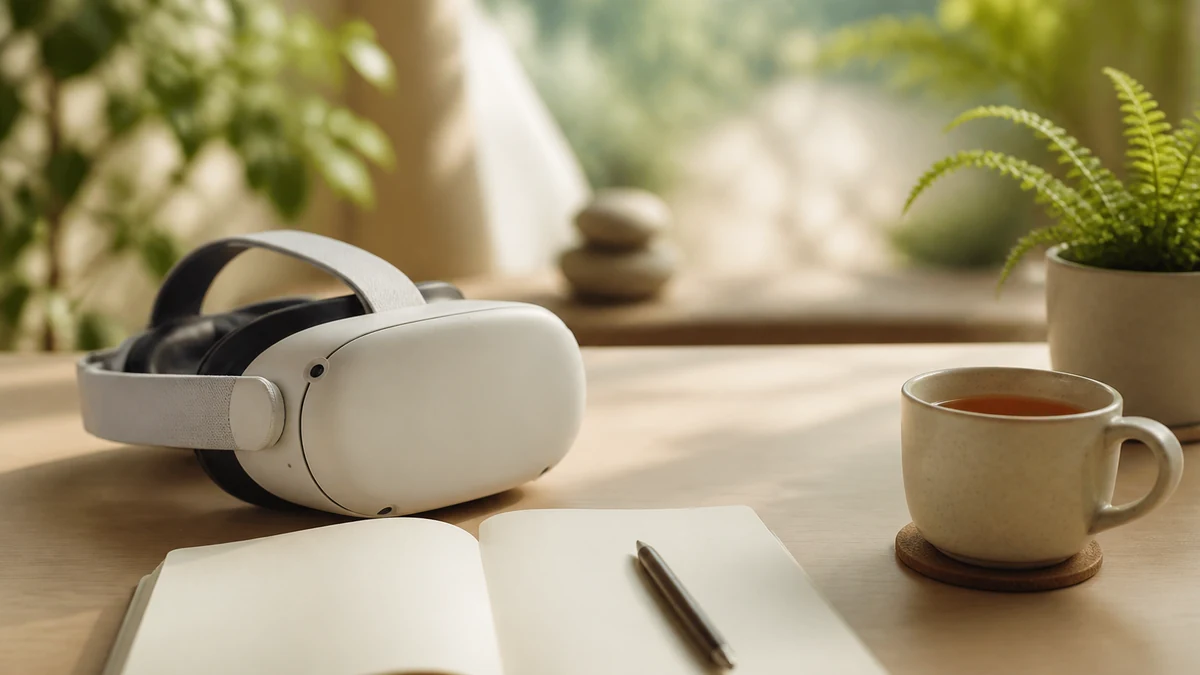
But VR changes the delivery experience. Instead of asking someone to sit with a wandering mind in a noisy apartment, VR can create a controlled scene, reduce outside distractions, and give the user something structured to look at or follow. The 2026 review discusses presence, emotional regulation, and decentering from rumination as possible reasons VR mindfulness could help some users stay engaged (PMC full text).
That’s plausible. I’ve also known plenty of people who find ordinary meditation weirdly frustrating at first (the “am I doing this wrong?” stage is real). For them, an immersive scene might make the first few sessions feel less abstract.
But plausibility isn’t proof. A more engaging doorway into mindfulness doesn’t automatically become more effective care, and a beautiful virtual forest doesn’t turn into a clinician.
Don’t turn subgroup signals into advice #
The review reported moderator findings that are tempting to convert into headlines: larger effects in older-adult samples, different signals by region, and more favorable results for sessions under 30 minutes (PMC full text). This is exactly where cautious wording has to do some work.
Those findings are exploratory. They can help researchers ask better questions, but they shouldn’t become reader prescriptions. Older adults should not be told to use VR mindfulness because a subgroup looked stronger. Short sessions should not be marketed as the proven ideal dose. And regional differences shouldn’t be translated into cultural claims about who VR mindfulness “works for.”
One more thing: the review found both immersive and semi-immersive VR subgroups had significant pooled reductions, with no simple proof that more immersion is automatically better (PMC full text). That undercuts the usual tech-sales instinct. More headset, more graphics, more sensory intensity - not necessarily more benefit.
The professional-care boundary #
Mindfulness already has a broader evidence base than VR mindfulness, but even that broader field has limits. NCCIH says mindfulness research can be hard to analyze because practices vary, effects are difficult to measure, and many studies have been preliminary or not scientifically rigorous (NCCIH mindfulness guidance). AAFP describes mindfulness-based interventions as mainly adjunctive for depression and cautions against using them as first-line monotherapy for anxiety or depressive disorders (AAFP review).
So VR mindfulness belongs in the add-on conversation. It might sit beside therapy, CBT skills, medication when prescribed, sleep support, exercise, social support, or ordinary mindfulness practice. It should not delay diagnosis, replace psychotherapy, replace medication, or become the thing someone tries instead of crisis care.
Because here’s the uncomfortable practical test: if a person is too unwell to be safe, function, sleep, work, care for themselves, or stop thinking about self-harm, the app store is the wrong front door.
VR has its own safety issues #
Mindfulness is often talked about as low-risk, and for many people it may be. But low-risk isn’t the same as risk-free. NCCIH says few studies have examined meditation and mindfulness harms well enough for firm safety statements, and it summarizes a review in which about 8% of participants reported a negative effect, most commonly anxiety and depression (NCCIH mindfulness guidance). Mayo Clinic also cautions that meditation can sometimes worsen symptoms linked to some mental health conditions and says it doesn’t replace medical treatment (Mayo Clinic meditation overview).
Then VR adds a physical layer. FDA’s AR/VR medical-device page lists possible risks including neck discomfort or pain from headset weight, dizziness, fatigue, vision effects, low-contrast images, display errors involving depth or location, and information overload (FDA AR/VR medical-device page). The 2026 review also notes practical issues such as device operability, motion sickness risk, and scenario adaptability for groups needing more study, including older adults, pediatric and adolescent groups, people with comorbid physical illness, and people with PTSD or trauma-related conditions (PMC full text).
Worth knowing: immersive content can feel emotionally intense in a way a phone-based meditation doesn’t. That doesn’t mean VR is bad. It means people with severe or worsening depression or anxiety, suicidal thoughts, psychosis, mania, dissociation, trauma symptoms, vestibular disorders, seizure or photosensitivity history, migraines triggered by visual motion, major balance or vision problems, significant neck pain, or severe motion sickness should be especially cautious and should discuss it with a qualified professional first.
And if a session makes symptoms worse, stop. Don’t “push through” because an app framed discomfort as healing.
Consumer apps are not automatically validated care #
This is the boring regulatory sentence that prevents a lot of bad wellness copy: a VR mindfulness app is not clinically validated just because VR mindfulness has been studied.
FDA says software or digital-health products may fall under medical-device rules depending on intended use and claims (FDA digital health FAQ). In plain language, claims matter. A general wellness app, a research protocol, and an FDA-cleared medical device are not interchangeable.
So if a product claims to treat anxiety, treat depression, prevent relapse, replace therapy, or provide clinical care, readers should ask harder questions: Was this exact product tested? In whom? Against what comparison? For how long? Were adverse effects tracked? Was there clinician support? Is there FDA clearance for that specific intended use, or is this wellness marketing wearing a lab coat?
Bottom line #
The 2026 meta-analysis gives VR mindfulness a real, sourceable signal: in pooled randomized trials, it was associated with reductions in depression and anxiety symptom scores. That’s enough to take the format seriously as a possible mindfulness delivery tool.
But it’s not enough to sell a headset-based mental-health cure. The evidence is exploratory, heterogeneous, and mostly short-term; ordinary mindfulness doesn’t require VR; consumer apps vary; and depression or anxiety symptoms that are severe, persistent, worsening, or linked to self-harm need professional care.
Use VR mindfulness, if you use it, as a possible add-on practice - not as a substitute plan. The headset may help some people get into the exercise. It doesn’t replace the care system around the person wearing it.
Related
Essential Oils for Stress: What a Two-Week Cortisol Study Can Actually Prove

Akkermansia Is Interesting Microbiome Science, Not a GLP-1 Shortcut