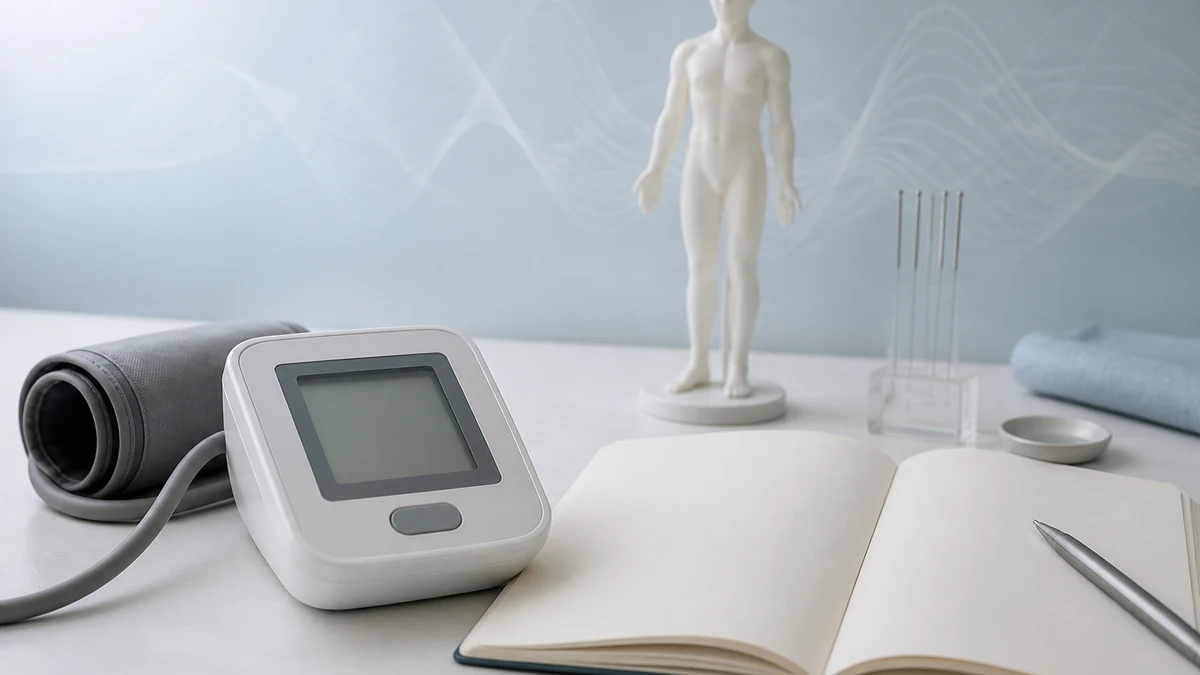
Electroacupuncture and Blood Pressure: Mechanism Signals, Not a Medication Substitute
Table of Contents
Electroacupuncture is having a blood-pressure research moment. That doesn’t make it a blood-pressure treatment.
A 2026 review in Clinical and Experimental Hypertension pulled together mechanistic, clinical, and translational evidence on electroacupuncture for essential hypertension. The interesting part is real: researchers can point to plausible pathways involving sympathetic nervous-system activity, autonomic balance, inflammation, blood-vessel function, and heart-remodeling signals (2026 Clinical and Experimental Hypertension review).
But the caution belongs near the top, not buried politely at the end. The 2026 paper is a narrative/integrative review, not a formal systematic review, and its own conclusion says clinical efficacy is still unconfirmed. And Cochrane’s acupuncture-for-primary-hypertension review found no evidence that acupuncture produces the sustained blood-pressure reduction needed for long-term hypertension management, with short-term effects left uncertain because the evidence quality was very low (Cochrane acupuncture-for-primary-hypertension review).
So if your blood pressure is high, this is not the place to freestyle. Hypertension needs actual measurements, repeated readings when appropriate, clinician-guided risk management, lifestyle foundations, and medication when medication is indicated. High blood pressure usually doesn’t announce itself with obvious symptoms; CDC says measurement is the way to know where you stand (CDC high blood pressure overview).
What electroacupuncture is, and what it isn’t #
Electroacupuncture is a form of acupuncture in which inserted needles are stimulated with small electrical currents. NCCIH describes it as acupuncture plus electrical stimulation, still within the acupuncture setting rather than a generic home gadget category (NCCIH acupuncture overview).
That distinction matters. A practitioner-controlled electroacupuncture session is not the same thing as sticking consumer electrodes on yourself because a device listing mentioned circulation, nerves, or relaxation. This article isn’t a protocol, a settings guide, or a workaround for medical care. It also isn’t a claim that any consumer electrostimulation or TENS-style product has been validated for blood pressure.
And yes, acupuncture has a long traditional history. Cochrane notes its use in traditional Chinese medicine around blood pressure and hypertension symptoms, while NCCIH places acupuncture’s origins at least 2,500 years back (Cochrane acupuncture-for-primary-hypertension review; NCCIH acupuncture overview). Tradition explains why the question keeps coming up. It doesn’t prove sustained hypertension control.
Why researchers are interested #
The mechanism story is the strongest part of the electroacupuncture-blood-pressure conversation.
The 2026 review describes preclinical and translational work suggesting that electroacupuncture may influence central sympathetic outflow, autonomic balance, inflammatory signaling, endothelial protection, and myocardial-remodeling pathways (2026 Clinical and Experimental Hypertension review). In plainer language, researchers are asking whether needle-based electrical stimulation can nudge some of the nervous-system and vascular pathways involved in blood-pressure regulation.
That’s biologically plausible. It’s also not the same thing as proof that a person with hypertension can swap a medication plan for acupuncture.
Because mechanisms are slippery like that (useful, but easy to oversell). A lab or animal signal can point to a pathway worth studying. It can’t tell you whether someone has reduced their stroke risk, protected their kidneys, avoided heart failure, or safely changed a prescription plan. Those are clinical questions, and the clinical evidence is much thinner.
The human evidence is still too thin for treatment claims #
Here is the less glamorous read: direct human electroacupuncture evidence for essential hypertension remains sparse.
The 2026 review discusses one stage 1 hypertension study, adjunctive-therapy evidence, trial protocols, and mechanistic work, but it does not present a settled body of large, completed, sham-controlled, multicenter electroacupuncture trials proving durable blood-pressure benefit (2026 Clinical and Experimental Hypertension review). That’s not a small limitation. That’s the whole boundary of the story.
Some older acupuncture reviews and meta-analyses are more encouraging in places. A 2015 PLOS One review found signals when acupuncture was added to medication in some trials, while acupuncture alone did not show a significant systolic or diastolic blood-pressure effect compared with medication in subgroup analysis; adverse-event reporting was also inadequate (2015 PLOS One systematic review). A 2022 review of electroacupuncture plus rehabilitation training reported lower blood-pressure readings than conventional rehabilitation training, but the authors still called for larger studies to verify effectiveness (2022 International Journal of Cardiology Heart & Vasculature review).
And then there is the evidence-quality problem. A 2023 overview of systematic reviews and meta-analyses found methodological, reporting, risk-of-bias, and evidence-quality problems across the review base, with included reviews rated low or very low quality by AMSTAR-2 and most outcomes low or very low quality by GRADE (2023 overview in Cardiovascular Therapeutics).
So the fair sentence is messy, because the evidence is messy: electroacupuncture is a plausible research area with some adjunctive signals, but it isn’t established as a stand-alone or medication-replacement approach to chronic high blood pressure.
Why Cochrane still matters here #
Cochrane’s review is the counterweight a reader deserves before getting excited.
Across 22 randomized trials with 1,744 people, Cochrane found no evidence for sustained blood-pressure lowering by acupuncture that would be useful for managing chronically elevated blood pressure. It also found short-term changes uncertain because the evidence was very low quality, and safety couldn’t be assessed well because adverse events were reported by only a few trials (Cochrane acupuncture-for-primary-hypertension review).
That doesn’t mean every acupuncture study is worthless. It means a strong consumer claim needs more than a plausible pathway, a short-term reading, or an add-on signal from a small trial.
Worth keeping in mind: hypertension care is not just about making one number look better after one intervention. The point is sustained risk reduction - fewer strokes, fewer heart attacks, less kidney damage, less heart strain, and safer long-term control. If a practice hasn’t shown that kind of durable, clinically useful effect, the claim has to stay modest.
The practical safety line #
If someone is curious about electroacupuncture, the first question should not be, “Which points or settings should I try?” It should be, “Is my blood pressure measured, understood, and being managed safely?”
CDC describes high blood pressure as consistently at or above 130/80 mm Hg and warns that it usually has no symptoms (CDC high blood pressure overview). AAFP guidance centers blood-pressure targets and clinician-directed treatment planning, while Mayo Clinic explains that lifestyle changes can help manage high blood pressure, but medicines may be recommended when lifestyle measures are not enough (AAFP hypertension guidance; Mayo Clinic high blood pressure treatment guidance).
And medication changes are not DIY territory. Mayo Clinic warns not to skip doses or abruptly stop blood-pressure medicines, and NCCIH tells people with hypertension not to replace prescribed treatment with unproven products or practices (Mayo Clinic high blood pressure treatment guidance; NCCIH hypertension guidance).
There is also a needle-safety piece. NCCIH says acupuncture generally has few complications when performed by a licensed, well-trained practitioner using sterile needles, but complications have occurred with nonsterile needles and improper delivery (NCCIH acupuncture overview). Federal device rules classify acupuncture needles as Class II devices with special controls including single-use labeling, prescription-device requirements, biocompatibility, and sterility (eCFR acupuncture needle device controls).
People with pacemakers, implanted defibrillators, neurostimulators, implanted pumps, arrhythmia history, seizure history, pregnancy, bleeding disorders, anticoagulant use, immune compromise, lymphedema, active skin infection near possible needle sites, or severe needle anxiety should talk with a clinician and a qualified acupuncturist before considering acupuncture or electroacupuncture. That’s practical caution, not a formal one-size-fits-all contraindication list.
And urgent symptoms don’t belong in an acupuncture decision tree. Chest pain, stroke symptoms, severe shortness of breath, severe headache with neurological symptoms, or very high blood-pressure readings with concerning symptoms need urgent medical care.
Bottom line #
Electroacupuncture for high blood pressure is interesting for the right reason: the mechanism story is biologically plausible, and researchers have enough signals to justify better trials.
But that’s where the sentence should stop. The 2026 review is useful for mapping mechanisms and research gaps; it isn’t proof that electroacupuncture controls hypertension. Cochrane’s sustained-effect caution still matters, and the broader acupuncture evidence base has quality problems that shouldn’t be waved away because the topic sounds gentler than medication.
So the AMZ take is cautious but not dismissive: respect electroacupuncture as a research question, don’t inflate it into a treatment claim. If blood pressure is the concern, start with measured readings, clinician-guided risk management, lifestyle foundations, and medication when indicated. Electroacupuncture, if considered at all, belongs in a safety-aware conversation with qualified professionals - not as a medication substitute, not as a home-device experiment, and not as a reason to delay real hypertension care.
Related
VR Mindfulness Has a Real Signal. It Still Isn't Headset Therapy.


Essential Oils for Stress: What a Two-Week Cortisol Study Can Actually Prove

A Probiotic Did Not Boost COVID Booster Antibodies. That’s the Point.