Rhodiola for Sports Performance: Promising Endurance Evidence, But Not a Miracle Workout Herb
Table of Contents
Rhodiola is the kind of herb that sounds almost too perfect for sports marketing.
It has a traditional-use story around stamina and fatigue. It is sold for energy, stress, focus, and workout performance. And now there are randomized-trial reviews suggesting it may have a small, real signal for endurance or fatigue resistance.
But that is not the same as saying rhodiola is proven to boost athletic performance.
NCCIH, the federal complementary-health agency, still says there is not enough reliable evidence to know whether rhodiola or its components are useful for any health-related purpose. That caution matters, even when sports-nutrition papers sound more excited. The honest middle ground is this: rhodiola has promising but uneven exercise evidence, especially around endurance outcomes, and the safety/product-quality caveats are not small print.
So yes, it is worth looking at. No, it is not a miracle workout herb.
What rhodiola is, and why athletes care #
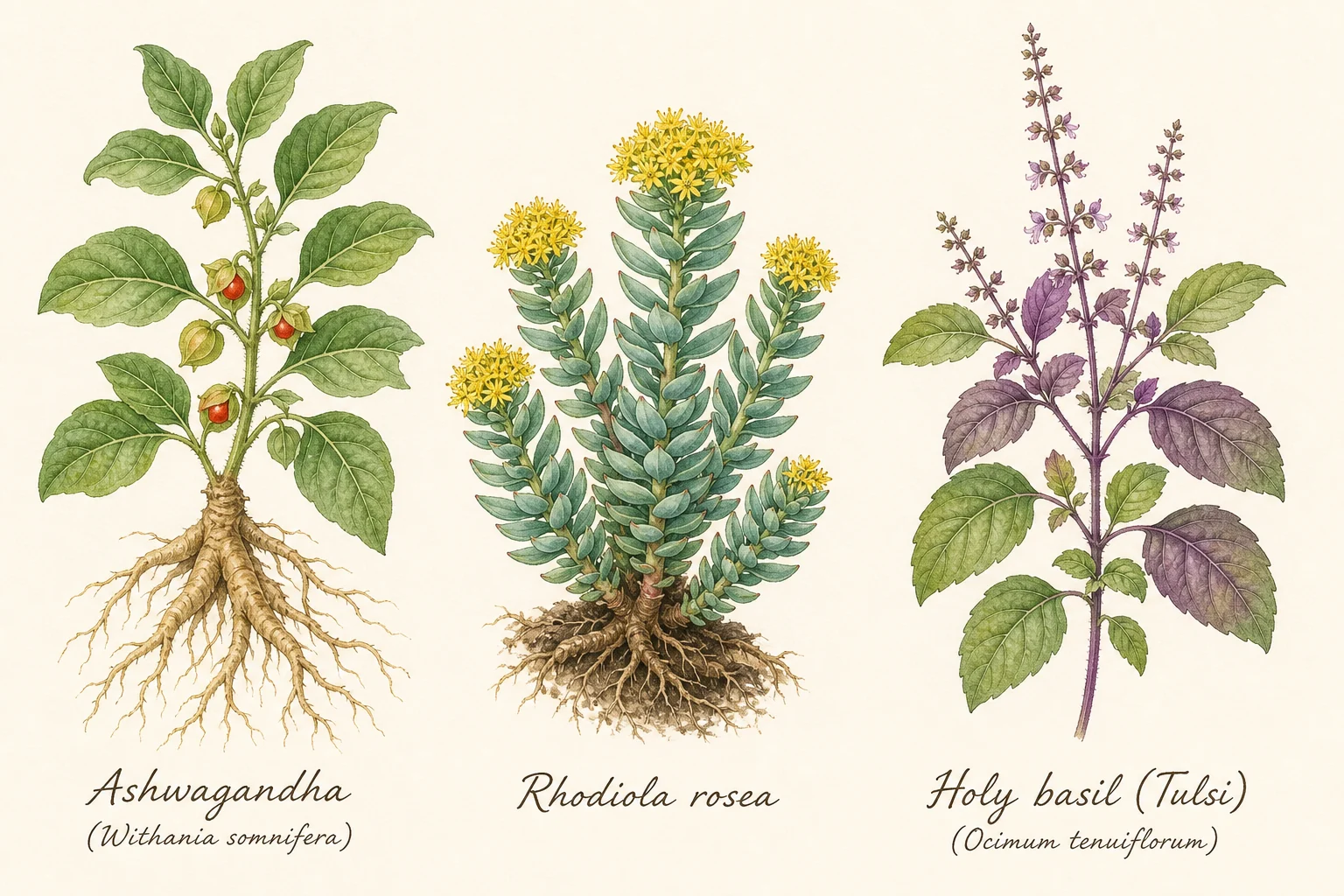
Rhodiola rosea is an herb with a long history of traditional use in parts of Europe and Asia, including use for fatigue, work performance, endurance, altitude stress, and mood-related purposes. Today, it is usually sold as an “adaptogen,” which is a marketing-friendly word that can mean anything from “helps stress resilience” to “vaguely makes you better at life.”
That vagueness is part of the problem.
For athletes and active adults, the plausible appeal is narrower. Rhodiola might affect perceived exertion, fatigue signals, antioxidant pathways, muscle-damage markers, stress-response biology, or energy metabolism. Those are reasonable hypotheses. Some are supported by early human data. But mechanisms are not outcomes, and a changed blood marker does not automatically mean you run faster, lift more, recover better, or feel great during a hard session.
And if a supplement ad jumps straight from “traditional stamina herb” to “performance booster,” it is skipping several steps.
What the sports-performance reviews found #
The most useful research is not one isolated gym study. It is the review evidence.
A 2023 systematic review in Phytotherapy Research looked at 13 randomized controlled trials with 263 healthy participants. The review found positive effects in many of the included studies, but also flagged the obvious weaknesses: small samples, different supplement products, different exercise tests, different timing, and unclear or high risk of bias in most studies (PubMed).
That is a familiar supplement-research pattern. The signal is interesting. The foundation is not rock-solid.
The review suggested acute rhodiola use appeared more promising for endurance performance and ratings of perceived exertion, while chronic use looked more mixed and somewhat more positive for anaerobic outcomes than endurance. But do not turn that into a protocol. The studies used varied approaches, and this article is not a dosing guide.
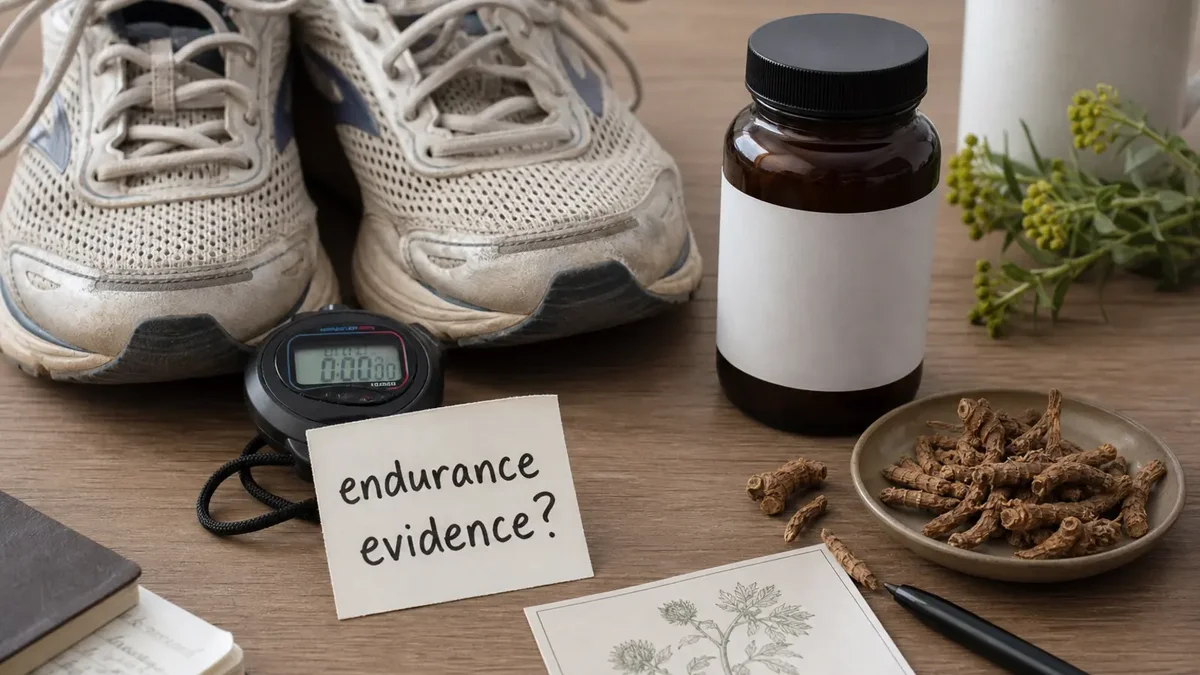
A newer 2025 Frontiers in Nutrition systematic review and meta-analysis widened the lens to 26 randomized trials and 668 participants. It reported small statistically significant improvements in endurance-related outcomes, including VO2max, time to exhaustion, and time-trial performance. It also reported changes in creatine kinase, lactate, and antioxidant markers (PMC).
Useful? Yes.
A guarantee? Not even close.
The effect sizes were modest, trial designs varied, and many outcomes still came from small numbers of studies. The review also noted gaps in training-protocol reporting and adverse-event reporting. So the best plain-English reading is not “rhodiola works.” It is more like: pooled RCT evidence now points toward a small endurance/fatigue-resistance signal, but the evidence is still too uneven for confident performance claims.
Endurance looks more plausible than strength #
If rhodiola has a sports niche, endurance and fatigue resistance look more believable than strength or muscle-building claims.
That matters because supplement labels often blur everything into one big “performance” promise. Endurance, repeated sprint fatigue, perceived exertion, strength, peak power, cognition, recovery, inflammation, and muscle damage are not the same outcome.
A small 2026 trial in 24 male competitive football players reported promising results after four weeks of rhodiola, including improvements in Yo-Yo intermittent recovery performance, repeated-sprint mean time, lactate, decision-making measures, and some match-running metrics (PMC). That is interesting sport-specific evidence. But it was one small, male-only trial, and it should not be generalized to every athlete, every sport, or every product on the shelf.
By contrast, a 2025 triple-blind crossover trial in 18 resistance-trained volunteers found mostly trivial-to-small effects on strength and cognition, with only 4 of 32 strength comparisons favoring rhodiola (PMC).
So if someone is selling rhodiola like a natural strength booster, be skeptical. The stronger case is not “build more muscle.” It is “there may be a modest fatigue/endurance signal in some settings.”
That is less exciting on a label. It is also more honest.
The biomarker trap #
Rhodiola research often mentions lactate, creatine kinase, antioxidant markers, inflammation markers, and muscle-damage signals. Those details can be useful, but they are easy to overread.
The 2025 meta-analysis reported reduced creatine kinase and lactate and improved antioxidant markers. But it did not find significant effects on IL-6 or CRP, two inflammation-related markers. So “rhodiola reduces exercise inflammation” is not a safe takeaway from that review.
And even when a biomarker moves in a favorable direction, the reader question is still: did performance improve in a way that matters outside a lab test? Sometimes maybe. Sometimes not. Athletes do not compete in biomarker panels.
This is where a little boredom protects you. Small changes in VO2max or time to exhaustion may matter to trained athletes at the margins, but they do not turn an under-recovered, underfed, underslept training plan into a good one.
Safety box: who should be careful #
Rhodiola is often described as “natural,” but natural does not mean automatically safe or cleanly compatible with medications.
NCCIH says rhodiola is possibly safe for up to 12 weeks, and lists possible side effects including dizziness, headache, insomnia, dry mouth, and excessive saliva production. Insomnia is especially relevant for active people who already use caffeine, pre-workouts, stimulants, or late-day training.
Medication interactions deserve real attention. NCCIH reports interactions between rhodiola and losartan, a blood-pressure medication. Memorial Sloan Kettering Cancer Center also lists cautions around blood thinners such as warfarin, anti-seizure drugs such as phenytoin, antidepressants, antihypertensives, stimulants, and drugs affected by CYP3A4, CYP2C9, or P-glycoprotein pathways (MSKCC).
There is also a case report, cited by MSKCC, involving tachyarrhythmia after rhodiola was taken with an antidepressant. That does not mean the reaction is common. But it is enough reason not to mix rhodiola casually with psychiatric medication, stimulant products, or narrow-therapeutic-index drugs.
Pregnancy and breastfeeding are another stop sign. NCCIH says little is known about rhodiola safety during pregnancy or breastfeeding, so it should not be treated as risk-free in either situation.
And if you have persistent fatigue, fainting, palpitations, shortness of breath, chest pain, unexplained performance drop-off, mood symptoms, anemia concerns, or a diagnosed medical condition, do not use rhodiola as a workaround. Get medical evaluation. A supplement should not be a substitute for figuring out why your body is waving a flag.
Product quality may be the most practical problem #
Here is the part supplement marketing usually leaves out: the rhodiola used in a trial may not match the rhodiola in an online bottle.
The 2022 exercise systematic review emphasized that rhodiola products can vary by extraction method, rosavin and salidroside content, harvest factors, and possible adulterants (PMC). Marker compounds alone may not prove purity or equivalence.
A 2026 PLOS One analysis of 10 U.S. rhodiola products bought on Amazon made that concern more concrete. The study found wide variation in rosavins and salidroside, substantial deviations from advertised amounts, one likely synthetic salidroside addition, and trace heavy metals in tested capsule products (PMC).
That does not mean every rhodiola product is unsafe. It does mean “rhodiola” is not one standardized thing.
For competitive athletes, the caution is even sharper. Even if rhodiola itself is not the issue, supplement contamination and label mismatch can create anti-doping risk. Tested athletes should check governing-body rules and use third-party-tested products rather than assuming an herbal label is clean.
How to think about rhodiola without getting played #
A reasonable reader does not have to dismiss rhodiola. The evidence is not empty. Compared with plenty of workout supplements, rhodiola at least has systematic reviews of randomized trials and a plausible endurance/fatigue-resistance angle.
But the hype still runs ahead of the data.
Do not use rhodiola to replace sleep, food, training structure, rest days, iron evaluation, medical care, or basic conditioning. Do not treat it as a natural stimulant without stimulant-like cautions. Do not assume a bigger effect because a product sounds ancient, Nordic, adaptogenic, or “clinically studied.”
And please, do not chase a best-dose answer from scattered trials. The research used varied products, timing, durations, and study populations. NCCIH does not provide an authoritative sports dosing recommendation, and this evidence base is not clean enough for AMZ to pretend there is one.
The practical question is simpler: are you a healthy adult or athlete, not pregnant or breastfeeding, not on interacting medications, not using other stimulant-heavy products, and interested in a supplement with modest endurance evidence and real product-quality caveats? If yes, rhodiola is something to discuss with a clinician, pharmacist, sports dietitian, or other qualified professional who knows your context.
If not, skip the miracle-herb story. You are not missing a secret training weapon.
Bottom line #
Rhodiola has better sports-performance evidence than a random wellness trend, but weaker evidence than the marketing suggests.
The most defensible claim is narrow: systematic reviews of small randomized trials suggest rhodiola may offer modest endurance or fatigue-resistance support in some healthy adults or athletes. The evidence is uneven, strength claims are much less convincing, inflammation claims are not established, and NCCIH remains cautious about health-purpose claims across health uses.
So treat rhodiola as a maybe-useful supplement with caveats, not as a proven performance booster. The boring stuff still wins: training, sleep, recovery, nutrition, medical evaluation when symptoms are unusual, and not trusting every “adaptogen” label on the internet.
Related

Berberine in 2026: What the Evidence Actually Shows (and What It Doesn’t)