Red Yeast Rice Has a New Contamination Warning. Here’s the Safety Context
Table of Contents
The new red yeast rice warning is not about whether fermented rice has a long history. It does. The warning is about what can end up inside a supplement bottle.
On April 24, 2026, USP posted a caution notice saying that Penicillium adametzioides contamination of red yeast rice has “resulted in death and serious adverse reactions including nephrotoxicity (kidney toxicity),” and that manufacturers should consider screening red yeast rice for contaminants, including puberulic acid (USP). That wording is strong, and it should stay attached to USP. It does not mean every red yeast rice product on a shelf is contaminated. But it does mean this category has moved beyond the old, vague “supplements can vary” warning.
And red yeast rice already had a safety problem before this newer contamination notice: some products can act like unlabeled, unpredictable statin exposure.
Why red yeast rice is not just “natural cholesterol support” #
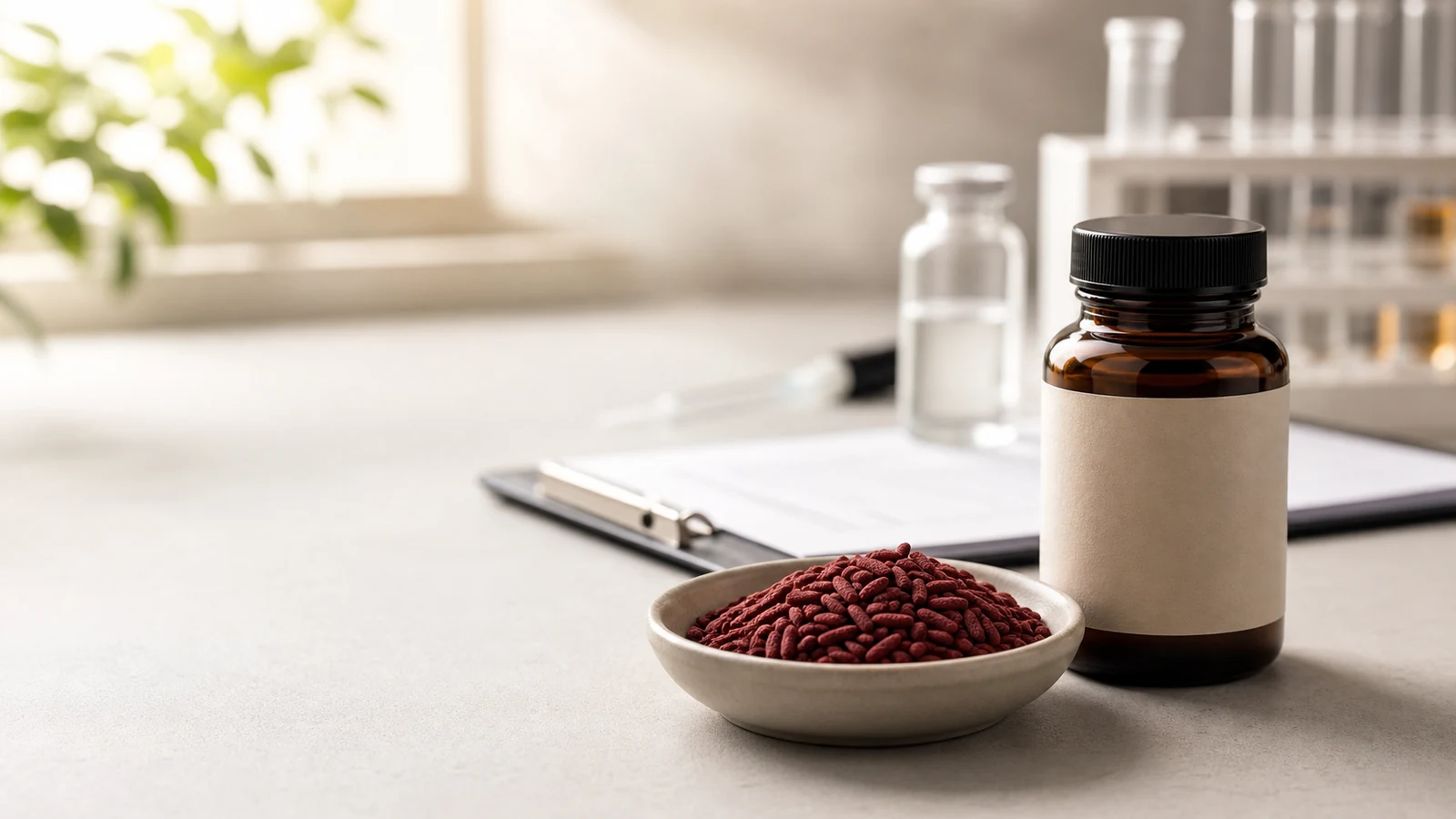
Red yeast rice is rice fermented with Monascus yeast, and it has been used in food and traditional Chinese medicine as well as in modern supplements (NCCIH; LiverTox). The tricky part is monacolin K. NCCIH says some red yeast rice products contain monacolin K, which is chemically identical to lovastatin, the prescription cholesterol drug (NCCIH).
So the risk is not “natural versus pharmaceutical,” as if those are tidy opposites. If a product contains enough monacolin K, it can carry statin-like effects and statin-like side effects. Mayo Clinic lists possible red yeast rice side effects including liver, muscle, and kidney problems, along with digestive symptoms such as stomach pain, heartburn, gas, and dizziness (Mayo Clinic). LiverTox also notes rare clinically apparent liver injury reports, probably tied to lovastatin-like exposure from monacolin K (LiverTox).
But here’s the part consumers can’t easily solve by squinting at a label: the amount of monacolin K can vary sharply, and labels often do not tell you what you’re actually getting.
A 2017 analysis of 28 U.S. red yeast rice products bought from mainstream retailers found more than a 60-fold difference in monacolin K content per 1,200 mg of red yeast rice, and estimated daily monacolin K exposure varied more than 120-fold depending on the product and serving instructions (Cohen et al., 2017). None of those labels disclosed the monacolin K quantity. That’s not a small labeling quirk. It means two bottles using similar “red yeast rice” wording may represent very different exposures.
The second layer: contamination risk #
The newer USP notice adds another safety layer: contamination. USP specifically flags Penicillium adametzioides contamination and recommends that manufacturers consider contaminant screening, including for puberulic acid (USP).
That lands on top of an older red yeast rice contamination concern, citrinin. NCCIH warns that some red yeast rice products contain citrinin, a contaminant that can harm the kidneys (NCCIH). In one 2021 analysis of 37 red yeast rice food supplements, researchers detected citrinin in all monitored products, only one met the newer EU limit of 100 micrograms per kilogram, and four contaminated products were labeled “citrinin free” (Righetti et al., 2021).
So, no, a “citrinin free” label should not be treated as a magic shield. Testing can help, but consumer-facing label claims are not the same thing as product-specific proof.
Puberulic acid is the newer term many readers won’t recognize. Public evidence is still developing, especially for exact human dose-response, but the kidney-risk signal is not coming from nowhere. A 2025 animal toxicity study reported proximal tubular kidney injury in high-dose rats exposed to puberulic acid, while also noting its work was part of investigations after Japan’s 2024 beni-koji red yeast rice supplement incident (Matsushita et al., 2025). Separate Japanese case reports described acute kidney injury likely induced by red yeast rice supplements, including proximal tubular damage and Fanconi syndrome context (Doi et al., 2025).
That does not prove a given U.S. bottle contains puberulic acid. And it does not tell shoppers a neat “safe” threshold. It does explain why USP’s 2026 manufacturer-screening warning deserves attention.
Interactions are where this gets especially messy #
What’s the most practical takeaway for someone who already takes cholesterol medication? Don’t treat red yeast rice as a casual add-on.
Mayo Clinic warns about interactions with alcohol, cyclosporine, CYP3A4 inhibitors, grapefruit, gemfibrozil, medicines or supplements that can harm the liver, high-dose niacin, St. John’s wort, and statins (Mayo Clinic). NCCIH also says red yeast rice products with substantial monacolin K can have the same kinds of side effects and drug interactions as statins (NCCIH).
Because the monacolin K level may be hidden or variable, a person may not know whether they’re adding a tiny amount of statin-like exposure or a meaningful one. That’s the awkward bit. It’s not enough to say, “well, it’s a supplement.” For some products, the body may not care what aisle it came from.
Pregnancy and breastfeeding are another hard stop for casual use. NCCIH says red yeast rice products are not recommended during pregnancy or while breastfeeding, and Mayo says not to take red yeast rice if pregnant, trying to become pregnant, or breastfeeding (NCCIH; Mayo Clinic).
What consumers can do without turning this into a buying guide #
This is not a product-recommendation article, and it’s not cholesterol-treatment advice. Still, there are a few conservative moves that make sense.
First, if you’re using red yeast rice for cholesterol, talk with a qualified health professional, especially if you take a statin or any medicine that affects the liver, muscles, kidneys, or CYP3A4 metabolism (Mayo Clinic; NCCIH). Second, don’t combine it casually with cholesterol drugs, grapefruit, alcohol-heavy use, high-dose niacin, St. John’s wort, or other liver-stressing herbs and medicines unless a clinician has specifically reviewed the combination (Mayo Clinic). Third, don’t rely on “natural,” “fermented,” or “citrinin free” wording as a safety shortcut, because monacolin content and contaminant findings have varied in product testing (Cohen et al., 2017; Righetti et al., 2021).
And if symptoms show up, don’t tough it out because the product came from a supplement bottle. Muscle pain or weakness, dark urine, jaundice, unusual fatigue, swelling, reduced urination, or other concerning symptoms deserve medical attention, particularly given the muscle, liver, kidney, and nephrotoxicity concerns described by NCCIH, Mayo, LiverTox, and USP (NCCIH; Mayo Clinic; LiverTox; USP).
Bottom line #
Red yeast rice now has two safety conversations running at once. One is the long-standing monacolin K issue: some products may expose users to a lovastatin-like compound in amounts the label does not clearly disclose (NCCIH; Cohen et al., 2017). The other is contamination: citrinin has been documented in product analyses, and USP’s 2026 caution notice adds a sharper warning around Penicillium adametzioides, puberulic acid screening, deaths, and serious adverse reactions including nephrotoxicity (Righetti et al., 2021; USP).
So the sane framing is caution, not panic. Red yeast rice is not automatically dangerous for every person, and the newer Japan-linked kidney-risk literature does not prove every market product is contaminated. But it’s also not a harmless “natural statin without statin problems.” If you’re considering it for cholesterol, the safer question is not “which brand looks clean?” It’s “does this make sense with my medicines, my kidney and liver risk, and the fact that the product may not be as predictable as the label makes it sound?”
Related
Common Herbal Supplements That Can Interfere With Medications
Herb-Drug Interactions: The Supplement Safety Check Most People Skip