Telehealth Mindfulness for Back Pain: What the OPTIMUM Trial Actually Found
For people living with chronic low back pain, the annoying part isn’t always finding advice. It’s finding care that’s realistic to attend, affordable enough to repeat, and not pitched as a miracle fix.
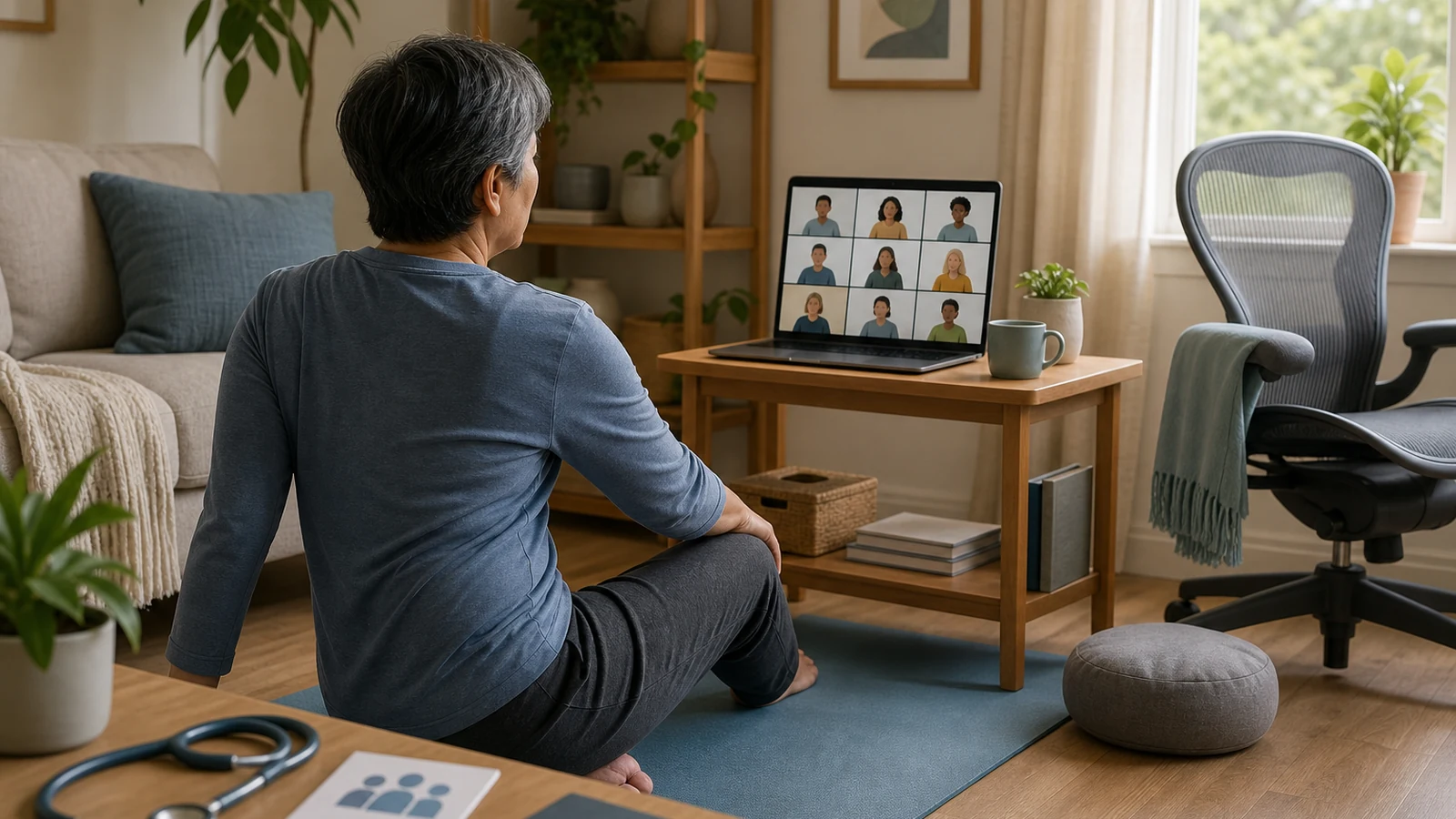
That’s why the OPTIMUM trial is worth a careful look. In a randomized clinical trial published in JAMA Internal Medicine, researchers tested an 8-week telehealth mindfulness group medical visit program, added to usual primary care, in 451 adults with chronic low back pain (JAMA Internal Medicine, 2026). The setup was practical: group mindfulness sessions delivered online, with primary care folded into the visit model rather than treated as an afterthought.
And the results were encouraging, if you read them slowly. On the PEG scale, which measures pain intensity and how much pain interferes with enjoyment of life and general activity, the mindfulness group improved more than usual care at 6 months: -1.21 versus -0.59. At 12 months, the gap was still statistically significant: -1.52 versus -0.78 (JAMA Internal Medicine, 2026).
But here’s the caveat that matters: the between-group difference didn’t meet the trial’s prespecified 1-point threshold for a minimal clinically important difference. So no, this wasn’t a dramatic back-pain breakthrough. It was a modest, sustained improvement in a real-world primary care model - which is still worth noticing.
Why does that matter? Because chronic low back pain is exactly the sort of problem where access can make or break the plan. A program might look good on paper, then fail because someone can’t travel, can’t sit in a waiting room, can’t take repeated time off work, or can’t afford a boutique class.
The telehealth angle doesn’t erase those problems, of course. But it does make the model more believable for regular primary care than a one-off wellness retreat. ClinicalTrials.gov describes OPTIMUM as group medical visits with mindfulness-based stress reduction added to usual primary care, with 8 weekly 90-minute sessions listed in the trial record (ClinicalTrials.gov NCT04129450). That’s useful context, though I wouldn’t hang the whole story on the exact session length because public summaries sometimes describe the full visit differently.
Worth knowing: national guidance already leaves room for nondrug care in chronic low back pain. NCCIH notes that the American College of Physicians guideline encourages nondrug approaches as initial treatment for chronic low back pain, and its low-back pain tip sheet says mindfulness-based stress reduction is associated with a small improvement in chronic low-back pain (NCCIH low-back pain guide; NCCIH chronic low-back pain tips). Small is the key word there. Not useless, not magic.
So what should a reader do with this? Treat telehealth mindfulness as a possible add-on conversation, not a substitute plan. The trial doesn’t prove mindfulness reduced opioid use. It doesn’t prove people avoided surgery. It doesn’t mean an online meditation group can replace physical therapy, medication, imaging when needed, or a clinician’s evaluation.
And back-pain red flags still matter. OPTIMUM’s trial record excluded people with certain concerns, including recent worsening pain, unexplained fever, unexplained weight loss, pregnancy, and metastatic cancer (ClinicalTrials.gov NCT04129450). In real life, new weakness, pain after injury, cancer history, fever, unexplained weight loss, pregnancy, or suddenly worsening pain should push you toward medical evaluation, not self-management experiments.
There were also small safety signals in the trial record. ClinicalTrials.gov lists no serious adverse events or deaths, but it does list non-serious events in the intervention group, including increased pain attributed to chair yoga or stretching, anxiety while lying down, nausea during meditation, and a sciatic flare linked to sitting position (ClinicalTrials.gov results). That’s not a reason to panic. It is a reason to skip the lazy “mindfulness has no downside” line.
Still, as an add-on to usual care? This is a pretty practical signal. If you have chronic low back pain and you’re curious about mindfulness, the concrete next step is to ask a qualified health professional whether a structured mind-body program fits your current back-pain plan, especially if your symptoms are changing or you’re already using medication, physical therapy, injections, or other care.
For source context, start with NCCIH’s low-back pain guide and the OPTIMUM trial record, then bring questions to your clinician rather than trying to turn one study into a treatment plan.
Related


How to Read Supplement Labels Without Mistaking Them for Safety Guarantees