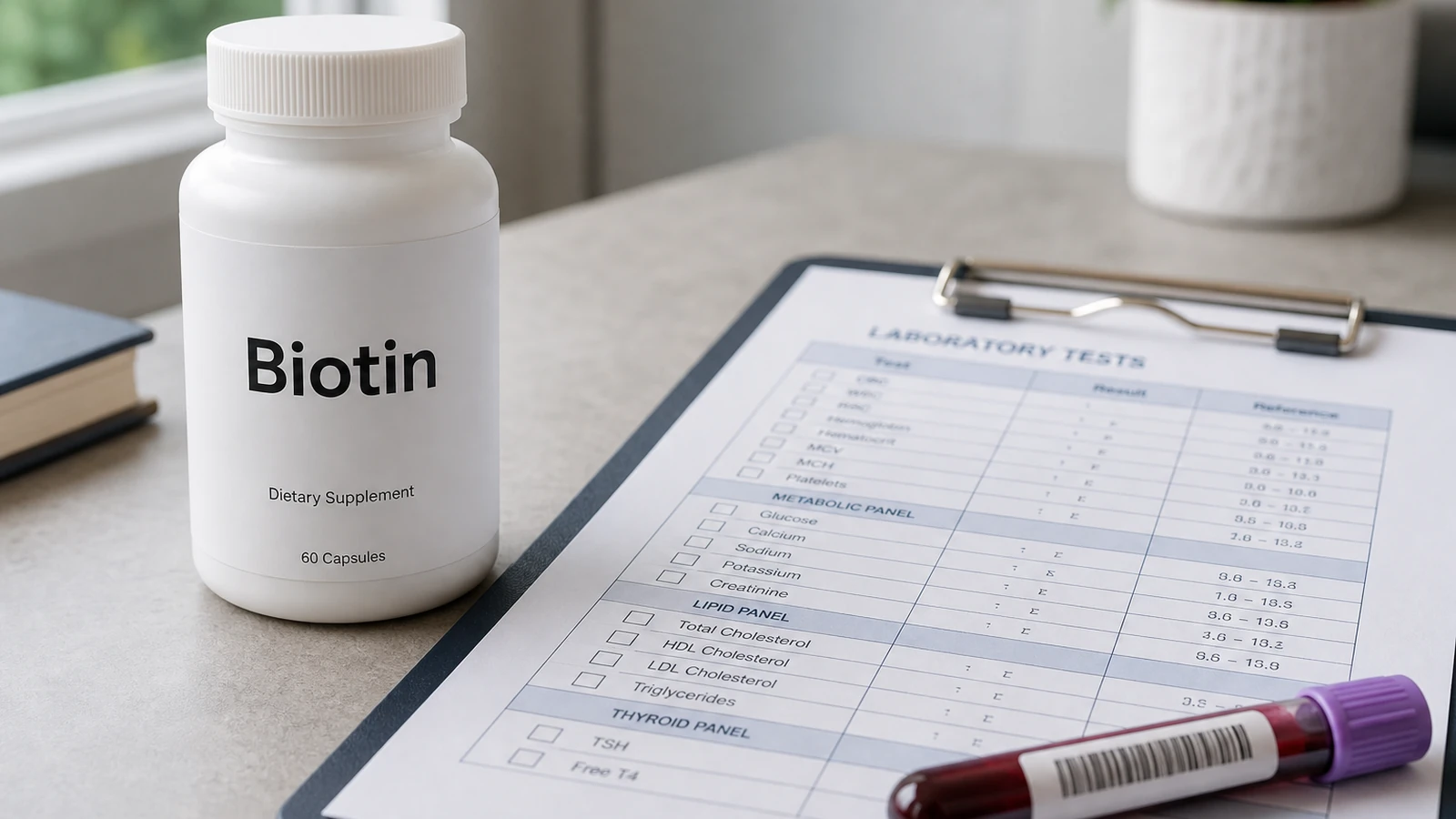
The Hair-Growth Supplement That Can Confuse Cancer Blood Tests
Table of Contents
A lot of people meet biotin in a very ordinary place: the hair, skin, and nails aisle.
After cancer treatment, that aisle can feel less ordinary. Hair thinning, brittle nails, and slow regrowth aren’t vanity problems when your body has already been through months of treatment (or years of follow-up reminders). So a vitamin promising stronger hair can look harmless, or at least worth a try.
But biotin has a quieter problem. It doesn’t appear to make chemotherapy stop working. It doesn’t “feed” cancer. The better-documented issue is stranger - and, in some ways, easier to miss: high-dose biotin can skew certain lab tests doctors use to monitor health during and after cancer care.
That means the action step isn’t panic. It’s disclosure. If you’re taking biotin, especially a high-dose hair/nail supplement, your oncology team and the lab need to know before blood work.
What biotin is, and why cancer patients may take it #
Biotin is vitamin B7, an essential nutrient found in foods and sold in supplements. The NIH Office of Dietary Supplements lists an adequate intake level for adults of 30 micrograms per day, which is a normal nutrition amount, not a beauty-supplement dose. Many hair, skin, and nails products are sold in much higher amounts, often measured in milligrams rather than micrograms.
And that’s where the mismatch starts.
True biotin deficiency is uncommon for most people eating a varied diet, according to NIH ODS. There are medical situations where biotin matters a great deal, including diagnosed deficiency and rare inherited metabolic disorders. Those aren’t the same as taking a high-dose beauty supplement because a bottle says it supports hair growth.
The evidence for biotin as a general hair-growth supplement is also thinner than the marketing suggests. A 2024 review in the Journal of Clinical and Aesthetic Dermatology found only a small eligible evidence base, and NIH ODS notes that evidence is insufficient to rate biotin’s usefulness for hair, skin, and nail health in people who aren’t deficient.
So, yes, the appeal is understandable. But the proof is limited - and the lab-test issue is real enough that oncology experts are now warning clinicians to ask about it.
The issue isn’t cancer treatment. It’s test measurement. #
This distinction matters, because the scary shorthand can get sloppy fast.
Biotin doesn’t directly change a PSA number, thyroid marker, hormone level, or tumor marker inside the body. The concern is that extra biotin circulating in the blood can interfere with how some lab tests measure those things.
Some immunoassays, a common type of blood test, use biotin-streptavidin binding as part of their test chemistry (basically, a lab version of two pieces designed to grab each other). If a person has a lot of supplemental biotin in their blood, that extra biotin can get in the way. Depending on how the test is designed, the result may come back falsely high or falsely low.
That’s not a small technicality. Doctors make decisions from lab trends. They compare new numbers with old numbers. They look for changes that match, or don’t match, symptoms.
And if the number is wrong, everyone may be looking at a distorted map.
The FDA has warned that biotin in dietary supplements can significantly interfere with certain lab tests and cause incorrect results that may go undetected. The FDA’s highest-profile concern has involved troponin tests used in heart-attack evaluation, where falsely low results can be dangerous. That isn’t a cancer-specific example, but it shows why the agency treats biotin interference as a patient-safety issue, not just a lab nuisance.
Why oncology teams are paying attention #
A recent JCO Oncology Practice caution for oncologists, along with Ohio State/ASCO Post coverage, focuses on a situation many cancer patients will recognize: taking biotin for hair or nail regrowth after treatment, then getting follow-up blood work.
Oncology care can involve tests for prostate, thyroid, ovarian, and breast cancer follow-up, as well as hormone monitoring, thyroid monitoring, and treatment side-effect checks. Not every test is affected. Not every lab platform is vulnerable in the same way. But patients usually can’t tell, from a standard lab order, whether a specific assay uses biotin-sensitive chemistry.
That puts the burden in the wrong place if nobody asks.
So the practical message is simple: bring biotin into the conversation. Mention it the same way you’d mention a prescription, an over-the-counter drug, a multivitamin, an energy supplement, or a “hair, skin, and nails” product (yes, even the gummy one that feels too minor to list). If the care team decides it matters for a planned test, they can tell you whether to pause it, for how long, or whether the lab can use a different assay.
Don’t guess the timing yourself. Some clinicians discuss holding biotin before planned blood work, but there isn’t a universal stop-for-72-hours rule that safely fits every test, patient, dose, and lab platform.
When biotin matters most #
The risk is most relevant when a lab result could change a clinical decision. That includes planned cancer surveillance blood work, thyroid tests, hormone tests, PSA testing, and cancer-marker testing where the assay is known or suspected to be biotin-sensitive.
It also matters when results don’t match the person in front of the doctor. A test that looks reassuring when symptoms suggest otherwise, or a test that suddenly looks abnormal without a clear reason, may need a second look. Worth knowing: biotin interference can push some results down and others up, so there isn’t one obvious pattern a patient can watch for.
Emergency care is its own category. If you have chest pain, shortness of breath, or symptoms that could suggest a heart attack, don’t delay care because you took a supplement. Seek emergency help and tell the clinicians about biotin when you arrive. The FDA’s troponin warning exists because that detail can matter.
Food biotin is not the problem #
This isn’t a reason to fear normal foods that contain biotin.
Eggs, nuts, seeds, meat, fish, and some vegetables can contribute biotin as part of a regular diet. The lab-test concern is mainly about supplemental biotin, especially higher-dose products marketed for hair, skin, and nails.
And even then, the right response depends on the person. Someone taking biotin because it was prescribed for a diagnosed deficiency or a metabolic disorder shouldn’t stop it on their own. Someone taking anticonvulsant medication should also ask a clinician about biotin status and supplementation, since NIH ODS notes interactions between anticonvulsant therapy and biotin status.
That may sound fussy, but it’s the whole point: biotin isn’t “bad.” Hidden biotin is the problem.
What to tell your doctor or lab #
Before blood work, say the boring thing out loud: “I’m taking biotin.” Include the dose if you know it, the brand if you have the bottle, and how often you take it. If it’s in a multivitamin, prenatal, beauty gummy, energy product, or hair-growth supplement, mention that too.
Then ask a direct question: “Could this affect any of the tests I’m having?”
Your clinician or lab may say no. They may ask you to hold it before a planned test. They may interpret a result with caution or repeat a test using a method less affected by biotin. The specific answer belongs to the team that knows the test, the lab platform, and your medical situation.
One more thing: don’t stop cancer treatment, thyroid medication, hormone therapy, anticonvulsants, or any prescribed medication because of biotin. This is about making lab results more reliable, not replacing medical care with supplement rules.
Bottom line #
Biotin’s reputation as a hair-growth helper is stronger than the evidence behind it for people who aren’t deficient. But its ability to interfere with some lab tests is well enough documented that cancer patients and survivors should treat it as relevant medical information.
The safest framing is also the least dramatic: biotin may skew certain tests used during cancer care. It doesn’t mean biotin starts cancer, and it doesn’t mean treatment stops working. It means your oncology team and lab should know what you’re taking before they interpret the numbers.
Bring the bottle. Ask the question. Let the lab-test advice be specific, not guessed.
Related

Glucosamine and Alzheimer's: A Caution Flag, Not a Panic Button
Berberine in 2026: What the Evidence Actually Shows (and What It Doesn’t)