How to Read a Supplement Label - What Proprietary Blends, Standardized Extracts, and Faded Claim Language Actually Tell You
Table of Contents
You’re standing in the supplement aisle, bottle in hand. The front label promises focus, vitality, immune support - all the things you came for. But flip the bottle around and you get a wall of small text, unfamiliar abbreviations, and ingredient names that read like a chemistry exam.
Most of us scan the front and hope for the best. Thing is, the back of the bottle - the Supplement Facts panel - is the part that’s actually regulated. It’s not perfect. It won’t tell you if a product works or if it’s risk-free for you. But it’s the closest thing to a legally structured information window you’re going to get before you buy.
Here’s how to read it without needing a nutrition degree - and, just as importantly, what it can’t tell you.
Start with the Supplement Facts panel, not the front-label promises #
Start with the basics most people miss.
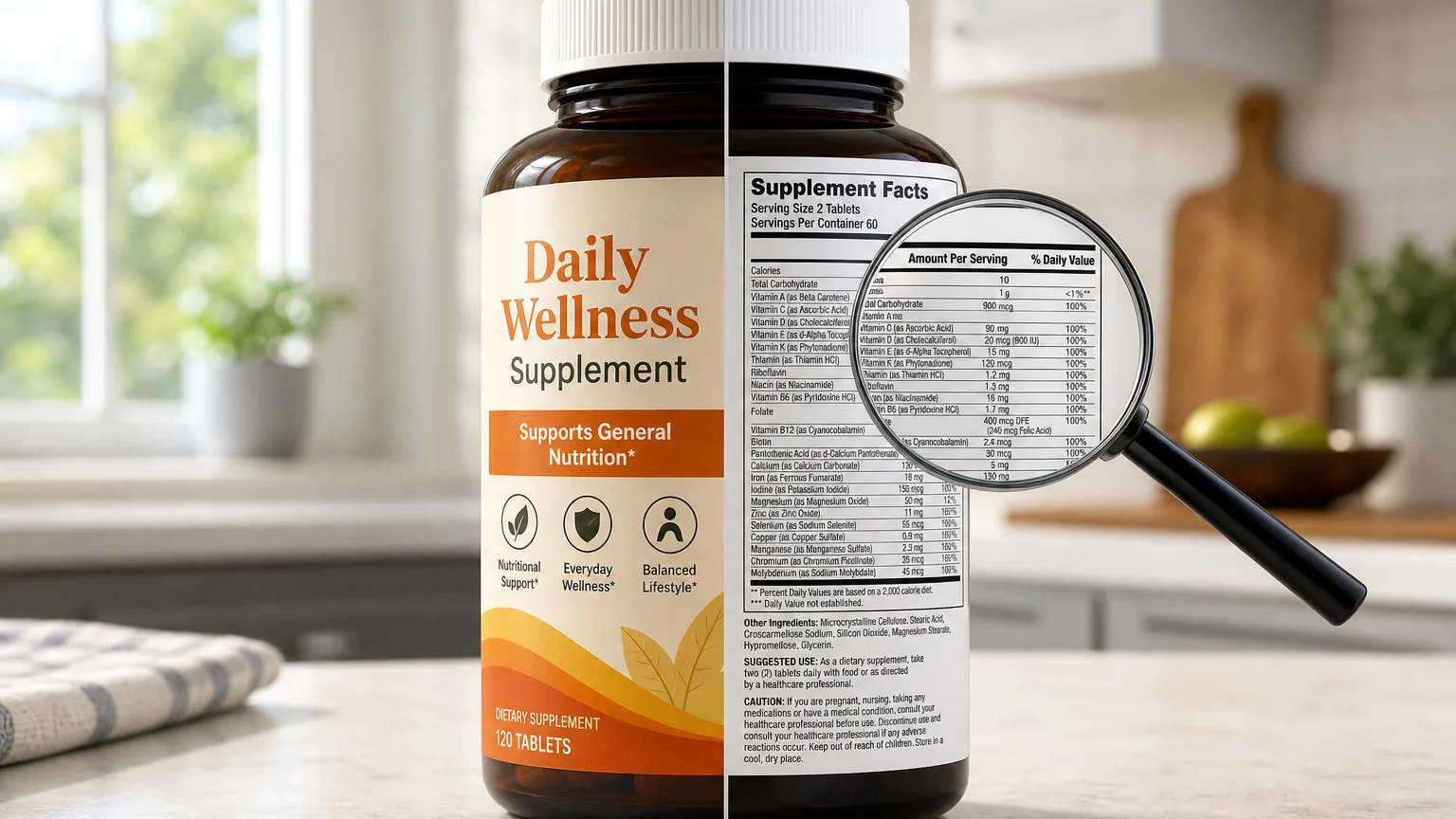
The Supplement Facts panel is basically the supplement version of the Nutrition Facts box on food. For most products, it has to list serving size, servings per container, and the amounts of each dietary ingredient per serving (FDA Dietary Supplement Labeling Guide, Chapter IV).
But here’s the catch - and this trips up a lot of people. The FDA doesn’t approve dietary supplements before they hit shelves the way it approves drugs (FDA Q&A on Dietary Supplements). “Sold in stores” isn’t a safety certification. What the panel gives you is structured ingredient information - useful, but limited.
The lines worth your attention #
Serving size comes first. Two capsules? Four? Six? The front label might say “200 mg” but if that’s per four-capsule serving and you take one, you’re getting a quarter of what’s listed. This sounds obvious - and yet it’s one of the most common misreads.
Amount Per Serving is where you look for actual numbers. If an ingredient lists milligrams, you have a quantity to work with. If the row is blank or reads “Daily Value Not Established,” that means the FDA hasn’t set a Daily Value for that ingredient - nothing more, nothing less. It doesn’t mean the ingredient is useless, and it doesn’t mean it’s dangerous. It means there’s no established benchmark to measure it against (FDA Dietary Supplement Labeling Guide, Chapter IV). Use it as a prompt to look further, not a verdict.
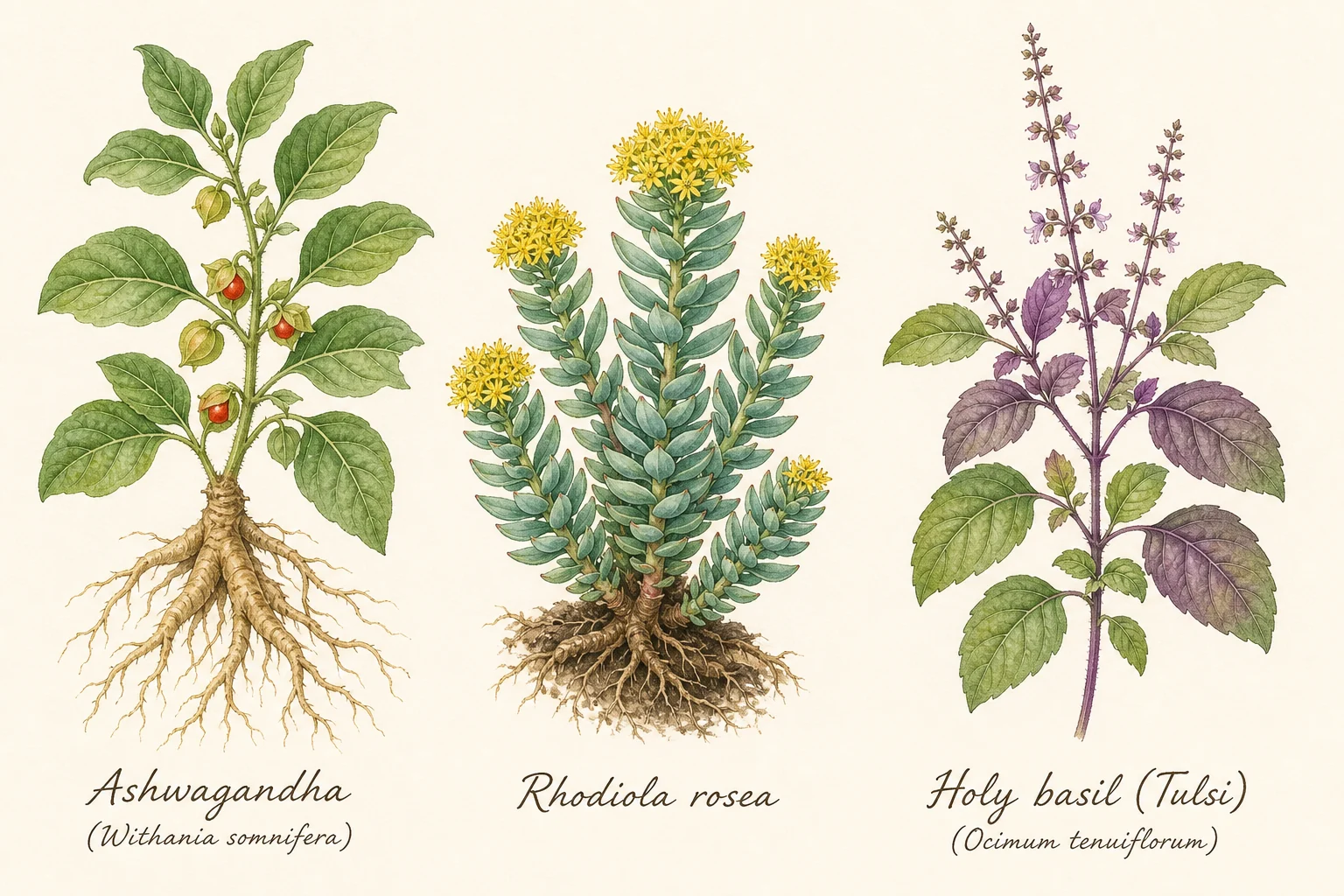
For botanicals, the plant part matters - root, leaf, seed, fruit, and extract are not interchangeable (FDA Dietary Supplement Labeling Guide). If the label says “ashwagandha root extract” that tells you something different from “ashwagandha leaf powder.” The FDA requires the Supplement Facts panel to list the plant part from which the ingredient is derived. If that detail is missing, you’re guessing about what’s actually in the bottle.
The proprietary blend problem #
Proprietary blends are legal - and they’re also the single biggest source of dose opacity on a supplement label. Here’s how they work:
A label for a “Focus & Energy Blend” might say: Proprietary Blend 750 mg. Ingredients: L-theanine, Rhodiola rosea root extract, caffeine anhydrous. The ingredients are listed in descending order by weight. But you don’t know how much of each you’re actually getting (FDA Dietary Supplement Labeling Guide, Chapter IV). Is it 500 mg of L-theanine and 50 mg of the other two? Or 50 mg of L-theanine and 350 mg of each of the others? The label won’t tell you.
This isn’t automatically a scam. A reputable company might have defensible reasons for blending. But from where you’re standing, in the aisle, with no lab equipment, the practical problem is straightforward: dose opacity. You can’t tell whether a studied ingredient is present at a comparable amount to what research used (Journal of Nutrition, 2023; PubMed 37004873). If you’re shopping for a specific ingredient at a dose you’ve seen in studies, a proprietary blend turns that comparison into guesswork.
The label must still disclose the total blend weight. That number is useful - if the blend total is 50 mg and it contains six ingredients, you know none of them individually can be more than 50 mg, and most will be well under. That’s still not the same as knowing individual amounts - you’d need a lab for that - but it’s a sanity check you can do in five seconds.
“Standardized extract” is a clue, not a guarantee #
So labels that say “standardized extract” are telling you that the manufacturer targeted a specific marker compound or ratio. That can be useful - it suggests someone was paying attention to consistency, at least on paper.
NCCIH warns that these terms don’t necessarily guarantee product quality or consistency, though (NCCIH, Using Dietary Supplements Wisely). Standardized to what? At what percentage? How many milligrams per serving? Was the testing credible?
Treat “standardized extract” as a prompt to ask those questions, not as a seal of clinical proof. If a label can’t answer them - if it just says “standardized” with no further detail - you’re looking at marketing language dressed as technical specification.
On the other side of the aisle, product testing tells a cautionary tale. One analysis of red yeast rice products found wide variability in the active compound monacolin, along with a kidney toxin called citrinin in about one-third of the samples tested (Archives of Internal Medicine, 2010; PubMed 20975018). That’s one product category, not all supplements - but it shows why label claims about amounts and quality can’t always be taken at face value.
Claim grammar: “supports” isn’t “treats” #
Supplement labels can’t legally claim to diagnose, treat, cure, mitigate, or prevent disease. Those are drug claims, and they’re off-limits for dietary supplements (NCCIH, Using Dietary Supplements Wisely).
What supplements can do is make structure/function claims - things like “supports immune health” or “promotes relaxation.” By law, those claims must carry a disclaimer: “This statement has not been evaluated by the Food and Drug Administration. This product is not intended to diagnose, treat, cure, or prevent any disease.”
If you see that disclaimer, don’t panic - it’s required, not a red flag by itself. But read “supports immune health” differently from “treats infection.” If a label slips into disease-treatment language without the drug-approval pathway behind it, that’s a warning sign (FTC Health Products Compliance Guidance). Similarly, if a brand leans on vague study references, testimonials, or “clinically tested ingredient” language without showing that the exact product and claim were actually tested in people, treat that as marketing rather than evidence.
Safety rules that labels won’t cover for you #
Even a well-labeled supplement isn’t necessarily safe for everyone. NCCIH flags several categories where supplements carry real risks (NCCIH, Using Dietary Supplements Wisely):
Medication interactions come first. Supplements can interact with prescription medicines, over-the-counter drugs, and other supplements. If you take anything, check with a pharmacist or clinician - the label won’t always surface interaction risks clearly.
Pregnancy, breastfeeding, and children: Many supplements haven’t been tested in these groups. The default assumption shouldn’t be “natural therefore safe.”
Chronic disease changes the equation: People with liver or kidney conditions, heart rhythm or blood pressure issues, bleeding disorders, or immune conditions should not self-navigate supplement choices. A clinician or pharmacist review is the right step.
Surgery and anesthesia introduce their own risks: some supplements can increase bleeding risk or affect how anesthesia works. NCCIH recommends telling your healthcare provider about every supplement you take well before any planned surgery.
Yet some product categories carry specific hidden-ingredient risks - and they’re worth knowing about before you buy. NCCIH warns that weight-loss, sexual-performance, and bodybuilding products have been found to contain prescription drugs or unlisted unsafe ingredients. Be extra cautious with extreme claims in these categories.
And if you do experience what you think is a harmful effect from a supplement? Stop, contact or see a healthcare provider immediately, and consider reporting it through the FDA’s Safety Reporting Portal (FDA Q&A on Dietary Supplements).
A five-point pre-buy scan #
You don’t need to memorize label regulations - just run a quick check before buying:
Serving size. Does the amount you plan to take match the listed serving?
Amounts. Can you see actual milligrams for the ingredients you care about, or are they hidden inside a proprietary blend?
Plant part and extract form. Does the label say root vs leaf, seed vs fruit, extract vs powder - or is it vague?
Claim language. Is the product making structure/function claims with the required disclaimer, or does it slip into disease-treatment territory?
Interaction check. If you’re on medication, pregnant, nursing, have a chronic condition, or have surgery planned - have you asked someone qualified before buying?
These five questions won’t tell you if the product works. They will tell you whether you’re making an informed choice or an uninformed one. For anything beyond label reading - whether a supplement is right for your health situation - that’s a conversation for a qualified health professional, not a shopping trip.
Bottom line, here’s what I’d tell a friend: the Supplement Facts panel is the most regulated thing on that bottle, so learn to read it. Don’t trust front-label promises. Treat “proprietary blend” as a dose-opacity flag, “standardized extract” as a question prompt - not a certification - and that FDA disclaimer as a reminder that supplements aren’t pre-approved drugs. And remember: natural doesn’t mean risk-free, “clinically tested ingredient” doesn’t mean the final product was tested, and no label, however well-written, replaces a conversation with someone who knows your full medical picture.
Related