Chamomile, Lavender, and Lemon Balm for Mood: What the Evidence Says — and What It Doesn't
Table of Contents
If you’re searching for something gentle to take the edge off stress or steady a low mood, chamomile, lavender, and lemon balm probably show up in every list you see. They’re the calm-down herbs — the ones friends mention, wellness sites recommend, and tea companies print on boxes. But if you’re also dealing with depression, the gap between what people say these herbs can do and what the evidence actually supports is a lot wider than most articles let on.
Before we go further: depression is a serious illness that affects how you sleep, eat, think, and function day to day. Herbs and supplements are not a substitute for diagnosis or treatment, and the National Center for Complementary and Integrative Health (NCCIH) explicitly warns against using complementary approaches to replace conventional care or to postpone seeing a health care provider. If your symptoms are persistent, worsening, or interfering with daily life, speak with a qualified health professional. And if you or someone you know may harm themselves or is in crisis in the U.S., call or text 988.
That’s not throat-clearing. It’s the most important thing in this article, and it belongs near the top.
So — what DOES the evidence say about chamomile, lavender, and lemon balm for mood? The short version: lavender has the strongest (but still limited) clinical signal, lemon balm looks promising but the research is thin, and chamomile’s evidence is mostly for generalized anxiety disorder, not depression. None of them are proven depression treatments.
Traditional use is real — but it isn’t clinical proof #
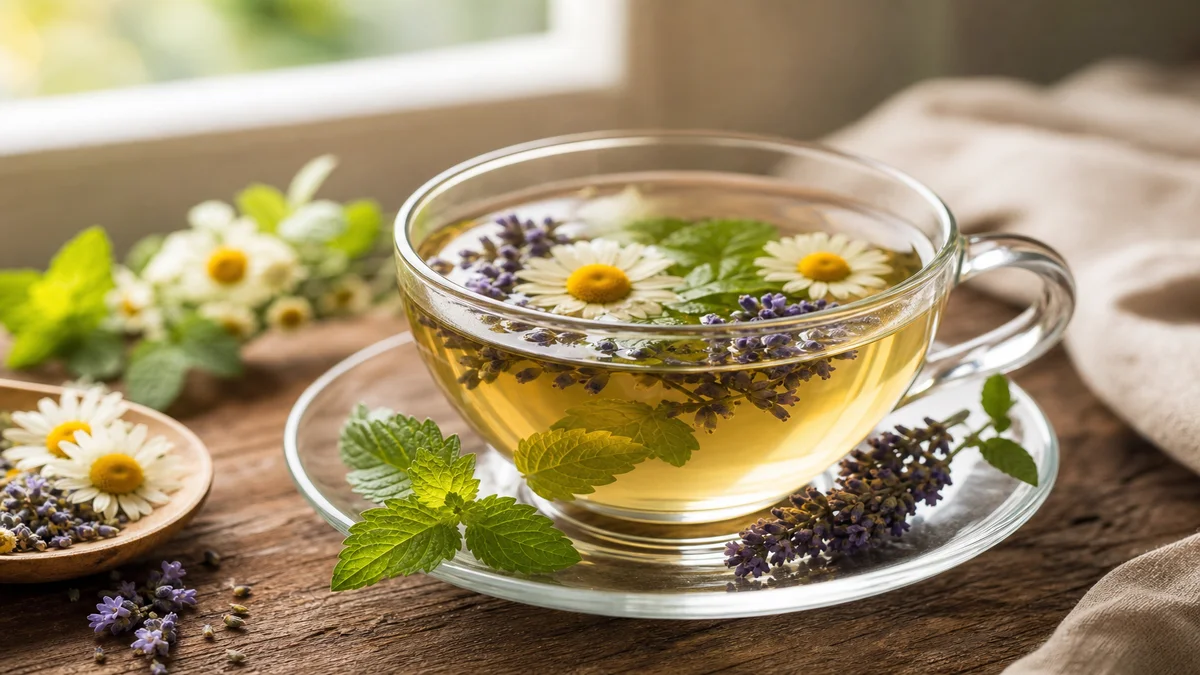
All three herbs have been used for centuries as calming remedies. Chamomile has a long folk-medicine history for sleep and relaxation. Lavender appears in traditional European and Mediterranean practices for nervous tension. Lemon balm (Melissa officinalis) has documented traditional use across Europe, the Mediterranean, and the Middle East for multiple conditions, with anxiety and nervous-system effects among the historically discussed uses.
Traditional use matters — it tells us these plants have been part of human health practices for a long time, and it’s often where modern research starts looking. But traditional use is not the same thing as clinical evidence. Plenty of traditional remedies don’t hold up under controlled study, and even the ones that do usually need stronger trials before anyone should call them proven.
Lavender: the most evidence of the three — with limits #
Of the three herbs, lavender has the most defensible clinical signal for mood and anxiety. But the details matter a lot more than the headlines.
The evidence centers mostly on oral lavender oil — particularly a specific product called Silexan, which is a standardized lavender oil preparation available in some countries. This is not the same thing as lavender essential oil from the health-food store, and (I cannot stress this enough) it is definitely not the same as lavender tea or aromatherapy. Different routes and formulations are not interchangeable, and assuming “lavender is lavender” is one of the most common mistakes in this space.
Here’s what the research landscape looks like. A 2019 systematic review and meta-analysis of lavender for anxiety found significant effects for both inhalation and oral Silexan, but the authors flagged low average study quality and high risk of bias (PubMed: 31655395). A 2021 meta-analysis looking specifically at lavender’s antidepressant effects found a positive pooled effect across studies — but called for larger, more rigorous, and more homogeneous trials before drawing firm conclusions (PubMed: 33549687). Another meta-analysis from 2021 reported anxiety and depression reductions in RCTs, though the authors noted depression-specific trials were scarce (PubMed: 34775136).
NCCIH, reflecting on this body of evidence, says an oral lavender oil product might help with anxiety — including anxiety that co-occurs with depression symptoms — but they’re careful to note the research has important limitations: small sample sizes, lack of independent funding and testing, and limited participant diversity. They also point out that topical lavender products don’t appear to affect depression symptoms.
At the guideline level, the WFSBP/CANMAT clinician guidelines — which synthesize evidence for nutraceuticals and phytoceuticals in psychiatric disorders — give lavender weak to modest support for unipolar depression and modest support for anxiety disorders. They stress that phytoceuticals should be used as adjunctive support within standard medical care, not as replacements. And they highlight quality and standardization as major limiting factors across the category (PubMed: 35311615).
Bottom line on lavender: there’s enough evidence to take it seriously, but not enough to present it as a stand-alone treatment for depression or anxiety. The product you use matters. The formulation you use matters. And it’s still in the “needs bigger, better trials” category.
Lemon balm: promising but preliminary #
Lemon balm has some of the more interesting mechanism research — lab and animal studies suggest possible effects on GABAergic, cholinergic, and serotonergic pathways (PubMed: 39458539). These are pathways involved in mood and calm, which helps explain why researchers are interested. But mechanism evidence is plausibility, not proof. A lot of things look good in the lab and don’t pan out in people. (If you’ve ever followed a promising supplement from “exciting animal study” to “no effect in humans,” you know this pattern well.)
On the human side, a 2021 systematic review and meta-analysis of lemon balm clinical trials found improved anxiety and depression scores compared to placebo, without serious side effects reported in the included studies (PubMed: 34449930). That sounds encouraging. But — and this is the kind of “but” that matters — the authors caution that the evidence base has high heterogeneity, a small number of clinical trials, and significant differences in methods across studies. A 2024 review reinforced that the mechanisms are plausible but more robust RCTs are needed (PubMed: 39458539).
There’s also a notable gap in lemon balm safety data. A major ethnopharmacology and pharmacology review (PubMed: 27167460) explicitly says that data remain limited for pharmacokinetics, adverse effects, potential interactions with standard medications, and active compounds. That’s not a red flag — it’s a “we don’t know enough yet” flag. For a herb that people sometimes assume is harmless because it’s in tea, that’s worth knowing.
Chamomile: GAD evidence, not depression evidence #
Chamomile is where the gap between public perception and evidence is widest. People reach for chamomile tea because they’re stressed, anxious, or can’t sleep — and the research that exists is almost entirely about generalized anxiety disorder (GAD), not depression. (And honestly, even the anxiety evidence is more contested than most tea-box marketing would have you believe.)
Back in 2009, a small placebo-controlled trial in mild-to-moderate GAD found chamomile extract produced a significantly greater reduction in anxiety scores — measured by HAM-A, for the study-design nerds — compared to placebo, with similar rates of people dropping out due to side effects. About 57 people were randomized, so you can see why nobody should build a treatment recommendation on this alone (PubMed: 19593179). A longer-term follow-up found chamomile looked safe and reduced GAD symptoms over time, but didn’t significantly reduce the relapse rate — which, for the record, was the main outcome the researchers were actually measuring (PubMed: 27912875). There’s also an exploratory analysis that hinted at possible mood benefits in people who had GAD along with depression symptoms, but — and I’ll say this plainly — this was a preliminary look, not a proper depression trial (PubMed: 31808709).
What does the bigger-picture evidence show? A 2019 systematic review and meta-analysis of chamomile RCTs found signals for GAD and sleep quality, weaker evidence for anxiety and insomnia generally, and only mild adverse events across just three trials (PubMed: 31006899). Meanwhile, the WFSBP/CANMAT guidelines don’t currently recommend chamomile for generalized anxiety disorder, and a 2022 network meta-analysis found insufficient evidence to confirm chamomile’s effectiveness versus placebo (PubMed: 35378276). That’s a polite way of saying the studies aren’t good enough yet to say it works.
So the state of chamomile evidence is genuinely mixed, even on the anxiety side — which is kind of wild when you think about how many people treat chamomile tea as the obvious go-to for stress. For depression specifically, there’s almost nothing. NCCIH’s official position is that preliminary studies suggest a chamomile supplement might be helpful for GAD and associated depression, but the overall clinical usefulness across conditions remains insufficiently established.
Safety: what to know before you try any of these #
“Natural” doesn’t mean risk-free, and all three herbs have safety considerations worth understanding — especially if you take medications, have allergies, or are pregnant or breastfeeding.
Chamomile #
Side effects are uncommon but can include nausea, dizziness, and allergic reactions — including severe hypersensitivity and, rarely, anaphylaxis. If you’re allergic to ragweed, chrysanthemums, marigolds, or daisies, you’re at higher risk (NCCIH). Chamomile may have estrogen-like effects, and there are theoretical concerns around birth control effectiveness and estrogen-sensitive conditions like breast or uterine cancer. Interactions — some reported, some theoretical — exist with warfarin, certain liver-metabolized drugs, and sedatives. Little is known about safety during pregnancy or breastfeeding (NCCIH).
Lavender #
At food amounts, lavender is likely safe. Short-term oral products at studied amounts might be safe, but adverse effects can include diarrhea, headache, nausea, or burping. Aromatherapy may cause headache or coughing. Topical lavender products can cause allergic skin reactions, and there are reports — causality unclear — of breast tissue swelling in children using topical lavender products (NCCIH). A theoretical interaction with sedative drugs or herbs exists, and it is especially relevant before surgery. Pregnancy and breastfeeding safety is largely unknown.
Lemon balm #
The 2021 systematic review reported no serious side effects in the clinical trials it included — but this doesn’t prove broad safety across all products or populations. The pharmacology review is explicit that interaction data, adverse-effect profiles, and pharmacokinetic information remain limited (PubMed: 27167460). For pregnancy, breastfeeding, thyroid conditions, sedative medication use, and pediatric populations, there is not enough safety data to make recommendations.
Who should be especially cautious #
If you take prescription medications — sedatives, antidepressants, blood thinners like warfarin, or anything metabolized by the liver — you should talk to a prescriber before adding herbs to the mix. Same goes for people with ragweed, daisy-family, or chrysanthemum allergies (chamomile cross-reacts), anyone with estrogen-sensitive conditions (the chamomile concern is theoretical, but worth flagging), and people scheduled for surgery (lavender has a sedative interaction risk that matters in an operating room). Pregnant and breastfeeding people should skip all three — the safety data just isn’t there. Same for children, and lavender specifically has those breast-tissue swelling reports that haven’t been fully explained. And anyone with severe, persistent, or worsening depression symptoms: herbs aren’t the answer here, and delaying proper care is a bigger risk than any herb is worth.
A word on supplements and regulation #
Dietary supplements in the U.S. are not FDA-approved for safety or effectiveness before they go on sale. That means the chamomile capsule you buy, the lavender oil you order, and the lemon balm extract on the shelf can vary substantially in what they actually contain, how potent they are, and how they’re manufactured. The FDA considers any supplement that claims to diagnose, treat, cure, or prevent a disease to be making an unapproved drug claim — so if a product says it treats depression, that’s a regulatory red flag as well as a safety one. Quality and standardization are real problems in this space, and even the guideline-level evidence from WFSBP/CANMAT flags them as major limiting factors for phytoceuticals.
How to think about calming herbs for mood #
If you’re considering chamomile, lavender, or lemon balm for mood or anxiety-related symptoms, here’s a reasonable way to think about them — not as a treatment plan, but as questions to work through with a qualified professional.
First: what’s actually going on? If your symptoms are mild, situational, and not impairing your ability to function, calming herbs might be part of a broader self-care approach — alongside sleep, movement, nutrition, and social connection. If symptoms are persistent, intensifying, or interfering with daily life, herbs should not be the first or only thing you reach for.
Second: which herb, which form, and what’s the evidence for that specific thing? Lavender as a standardized oral product (like Silexan) has more research behind it than lavender tea or aromatherapy. Chamomile tea is widely used but the clinical trials are mostly for concentrated extracts in GAD. Lemon balm’s evidence is the thinnest of the three, even though the mechanism research is interesting.
Third: what else are you taking? Herb-drug interactions are real and understudied. If you’re on any prescription medication — and especially if it’s a psychiatric medication, sedative, or blood thinner — don’t add herbs without checking with a prescriber or pharmacist.
Fourth: be honest about what you expect. None of these herbs are going to do what antidepressants do. They might help with mild stress, nervous tension, or low-level anxiety — and even then, the evidence is preliminary for most uses. If you’re looking for depression treatment specifically, the evidence simply isn’t there to support these herbs as primary options.
Bottom line #
Chamomile, lavender, and lemon balm are real plants with real traditional use and — in the case of lavender especially — some genuine clinical signals. But the evidence for mood and depression is not what most wellness content implies. Lavender has the most research weight, and even that sits in “promising but limited” territory. Lemon balm has early positive signals and big evidence gaps. Chamomile’s best evidence is for generalized anxiety disorder, not depression, and even the anxiety evidence is contested at the guideline level.
If you’re dealing with low mood, stress, or anxiety and want to explore calming herbs, do it with your eyes open: know which product and form has the evidence, know the safety considerations, know the gaps. And if depression is the actual concern — persistent low mood, loss of interest, changes in sleep or appetite, difficulty functioning — herbs are not a substitute for professional care.
In the U.S., if you or someone you know may harm themselves or is in crisis, call or text 988. It’s free, confidential, and available 24 hours a day. Outside the United States, Befrienders Worldwide (befrienders.org) maintains a searchable directory of emotional support helplines by country — there is likely a service available where you are.
Related