Creatine After 50: What the Evidence Really Says About Muscle, Memory, and Bones
Table of Contents
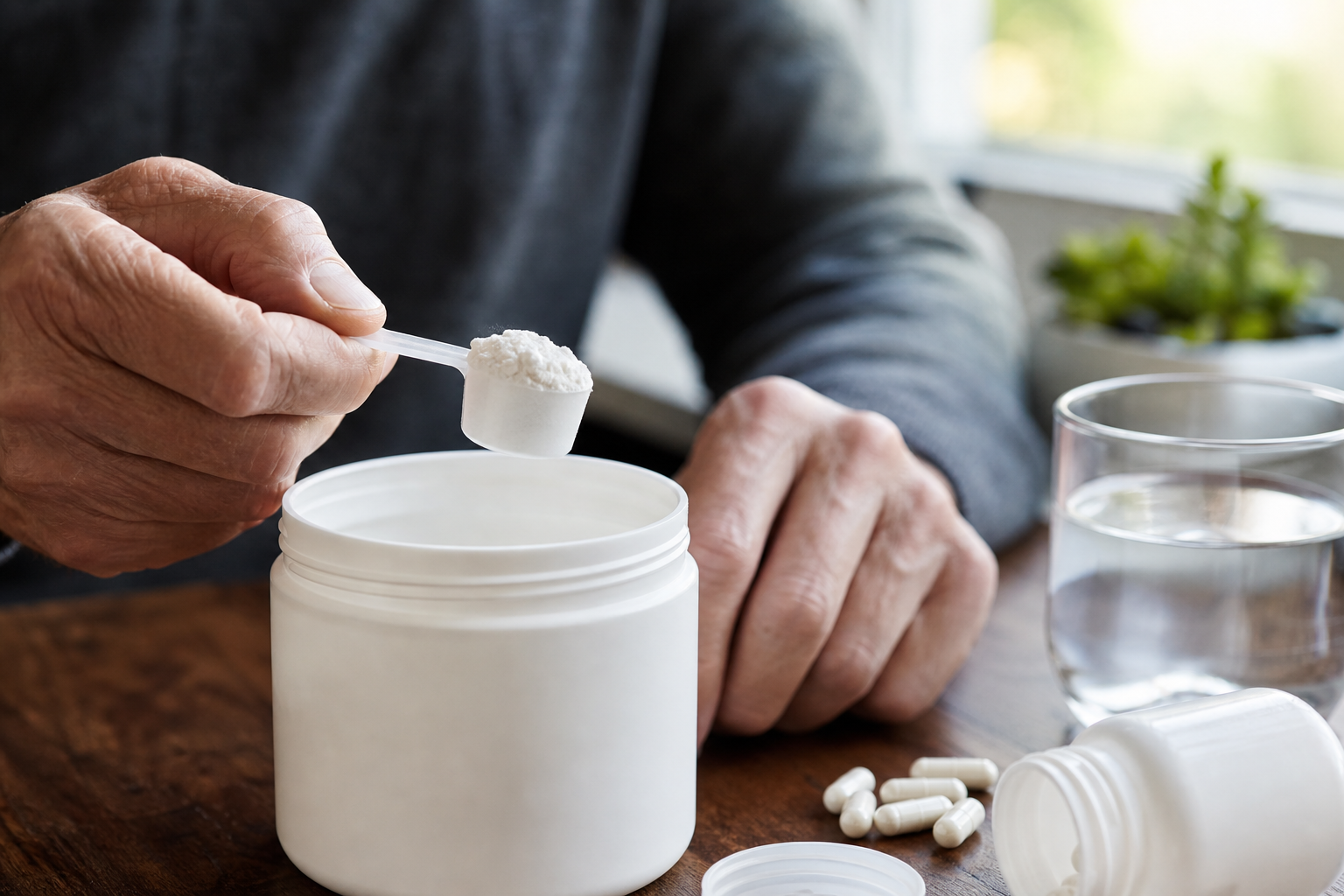
Creatine spent decades as a gym-supplement staple - the stuff people scoop into shaker bottles between sets. But lately it’s showing up in wellness newsletters, longevity podcasts, and supplement aisles next to collagen and CoQ10. The pitch: stronger muscles, sharper thinking, denser bones. One powder, three problems.
And honestly - that’s where the trouble starts. Because creatine for older adults isn’t a scam. But it isn’t the three-for-one anti-aging shortcut the marketing makes it sound like, either. The evidence is real, uneven, and very specific about when it helps and when it doesn’t. So what should you actually believe?
What creatine actually does #
Creatine is a compound your body makes naturally - mostly in the liver and kidneys - plus small amounts from meat and fish. Its job: replenish phosphocreatine, which cells use to regenerate ATP, the fuel for high-demand tissues like skeletal muscle and, to some extent, the brain. The International Society of Sports Nutrition position stand lays out that basic bioenergetic role clearly.
It’s not a hormone or herbal remedy. It’s a sports-nutrition compound researchers started testing in older adults because muscle and brain both decline with age.
Muscle and strength: the strongest evidence #
If you remember one thing from this article, make it this: creatine’s best-supported benefit in older adults only shows up when you pair it with resistance training.
A 2025 systematic review and meta-analysis found that creatine plus resistance training significantly improved muscle strength and lean tissue mass in older adults, especially in programs lasting up to 32 weeks. An earlier systematic review of randomized controlled trials reached the same broad conclusion: creatine can provide additive effects when combined with exercise, not on its own.
The key word is “plus.” Creatine didn’t replace the training. It added to it.
And the caution matters too. A broader meta-analysis of 33 randomized controlled trials with 1,076 participants found improvements in sit-to-stand performance, upper-body strength, handgrip strength, and lean tissue mass - but the researchers rated the evidence quality low or very low, largely because of risk of bias. Even positive findings come with a “don’t overinterpret this” sticker.
So the bottom line: creatine can modestly support strength and lean mass in older adults. But it’s a training partner, not a replacement.
Older women: strength before bone #
For postmenopausal women, there’s useful nuance. A systematic review and meta-analysis on postmenopausal women found that creatine - especially at higher daily doses with resistance training - produced small but meaningful gains in lean mass and strength. Bone density, though? Unchanged. Adverse events and kidney markers didn’t differ from placebo either.
Another review focused on older females concluded the same basic thing: strength benefits are more consistent than mass or bone benefits, and longer training matters more than supplement timing. So for older women, the evidence points toward strength support - and away from bone-building claims.
Brain and cognition: promising, not proven #
This is where the conversation runs ahead of the evidence. You’ll see creatine pitched as a brain booster for aging adults, and there’s a plausible reason - the brain relies on phosphocreatine for energy-demanding mental tasks like sustained attention or memory retrieval.
But in humans, the data is thin.
A systematic review on creatine and cognition in older adults found only six studies that met inclusion criteria. Quality ranged from good to poor. It noted limited evidence for possible memory and attention benefits and called for better trials before clinical conclusions. A memory-specific meta-analysis did find an overall benefit - stronger in older adults - but study heterogeneity was high, so the finding isn’t settled.
Practically speaking: if someone tells you creatine prevents dementia or reliably sharpens cognition, they’re either selling something or skipping the fine print. The memory signal is interesting. But it’s not a reason to buy a tub of creatine on its own.
Bone density: the claim to be most careful about #
Of the three big claims - muscle, brain, bone - bone density has the weakest case. And it’s worth saying plainly, because “creatine builds bone” is out there.
A 2-year randomized controlled trial in 237 postmenopausal women - exactly the kind of long study you want - found no effect on femoral neck, total hip, or lumbar spine bone mineral density. The trial did report some bone geometry and walking-time improvements as possible signals. But BMD - the standard clinical measure - didn’t move.
Another 12-month trial in older men found no greater effect on BMD, muscle, or strength versus placebo. A 1-year older-adult trial reported some favorable bone-area findings on CT scans, but geometry signals aren’t osteoporosis protection. Don’t let anyone collapse the two.
So: BMD evidence is null or mixed. Geometry signals exist and might be worth studying, but no major review has concluded creatine improves bone density in a clinically meaningful way. If bone health is your main concern, this isn’t the supplement for it.
Safety: well-studied, but not “safe for everyone” #
Creatine monohydrate has a substantial safety record - one of the better-studied supplements in sports nutrition. The ISSN position stand, reviewing decades of data, concluded there’s no evidence of adverse effects from short- or long-term use in healthy people.
But “well tolerated in research settings” isn’t the same as “safe for every 65-year-old on multiple medications.”
One thing that trips people up: creatine can raise serum creatinine because it breaks down into creatinine - the same marker doctors use to estimate kidney function. In a 2-year Parkinson disease trial, serum creatinine rose while other kidney markers like cystatin C stayed normal. Reassuring, but one trial in one population. Tell your clinician you’re taking it if you get regular blood work, so they don’t misinterpret a creatinine bump.
And the main side effects: GI complaints and water-retention weight gain. Not dramatic, but worth knowing.
Who should be cautious #
The National Center for Complementary and Integrative Health says anyone pregnant, nursing, giving supplements to a child, scheduled for surgery, or having side effects should involve a health professional. For older adults, talk to a clinician before trying creatine if you have kidney disease, reduced kidney function, diabetes, hypertension, Parkinson’s or another neurologic condition, heart disease, recent hospitalization, frailty, or complex medication use.
This isn’t a complete list - and that’s the point. If your medical picture has moving parts, the safest baseline is someone who knows your chart, not a supplement label.
The product-quality catch #
And one more thing people miss: dietary supplements in the U.S. aren’t FDA-approved for safety or effectiveness before hitting shelves. The FDA’s dietary supplement Q&A is explicit - manufacturers handle safety evidence and labeling, but rules differ from drugs and manufacturing standards are less strict. Not all powders are equal. Looking for third-party testing - NSF, USP, Informed Sport - is a few seconds well spent.
The real takeaway #
Creatine after 50 isn’t a bad idea. It’s just a narrower idea than the marketing implies.
The research is most convincing for modest strength and lean-mass support paired with resistance training. If you’re already lifting, or planning to start, creatine is one of the more evidence-supported additions - not a miracle, but not a waste of money.
For cognition, the signal is real enough to stay curious, but too thin as a standalone reason to supplement. And for bone density, the evidence isn’t there - the trials largely didn’t find it, and geometry signals need replication.
Nothing in this research replaces resistance training, adequate protein, fall-prevention work, osteoporosis evaluation, or medical care. Supplements add to what you’re already doing - they don’t substitute.
Before you try it: ask your clinician. Look for third-party-tested products. And if something feels off after starting - significant GI symptoms, rapid weight changes, unusual swelling - stop and contact your provider. For chest pain, shortness of breath, severe weakness, confusion, or signs of acute illness, seek urgent care. The research says creatine is generally safe. Your body gets the final vote.
Related