Curcumin, Ginger, and Boswellia for Arthritis Pain: What the Evidence Actually Says
Table of Contents
If you’ve got stiff, aching knees that make stairs feel like a negotiation, you’ve probably already heard someone suggest turmeric. Or ginger. Or boswellia — though that one tends to come up later, once you’ve been down the supplement rabbit hole a while.
And here’s the thing: these aren’t random wellness fads. All three have actual research behind them, and a fair number of people with osteoarthritis say they notice a difference. But — this is the part that matters — none of that research is strong enough to treat these supplements as replacements for standard arthritis care. And if you have rheumatoid arthritis, which is an entirely different condition, the conversation needs to go through a rheumatologist, not a supplement aisle.
So let’s walk through what the evidence actually says, keeping osteoarthritis (especially knee OA) and rheumatoid arthritis clearly separate — because the risk of getting that wrong isn’t small.
What Are These Three Supplements? #
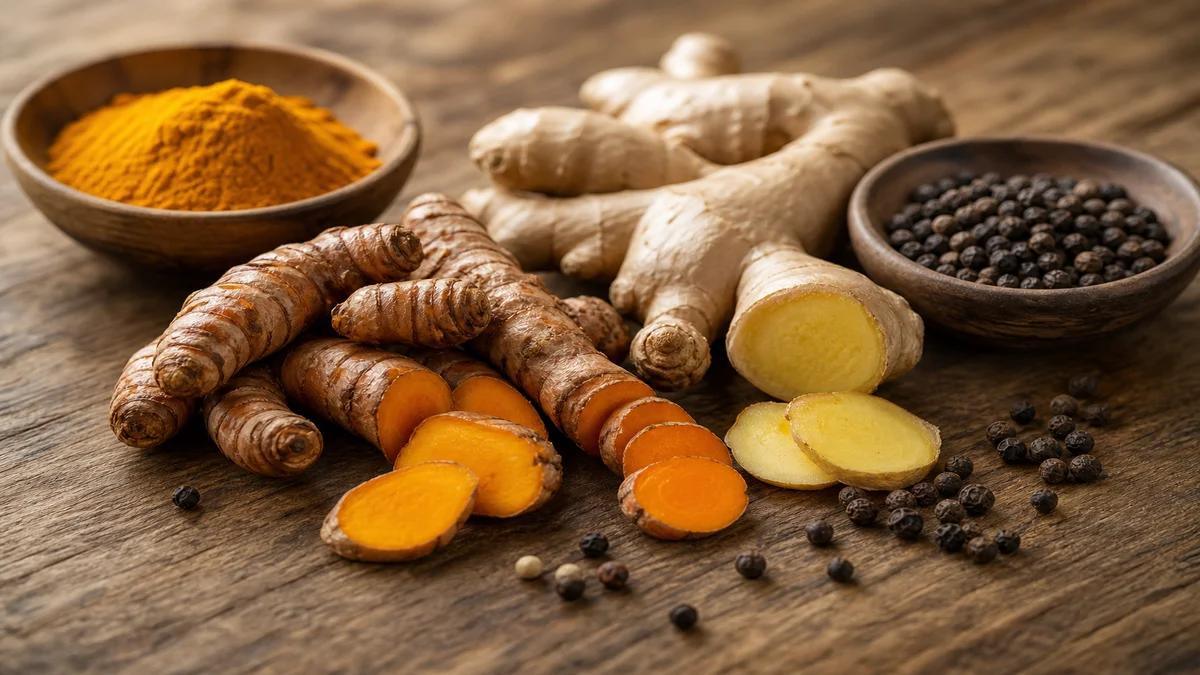
Turmeric — and its active compound curcumin — has centuries of use in Ayurvedic and Traditional Chinese Medicine for joint complaints and inflammation. Ginger’s been a folk-medicine staple for digestion and pain for equally long. Boswellia serrata, sometimes called Indian frankincense, is an Ayurvedic herb that’s been studied specifically for osteoarthritis symptoms.
Traditional use isn’t the same thing as clinical proof. It tells you these plants have been taken seriously for a long time — not that they work the way modern trials measure things.
Curcumin: The Most Encouraging Evidence — With Real Caution #
Of the three, curcumin has the strongest human research behind it. A 2021 systematic review and meta-analysis of 15 randomized controlled trials — that’s 1,621 people, mostly with knee osteoarthritis — found curcumin outperformed placebo on standard pain and function measures like VAS and WOMAC scores (PMID 34017975). A larger 2022 review covering 29 trials and nearly 2,400 participants across different arthritis types reported similar signals for pain and inflammation improvement (PMID 35935936). And a 2024 umbrella review — essentially a review of the reviews — confirmed the pattern, though it emphasized that the underlying studies still have quality problems (PMID 38576215).
So that’s the encouraging part. Here’s the part that tempers it.
The National Center for Complementary and Integrative Health — the NIH agency that evaluates this stuff — does not consider the evidence for curcumin definitive for any health purpose. Their position, and it’s worth quoting directly, is that despite the volume of study, the data isn’t there yet to make firm recommendations.
Then there’s the liver concern. NCCIH flags that highly bioavailable curcumin formulations — the kinds engineered for better absorption — have been associated with liver injury in some cases. If you experience fatigue, nausea, poor appetite, dark urine, or jaundice while taking a curcumin supplement, the advice is to stop and contact a health professional. This isn’t a theoretical warning; it’s on the official NIH consumer page for a reason.
And if you’re pregnant or breastfeeding: NCCIH says turmeric supplements during pregnancy may be unsafe, and safety above food amounts during breastfeeding isn’t well understood. A turmeric latte is not the same thing as a concentrated curcumin capsule — and the difference matters.
Ginger: Plausible, But the Evidence Is Thin #
Ginger’s story is more mixed. A 2020 systematic review of seven clinical trials looked at ginger capsules for knee osteoarthritis pain and function. The pooled data did show a pain reduction signal — but the function improvement wasn’t clearly significant, and the authors concluded that efficacy, optimal formulation, and safety all remained unclear (PMID 32214292).
NCCIH’s position matches that caution. Their consumer page says ginger supplements “might help” knee osteoarthritis symptoms — but immediately adds that much of the existing research is poor quality.
Worth knowing: ginger isn’t side-effect-free just because it lives in your kitchen. NCCIH lists abdominal discomfort, heartburn, diarrhea, and mouth or throat irritation as known oral side effects. People on blood thinners or other chronic medications should check with a health professional — herbs and medicines can interact in ways you won’t see coming.
Pregnancy and breastfeeding? NCCIH says ginger dietary supplements during pregnancy may be safe, but they still recommend consulting a health provider. For breastfeeding, there just isn’t enough safety information to make a call either way.
The bottom-line gap with ginger isn’t that the research says it doesn’t work. It’s that what we have isn’t good enough to say it does with any confidence — and the jump from capsule-form ginger studied in knee OA trials to, say, drinking ginger tea or using a topical ginger oil for every type of arthritis, is a bigger leap than the evidence supports.
Boswellia: Modest Signals, Uncertain Meaning #
Boswellia serrata has attracted less research attention than curcumin, but what exists is worth covering honestly. A 2020 systematic review and meta-analysis pooled seven trials with 545 participants and found improvements in pain, stiffness, and function scores versus controls (PMID 32680575). A 2024 review focusing specifically on knee OA reached similar conclusions (PMID 39314013).
But - and this is the persistent caveat across the evidence - NCCIH’s osteoarthritis page says Boswellia serrata may produce only “slight improvements” that patients might not consider meaningful. It also notes that little safety information is available for most herbal products used for OA, boswellia included.
That combination — small effect size plus limited safety data — means boswellia sits squarely in the “modest and uncertain” category. It’s not nothing. But it’s also not a reliable tool, and the research base is genuinely small compared to what you’d want before recommending something for chronic pain.
The Supplement Regulation Reality #
One thing that doesn’t get said enough in articles about natural pain relief: the FDA generally doesn’t approve dietary supplement claims or labeling before products hit the market. Manufacturers are responsible for safety and labeling — not the agency.
What that means in practice: a supplement being sold on a shelf doesn’t mean the FDA has verified that it works for arthritis pain or that it’s safe at the dose on the label. The FDA’s own consumer Q&A page explicitly advises talking with a doctor or pharmacist before using supplements, precisely because they can interact with medicines or other supplements. (And if you’ve ever wondered what “clinically studied” actually means on a supplement label — we covered that question in detail here.)
And there’s a specific warning worth knowing about if you’re looking at arthritis-pain supplements. Both NCCIH and the FDA have flagged that some arthritis and pain supplements have been found tainted with prescription drugs — hidden ingredients that can cause side effects or dangerous interactions (NCCIH Osteoarthritis and Rheumatoid Arthritis pages). Products making aggressive, miracle-sounding claims are the ones to be most suspicious of.
Safety and When to Ask a Professional #
A few situations where you really should involve a clinician rather than self-experimenting:
- You have rheumatoid arthritis or an autoimmune arthritis diagnosis. RA needs early medical treatment — DMARDs, biologics, or other prescribed therapies — to prevent joint damage and disability. Supplements don’t fill that role.
- You take blood thinners, diabetes medications, or any chronic prescription. Herb-drug interactions are real and understudied.
- You have liver disease or a history of liver issues — particularly relevant for curcumin.
- You’re pregnant, breastfeeding, or planning pregnancy.
- Your joint pain is getting worse, you’ve got unexplained swelling or heat in a joint, or you’re losing function. These are medical-evaluation signals, not supplement-shopping signals.
If you’re considering any of these supplements alongside your current care plan, the right move is a conversation with your doctor or pharmacist — not a substitution.
The Bottom Line #
Curcumin has the most encouraging evidence for short-term osteoarthritis symptom relief — particularly knee OA — but the evidence isn’t definitive, and liver safety concerns with enhanced-absorption formulations are real. Ginger is plausible but the research quality is weak, and the GI side effects aren’t trivial. Boswellia has some trial signals, but NCCIH frames the benefit as slight and the safety data as thin.
None of these three reverse arthritis, rebuild cartilage, or replace exercise, weight management, physical therapy, or prescribed pain medication — all of which are the actual first-line standard of care for osteoarthritis. They might offer modest additional symptom support for some people, discussed with a clinician. They aren’t cures, and they aren’t a reason to delay medical treatment.
And if what you’re dealing with is rheumatoid arthritis and not osteoarthritis, the evidence here doesn’t apply, and the priority is early rheumatology care — not natural pain relief.
Related
Fish Oil for Heart and Brain Health: What the Cochrane Evidence Really Says