Psoralea Corylifolia Has a Bone-Health Signal. The Liver-Risk Problem Comes With It.
Table of Contents
A traditional bone herb can have a real research signal and still be the wrong thing to self-prescribe.
That is the uncomfortable story with Psoralea corylifolia, also called Fructus Psoraleae, bakuchi or babchi, and Bu-gu-zhi. It has a long traditional-use history, including use around bone-related complaints, and researchers have found plausible bone-health mechanisms in cell and animal work. A 2026 Journal of Ethnopharmacology review/meta-analysis even reports a bone mineral density signal in postmenopausal osteoporosis research (2026 Journal of Ethnopharmacology review).
But the same research conversation keeps running into the liver.
So this isn’t a consumer article about “natural osteoporosis support.” It shouldn’t be read as a dose guide, shopping guide, or reason to delay a DXA scan. The more useful takeaway is narrower: Psoralea corylifolia is a good example of why a promising lab or review-level signal doesn’t automatically translate into a safe supplement decision at home.
What Psoralea corylifolia is #
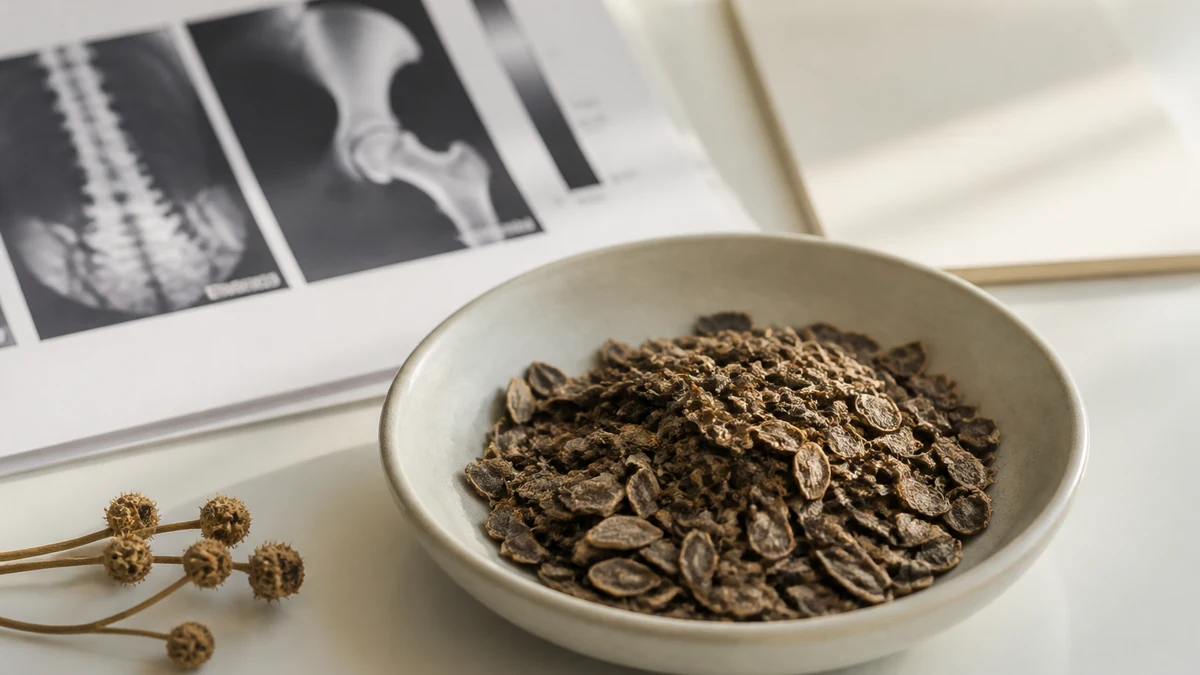
Psoralea corylifolia is a medicinal plant used in traditional systems, especially in Chinese medicine and Ayurveda. Reviews describe it under names such as Fructus Psoraleae, Bu-gu-zhi, bakuchi, babchi, Boh-Gol-Zhee, and related spellings, with traditional uses ranging from skin disorders to kidney-yang deficiency, waist and knee pain, urinary symptoms, diarrhea, and bone-related disorders (Chinese Medicine background review; 2026 Journal of Ethnopharmacology review).
Traditional use matters as cultural and historical context. It doesn’t, by itself, prove that the herb treats osteoporosis, prevents fractures, or is safe for modern supplement use.
And the product question gets messy fast. Whole seeds, processed herb, extracts, isolated compounds such as psoralen or bakuchiol, and multi-herb formulas are not interchangeable. A study material is not automatically the same thing as a capsule, tea, powder, or imported formula sold online.
Why researchers are interested in the bone signal #
There is a plausible bone-health story here. Cell work has reported that psoralen and bakuchiol can influence osteoclast differentiation and bone-resorption pathways, including AKT and AP-1 signaling (Cellular Physiology and Biochemistry in vitro study). Rat studies using ovariectomized models have reported improvements in bone mineral density or bone-loss markers after exposure to Psoralea corylifolia extract or bakuchiol (2007 ovariectomized-rat study; 2008 rat and in vitro study).
That’s interesting. But it’s also easy to misuse. Rats with induced bone loss are not postmenopausal patients deciding whether to start an herb. Cell pathways are not fracture outcomes. And bone mineral density movement in preclinical or mixed evidence doesn’t mean a person has lowered their hip-fracture risk.
The 2026 review is the new reason to talk about the herb. The authors assessed efficacy and hepatotoxicity in postmenopausal osteoporosis research, including 23 efficacy studies and 7 toxicity studies, and reported positive bone mineral density and trabecular microarchitecture findings while also modeling liver-safety outcomes and human-equivalent dosing across animal data (2026 Journal of Ethnopharmacology review).
But even there, the authors framed the proposed benefit-risk window as preliminary and pending further human validation. In plain English: a research window is not a supplement label.
The liver-risk problem isn’t cosmetic #
Here is where the article has to stay blunt: liver injury is the central safety issue with Fructus Psoraleae.
A 2022 safety review in Chinese Journal of Natural Medicines described liver injury as the predominant Psoraleae Fructus-related adverse reaction and discussed possible pathways involving bile-acid transport and metabolism, oxidative stress, mitochondrial damage, impaired liver-cell regeneration, and inflammatory responses (2022 Psoraleae Fructus safety review; publisher page). A 2024 zebrafish toxicology study pointed in the same liver-risk direction, with liver-enzyme and bile-acid/lipid-pathway disruption signals after exposure (2024 zebrafish hepatotoxicity study).
Case reports can’t tell us how often this happens. They can, however, show why “watch your liver” isn’t enough as a throwaway warning.
One BMC case report described acute cholestatic hepatitis after Qubaibabuqi tablets containing Fructus Psoraleae, followed by fatal acute liver failure and multiple organ dysfunction (BMC case report). A 2024 case report described bakuchi-induced acute-on-chronic liver failure in a person with underlying chronic liver disease (2024 bakuchi acute-on-chronic liver-failure case report).
That doesn’t mean every person who takes a Psoralea product will develop liver failure. It does mean severe outcomes are part of the safety record.
Supplement rules make the uncertainty bigger #
In the United States, dietary supplements aren’t FDA-approved for safety and effectiveness before marketing. FDA says manufacturers are responsible for making sure products are safe and properly labeled, and serving sizes are generally set by the manufacturer, not standardized by FDA (FDA dietary-supplement Q&A).
And disease claims are a hard boundary. A supplement label can use certain structure/function wording, but it can’t legally claim to diagnose, treat, cure, or prevent disease. “Supports bone health” is not “treats osteoporosis.”
NCCIH gives the practical consumer warning that supplement products can differ from products tested in studies, can interact with medicines, and can carry extra risks for people with medical conditions, during surgery, in pregnancy or breastfeeding, and in children. It also notes that rare supplement-related liver damage can be severe or fatal (NCCIH supplement-safety guidance).
With a hepatotoxicity-flagged herb, those general rules aren’t background noise. They’re the whole risk problem.
Who should be especially cautious #
Anyone with liver disease, abnormal liver tests, hepatitis history, heavy alcohol use, previous supplement-related liver reactions, or regular medication use should not treat Psoralea corylifolia as a casual experiment. The same caution belongs around pregnancy, breastfeeding, children, planned surgery, and people taking multiple chronic medications.
Medication interactions are another unknown. This research pass did not establish a clean, article-ready interaction list for Psoralea corylifolia. So don’t guess. If someone is considering any Fructus Psoraleae or bakuchi product, they should disclose it to a clinician or pharmacist, especially if they’re taking liver-metabolized drugs, osteoporosis medication, hormone-related therapy, blood thinners, immunosuppressants, or several medicines at once.
And if someone using any supplement develops jaundice, dark urine, pale stools, severe fatigue, nausea or vomiting, itching, right-upper-abdominal pain, confusion, easy bruising, swelling, or other worrying symptoms, they should stop the product and seek medical care urgently. That’s not a diagnosis - it’s a safety line.
Bone loss belongs in clinical assessment #
If osteoporosis, osteopenia, menopause-related bone loss, or fracture risk is the concern, the next step is not a self-directed herb trial.
USPSTF recommends screening women 65 and older for osteoporosis, as well as postmenopausal women younger than 65 who are at increased risk (USPSTF osteoporosis screening recommendation). Primary-care guidance and patient-facing medical sources center DXA/DEXA testing, fracture-risk assessment such as FRAX, lifestyle measures, calcium and vitamin D adequacy when appropriate, fall-risk reduction, and evidence-based medication when fracture risk is high (AAFP osteoporosis review; Mayo Clinic diagnosis and treatment guidance).
Worth knowing: Mayo Clinic also notes that diet, exercise, and lifestyle changes alone are not effective treatment for higher-risk or advanced osteoporosis. So adding an unvalidated herb with liver concerns doesn’t fix the gap.
The practical question is simple: are you looking at Psoralea corylifolia as a research topic, or are you trying to use it instead of care?
If it’s the first, the bone signal is worth watching. If it’s the second, slow down and get proper assessment.
Bottom line #
Psoralea corylifolia has more going on than a random supplement trend. Traditional use, cell mechanisms, animal data, and a 2026 review/meta-analysis all point to a bone-health signal that researchers may reasonably want to study further.
But that signal does not make the herb a safe osteoporosis treatment, a fracture-prevention tool, or a consumer dose recommendation. The liver-risk literature is too serious, the human validation is too unresolved, and supplement products are too variable to turn this into self-treatment advice.
So the best AMZ read is safety-first: respect the research question, don’t inflate it into a remedy. Bone-density concerns belong with DXA/FRAX-informed care and a qualified clinician, not a liver-risk herb experiment bought off a label that says “supports bone health.”
Related

Stanford's Five Supplement Myths, Turned Into a Safer Buying Checklist

Akkermansia Is Interesting Microbiome Science, Not a GLP-1 Shortcut