Tai chi or aerobic exercise for fibromyalgia? The trial's answer needs a second look
Table of Contents
A 2018 trial of 226 adults with fibromyalgia found a statistically better result for tai chi than for aerobic exercise. It also found something less headline-friendly: every group improved, and the average gap in the main comparison fell short of the researchers’ own estimated benchmark for a noticeable difference. A particular tai chi schedule did better by a wider margin. Those aren’t interchangeable findings.
If you’re choosing a movement class while pain and fatigue keep changing the rules, the useful question isn’t whether tai chi has won an exercise contest. It’s whether this evidence gives you a reasonable option you could actually attend - without pretending that one trial settles what works best for everyone.
What the comparison measured #
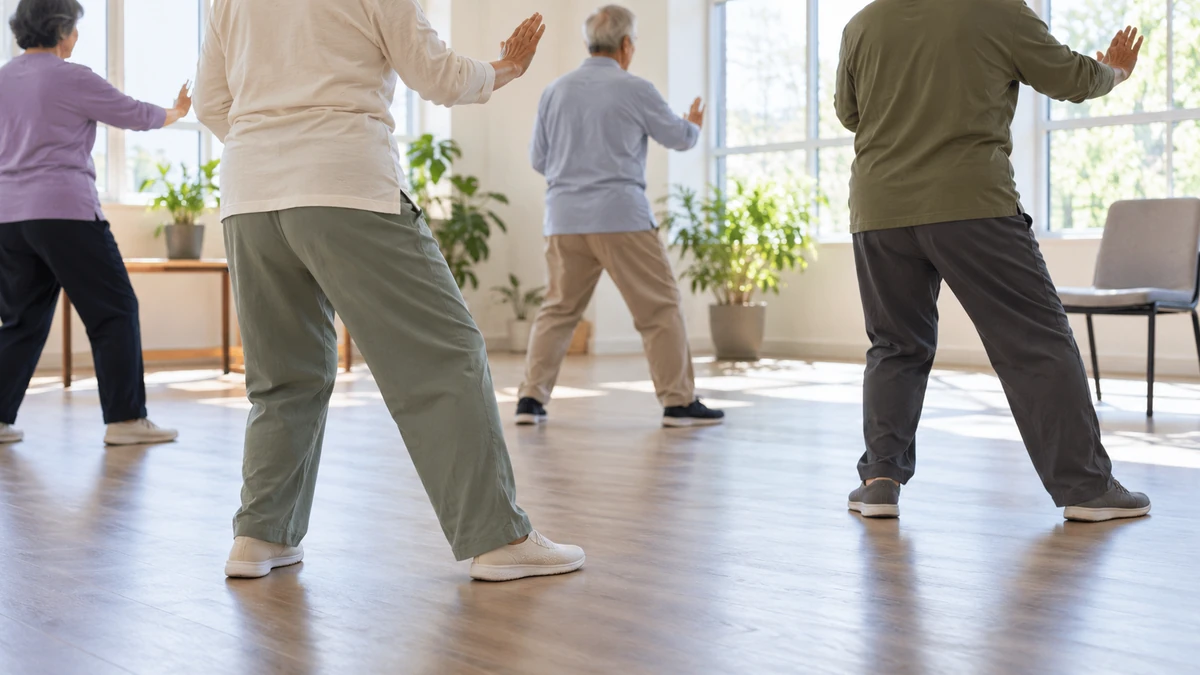
The BMJ study assigned 151 adults to one of four supervised Yang-style tai chi schedules and 75 to a supervised aerobic exercise program. Tai chi classes ran once or twice weekly for either 12 or 24 weeks; aerobic classes ran twice weekly for 24 weeks. Both programs involved encouragement to be active at home and calls to support participation. This wasn’t a test of a single video against a gym membership.
Its main measure was the Revised Fibromyalgia Impact Questionnaire, or FIQR. Scores run from 0 to 100, with lower scores reflecting less overall impact from symptoms and difficulties with functioning. It’s a composite score, not a pain rating. That matters when you hear someone say tai chi “reduced pain by 5.5 points” - the trial didn’t measure that particular number as a standalone pain drop.
At 24 weeks, FIQR scores had improved from baseline in all five groups. And the comparison was between active, supported programs, not between tai chi and doing nothing. The investigators who assessed outcomes were blinded to group assignments, but participants knew which classes they were taking; the FIQR was self-reported. Those design details make the results useful without making them immune to expectations or differences in participation.
The small average gap and the larger matched-schedule gap #
Pooling the four tai chi groups, researchers found a 5.5-point greater FIQR improvement than in the aerobic group at week 24 (95% confidence interval 0.6 to 10.4; P=0.03). That is a statistical difference in the trial’s primary comparison. But the authors estimated that an 8.1-point FIQR difference would be clinically important, using an extrapolated benchmark. The 5.5-point average didn’t reach it. Nor does a benchmark tell us exactly what any one person would feel.
Here’s the number that can change the headline: comparing the 36-person tai chi arm scheduled twice a week for 24 weeks with the 75-person aerobic arm on the same planned schedule produced a 16.2-point FIQR difference favoring tai chi (95% confidence interval 8.7 to 23.6). That’s a substantial-looking gap - and it’s one arm-to-arm comparison within the same single-center trial, not an independent repeat of the finding. Matching the calendar didn’t match how many sessions people actually attended, or prove the activities involved equivalent exertion. See the trial’s schedule and results.
So why not just quote 16.2 and call it settled? Across the trial, participants attended 62% of possible tai chi sessions versus 40% of aerobic sessions. Perhaps a class people will turn up for is part of its value in real life. Yet these data don’t prove attendance caused the difference; preference, expectations, the activity itself and other features of a supported class could all matter. The trial wasn’t designed to prise those pieces apart. The authors also reported that only 181 of 226 participants returned at 24 weeks, and one analysis that filled in missing data shifted the main comparison to P=0.08. Other sensitivity analyses were broadly consistent, but the primary statistical signal wasn’t equally firm under every assumption.
Longer participation looked promising within this study: the 24-week tai chi schedules did better than the 12-week schedules at week 24, though that advantage diminished at week 52. The researchers didn’t find a statistically significant once-versus-twice-weekly difference at week 24. Neither finding establishes a dose of tai chi to prescribe, or proves one weekly class is equivalent to two. These are trial-arm observations, not a home-practice recipe.
What the wider evidence does - and doesn’t - add #
A 2019 review of six randomized trials involving 657 participants reported favorable signals for tai chi on fibromyalgia impact, pain, sleep, fatigue and other measures. It strengthens the case for considering tai chi as a symptom-management option, particularly against standard care. But it doesn’t give us six fresh confirmations of the 226-person head-to-head result. The review authors specifically called for larger, higher-quality multicenter studies to establish whether tai chi is better than conventional therapeutic exercise.
And established care guidance hasn’t thrown exercise out. In the EULAR recommendations, exercise was the only therapy with a strong-for recommendation in that evidence review; meditative movement had weaker support. A 2023 AAFP clinical overview places gradual exercise, education and individualized care together, and includes tai chi as a possible complementary approach. The practical reading is not “tai chi instead of exercise.” Tai chi is itself movement, and it may be one way to find a sustainable place for movement in a broader plan.
We also don’t know which part of the supervised class did the work. The slow movements, breathing, attention, instructor contact and group setting arrived as a package (and the trial had no sham class to isolate one ingredient). Tai chi’s traditional roots explain what the practice is, not why it might help this condition. NCCIH describes its movement and meditative elements, but neither tradition nor a plausible mechanism can substitute for a clinical comparison.
A safety check before you sign up #
In the 226-person trial, eight intervention-related adverse events occurred in tai chi groups and four in the aerobic group, mostly minor musculoskeletal problems. Ten serious events occurred, but none were judged related to the interventions. That’s reassuring within a selected, supervised study - not a promise that tai chi is risk-free. The trial excluded pregnancy or planned pregnancy and serious conditions that could limit participation, among others.
If ordinary aerobic exercise leaves you in a flare, talk with your clinician or physical therapist about what movement you can tolerate and how to build up gradually. Ask a qualified instructor whether they can adjust standing time, turns, range of motion or pace. This is a sensible adaptation, not a protocol proven by the trial. AAFP’s management guidance favors gradual activity and notes that exercise can initially increase pain; persistent or markedly worse symptoms merit a discussion with your care team. And if you have significant heart, joint, mobility or balance concerns, dizziness, a recent injury or surgery, or an unstable condition, get individual advice before joining a class.
Pregnant? NCCIH says tai-chi-specific pregnancy safety studies haven’t been published and recommends checking with a health care provider before starting. This fibromyalgia trial offers no special assurance during pregnancy or breastfeeding. Don’t change prescribed medicines or delay assessment to try a class; participants in the trial continued usual medicines and clinician care, and the study didn’t establish tai chi as a way to reduce medication. New or changing severe symptoms, fainting, chest pain or weakness call for medical evaluation rather than being put down to fibromyalgia.
The choice the study can help you make #
I’d take the trial as permission to ask about tai chi, not as an instruction to abandon aerobic activity. If a supervised tai chi class feels more manageable (or you’re more likely to keep going to it), that matters when weighing options with your care team. But this study can’t tell you that an unsupervised routine will reproduce its results, or that everybody will prefer the same class.
The average head-to-head gap was statistically significant yet below the authors’ estimated clinical-importance mark; the schedule-matched gap was larger, with unequal attendance and incomplete follow-up still in view. And the six-trial review left superiority over conventional exercise open. Choosing movement that fits your symptoms and life is a more defensible goal than crowning a universal winner.
Related