Music During Cancer Care: What a Therapist Does That a Playlist Doesn't
Table of Contents
You’re waiting for an infusion and someone offers you headphones. Or your cancer center has a music therapist. Are those two versions of the same thing? Not quite. Both might make a difficult appointment easier, but the research treats them differently - and neither is a treatment for cancer itself.
The useful question isn’t whether music is good for you in the abstract. It’s what kind of music support is being offered, for which symptom, and whether the evidence behind it actually fits your situation.
A session isn’t a playlist #
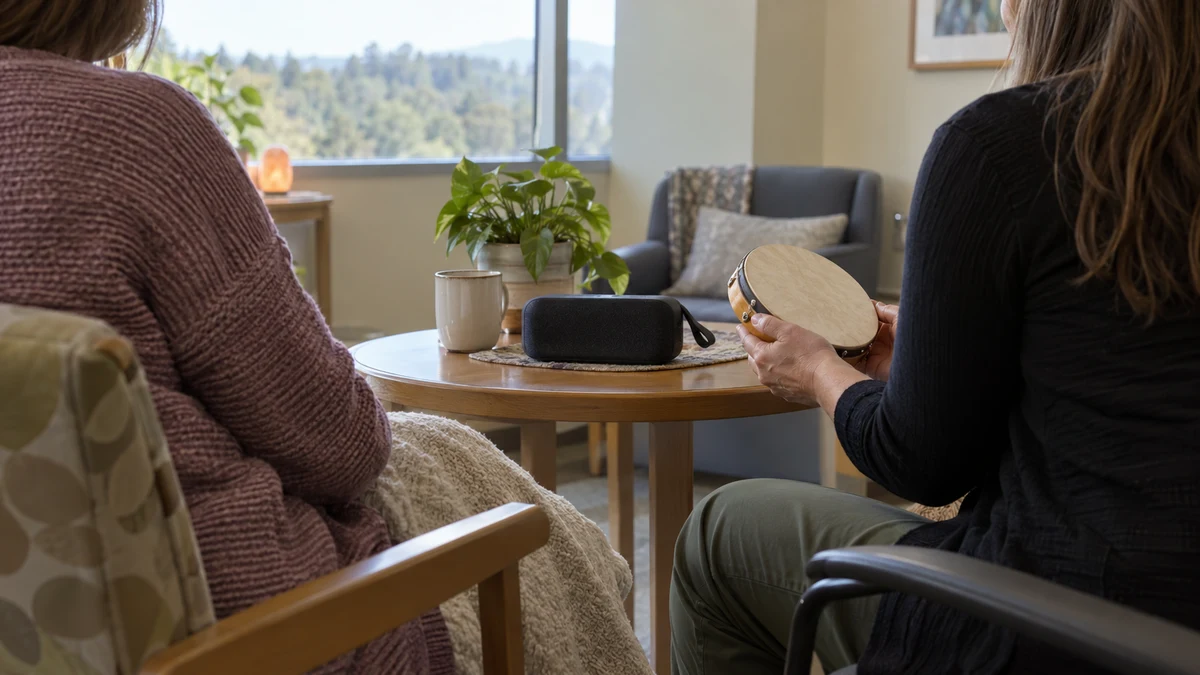
In the 2021 Cochrane review of music interventions in cancer care, music therapy meant work with a trained music therapist, a therapeutic relationship and experiences tailored to the patient. That could involve listening, making music or talking about the response to it. The review’s other category, music medicine, meant prerecorded music offered by medical staff. NCCIH likewise distinguishes professional music therapy from other uses of music for health.
And then there’s your own playlist at home. That’s a perfectly reasonable thing to enjoy if you want to, but it’s not automatically either of the studied interventions. The distinction matters most when a headline says “music therapy” and the actual study involved recorded listening. Names can blur; the person delivering the intervention and what happens in the room tell you more.
A therapist can respond if a song brings up grief rather than calm, for instance, or if you don’t want to listen at all. A recording offered before a procedure can’t provide that back-and-forth. That’s a description of how the experiences differ, not proof that the therapist-led one produces a better outcome for every patient.
Because the names are so easy to mix up, it’s worth asking what the session actually involves (and who leads it) before assuming the research describes what you’ve been offered.
What the studies found (and what they didn’t) #
Cochrane included 81 trials with 5,576 people, mostly adults, comparing music interventions with standard care. Its search ran through April 2020. Across the adult studies, music interventions were associated with lower anxiety scores, and there were possible improvements in depressive-symptom scores and pain. Fatigue showed a smaller signal. But most studies were at high risk of bias, and the certainty was very low for anxiety, depressive symptoms and pain, and low for fatigue. These pooled results mixed therapist-led and clinician-offered recorded interventions; they aren’t estimates for a personal playlist.
One number shows both the promise and the problem. Adult anxiety scores averaged 7.73 points lower on a 20-to-80 State Anxiety Inventory scale in the pooled analysis of 17 studies and 1,381 participants. That’s a comparison with standard care, not a prediction that you’ll feel 7.73 points better after putting on headphones - and Cochrane graded that finding very-low certainty.
What about quality of life? The main pooled adult estimate was too imprecise to establish a benefit: its confidence interval included no difference. A more favorable result after excluding studies with improper randomization doesn’t erase that uncertainty. And while therapist-led interventions looked more consistent than recordings across several adult outcomes (including fatigue and quality of life), that’s a pattern across different studies, not a clean head-to-head test showing that therapy beats recordings. Lack of a clear recording result isn’t proof recordings can’t help, either.
Why the oncology guideline singles out therapy #
For adults during active cancer treatment, the 2023 Society for Integrative Oncology-ASCO guideline recommends music therapy as an option for anxiety and depressive symptoms. That recommendation is for a defined kind of care and those symptoms. It doesn’t turn every recording into a therapist-led session, extend to every stage of survivorship, or claim music treats clinical depression on its own.
So if anxiety is making treatment days harder, asking whether a credentialed music therapist is available is more specific than asking for “music therapy” and receiving a generic playlist. It’s also okay to ask about a recording if that’s what the clinic offers. Just don’t mistake a guideline recommendation for one service as a guarantee about the other.
The adult evidence shouldn’t quietly become advice for children. Cochrane found only seven pediatric studies (270 children), and its two-study anxiety estimate had a confidence interval that included no difference. The review calls that evidence very uncertain; the adult guideline isn’t a pediatric recommendation. Likewise, these sources don’t establish separate benefits for pregnant or breastfeeding people receiving cancer care. Those decisions belong with their treating teams.
Keeping the choice yours #
Cochrane reported no adverse effects in its included trials. Still, “none reported” isn’t the same thing as risk-free. NCCIH notes that music can bring up painful memories or emotions. If a track makes you feel worse, change it or stop. No one needs to endure a song for its supposed therapeutic value.
Volume matters, too. NIDCD warns that loud or prolonged sound exposure can harm hearing. Keep listening comfortable, and tell staff if hearing changes, tinnitus or sensory sensitivity make headphones a poor fit. Before using them in a treatment room, ask whether you need to hear instructions or alarms and whether the timing works for your care (that’s a practical clinic precaution, not a trial-proven restriction).
And persistent pain, fatigue, anxiety or low mood need more than a soundtrack. Tell your oncology team or a qualified mental-health professional if symptoms are significant, worsening or not settling; don’t stop pain medicine, mental-health treatment or cancer treatment because music seems to help. NCCIH’s cancer-care guidance is blunt about complementary approaches: don’t use them to replace or delay conventional cancer care. Music here is support for symptoms, not tumor-directed treatment.
Before the next appointment, you could ask: Is there a trained music therapist here, or are you offering recorded listening? Can I choose the music, decline it or stop midway? What else should we do about the symptom I’m hoping it will ease? That last question matters. A better treatment day is worth pursuing - without asking a playlist to do a clinician’s job.
Related

Yoga for IBS: Why Two 2025 Reviews Sound Like They Disagree

Can You Get a Massage During Cancer Treatment? Comfort, With Conditions


Exercise for Hip Osteoarthritis: Small Gains, Still Worth Discussing