PC6 wristbands after surgery: what the evidence says (and what it doesn't)
Table of Contents
You wake up after surgery feeling sick. A pressure-point wristband sounds like an easy extra precaution - especially if you’d rather not feel any worse. But the question isn’t whether a band looks harmless. It’s whether the evidence about PC6, a point on the inner wrist, actually tells us what a band can do for your postoperative nausea.
The short answer: a 2025 Cochrane review of 77 randomized trials involving 9,847 people found a signal that noninvasive PC6 stimulation can reduce nausea and vomiting after surgery compared with sham treatment. Those 77 trials weren’t 77 tests of the same wristband. And the result doesn’t make a retail band a substitute for the anti-nausea medicines and monitoring your surgical team has planned.
A band is one way of stimulating PC6 #
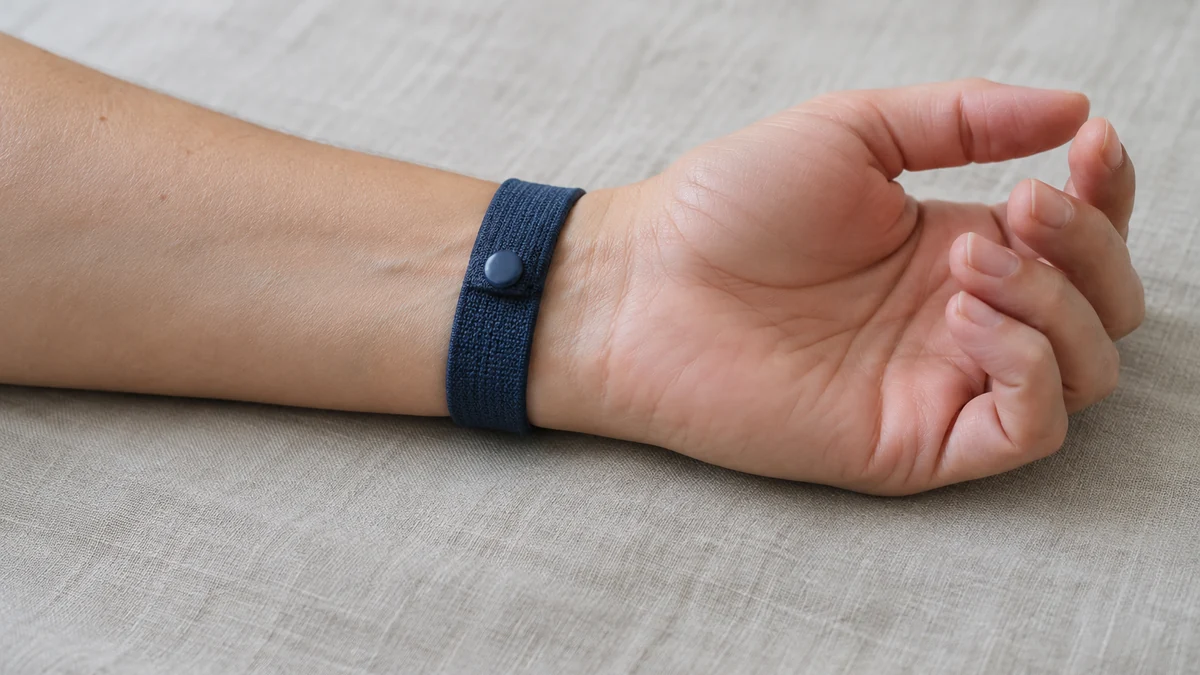
PC6 (also called P-6 or Neiguan) sits on the inner forearm near the wrist. In traditional practice, it’s used for nausea; that history explains the interest, not whether it works after an operation. Memorial Sloan Kettering’s P-6 instructions describe pressing the point with a finger. A pressure band applies pressure differently. Needle acupuncture and electrical stimulation are different again - they shouldn’t be treated as interchangeable with a fabric band and plastic stud. NCCIH describes acupuncture as a needle-based practice, not proof of a pressure band’s mechanism or effects.
Why fuss over that distinction? The Cochrane review grouped multiple PC6 approaches, including different noninvasive techniques, in a network analysis. A pooled result can be useful without answering the shopping question: which ordinary band, worn how, works for which patient? The available summary doesn’t settle that.
And there’s a second wrinkle. A network analysis draws on both direct and indirect comparisons across its set of trials. That’s useful for mapping a crowded field, but a neat-looking pooled number can hide differences in technique, operation and when symptoms were measured. So I’d be wary of a package that translates the review’s result into a promise about its own stud, elastic and fit. Those details matter to the buyer, yet this summary doesn’t give a reliable ranking of retail bands. The review authors discuss uncertainty in the evidence.
The sham comparison matters #
Across noninvasive PC6 methods, the review estimated less postoperative nausea than with sham stimulation (relative risk 0.67, 95% confidence interval 0.58-0.76). The researchers rated confidence in that network estimate low. Vomiting showed a similar direction (relative risk 0.58, 95% confidence interval 0.49-0.70), also with low confidence. These are prevention outcomes in surgical studies, not a promise that putting on a band will stop vomiting that’s already happening. See the updated review abstract and its certainty ratings.
But people usually want a different answer: “Will adding a wristband to my prescribed antiemetic help more than the drug alone?” The review’s combination estimates cited here compare noninvasive PC6 plus antiemetics with sham, often through indirect network evidence. They don’t establish the extra benefit of a pressure band over antiemetics alone. For instance, the combination was associated with less nausea in that sham comparison (relative risk 0.65, 95% confidence interval 0.45-0.96), but confidence was low and the evidence indirect. Calling that a proven medication add-on would change the comparator mid-sentence. The review’s abstract spells out the comparison.
So the practical reading isn’t “bands beat drugs.” Nor is it “the whole thing is bunk.” It’s a limited signal from pooled noninvasive methods, with a real gap between that research question and the one an individual patient asks in a shop. If someone promises the band will spare you antiemetic medication altogether, they’re answering a question these comparisons didn’t test.
There’s also an estimate for needing later rescue anti-nausea treatment: noninvasive PC6 plus medication probably reduced its use compared with sham in the network analysis, with moderate confidence from indirect evidence. That isn’t a reason to refuse rescue medicine. If you’re nauseated in recovery, tell the nurse - the team can assess you and treat symptoms rather than waiting for a band to do the job. The adult postoperative nausea pathway from MD Anderson explicitly includes assessment and escalation when prevention doesn’t work.
Where it might fit in a surgical plan #
I’d treat a band as a question for the preoperative conversation, not a private workaround after waking up sick. “I was thinking of using a PC6 pressure band. Is there any reason it would get in the way of my care, and what’s the plan if I’m nauseated anyway?” That’s a more useful question than asking whether it works “instead of” medication.
The 2025 consensus guidance on postoperative nausea and vomiting addresses risk assessment, preventive antiemetics and treatment when prevention fails. A team may have several reasons for its medication plan (including your procedure and personal risk). Keep that plan intact unless the team changes it. There’s no evidence in the sources here for a universal band-wear time, pressure setting or placement schedule around surgery.
And check the wrist itself. Don’t place pressure on an open wound, rash, blistered or inflamed skin; MSK’s patient instructions caution against pressing damaged or infected areas. Ask staff first if that wrist has an IV, dressing, monitor or vascular access - avoiding interference with equipment is a practical precaution, not a band-specific trial finding. If it hurts or irritates your skin, take it off and let your care team know.
But don’t use those finger-pressure instructions as a band prescription. They tell you where the point is; they don’t specify how long a postoperative patient should wear a retail device. Especially on a day when staff need access to your arms, it’s worth asking before adding something to your wrist. It sounds small. It’s still part of the care environment.
The review recorded minor, usually transient reactions such as redness, irritation and swelling. It didn’t report serious or long-term complications in the studies that reported harms, but harms reporting was inconsistent; “none reported” isn’t the same thing as “can’t happen.” Review safety summary.
Don’t try to manage persistent vomiting with a wristband #
Postoperative nausea is common enough that NHS after-surgery guidance says staff can offer medicine for sickness. So speak up while you’re in recovery. Once home, follow your own discharge instructions and contact your surgical team promptly if vomiting is severe or persistent, you can’t drink adequately, or you’re dealing with concerning pain or fever. North Bristol NHS Trust’s colorectal-surgery discharge guidance treats persistent/severe vomiting or poor intake as reasons to seek help; its specific discussion of bowel obstruction applies to colorectal patients, not every operation. Your own team’s instructions come first.
This evidence isn’t a green light for pregnancy or breastfeeding, for children, or for someone with a circulation, skin or vascular-access problem to use a band without individual advice. The review included some children but mostly adults; these sources don’t establish safety for those other circumstances or settle every chronic-condition or medication-interaction question. MD Anderson’s pathway is explicitly for nonpregnant adults. Nor should surgical-trial findings be carried over to motion sickness, chemotherapy nausea or unexplained vomiting.
And if you have another condition or take regular medicine, mention it when you discuss nausea prevention with the clinical team. A pressure band isn’t a drug, but that doesn’t make your overall postoperative plan simple; what the team prescribes and what they need to monitor still depend on you and your operation. The studies summarized here can’t make that decision for them.
A PC6 band might be a reasonable adjunct to discuss. The strongest evidence is for a broader family of stimulation techniques against sham, not a guaranteed result from a particular band. And if nausea breaks through after surgery, the useful next move is to tell the team - not to tighten the band and wait.