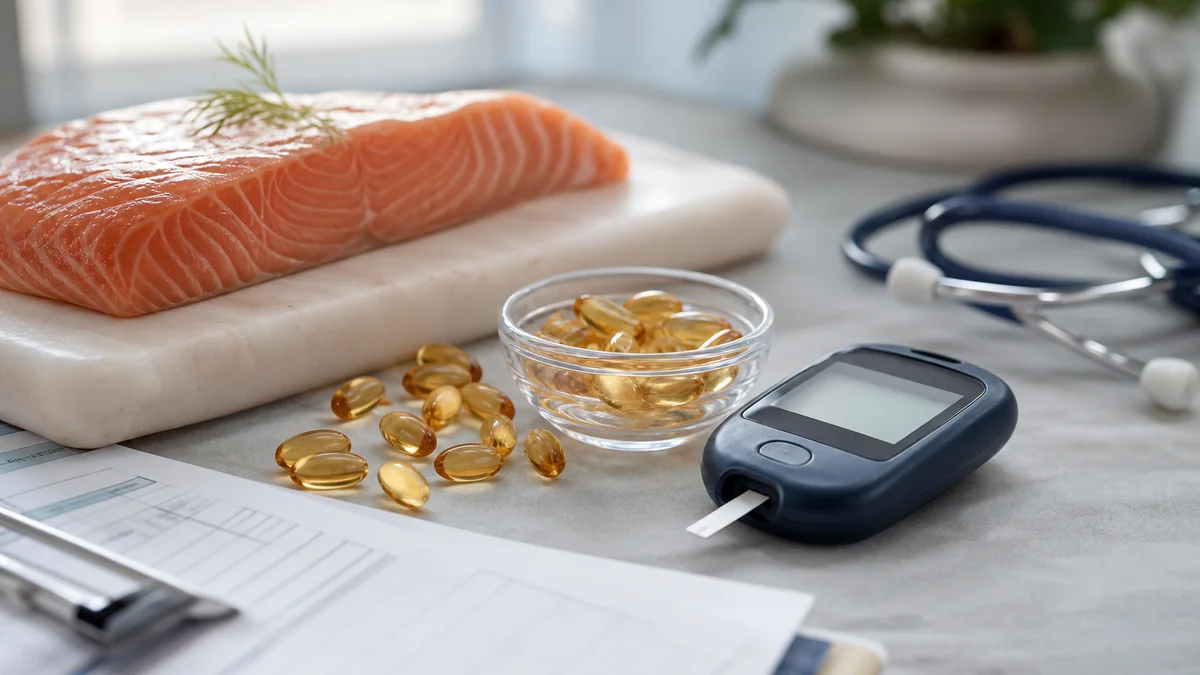
Omega-3 and Diabetes: What the Latest Evidence Actually Shows
Table of Contents
If you have type 2 diabetes - or you’re worried about developing it - you’ve probably heard someone tell you to start taking fish oil. It’s one of those things that sounds like it should work. Omega-3s reduce inflammation. Inflammation drives insulin resistance. Connect the dots and the conclusion writes itself, right?
The actual evidence is messier than that.
And I don’t mean “the jury’s still out but things look promising.” I mean the largest randomized trial ever run on this question - the VITAL study, which followed over 25,000 people for more than five years - found no significant reduction in diabetes risk with daily omega-3 supplementation. Several meta-analyses since then have confirmed small improvements in some blood sugar markers, but the effect sizes are modest, the studies disagree with each other, and there are real safety concerns that most supplement marketing conveniently skips.
So let’s walk through what the research actually says - the good, the limited, and the genuinely concerning.
Why people take omega-3s for diabetes - and the biology that makes it plausible #
The biological rationale isn’t made up. Omega-3 fatty acids - EPA and DHA, mostly from marine sources - get incorporated into cell membranes. Once there, they shift the body’s production of signalling molecules away from pro-inflammatory compounds (made from arachidonic acid, an omega-6 fat) toward less inflammatory ones called resolvins and protectins.
In animal models, omega-3s improve insulin sensitivity and reduce fat accumulation in the liver. The mechanism is real. And observational studies consistently find that people who eat more fatty fish have lower rates of type 2 diabetes and, among those who already have it, lower mortality - one 2023 analysis (Barbaresko et al., Diabetes Care) found about a 13% lower risk of death from any cause per 0.1 grams of daily omega-3 intake.
The problem is that observational data doesn’t prove causation. People who eat salmon twice a week also tend to exercise more, smoke less, and see their doctor regularly. When researchers actually test omega-3 supplements in randomized controlled trials - same question, controlled conditions - the results pull back hard from the observational promise.
What the evidence actually shows for blood sugar #
The best numbers we have come from two large meta-analyses.
A 2022 review by Xiao and colleagues pooled data from 46 randomized controlled trials covering nearly 5,000 people with type 2 diabetes. They found that omega-3 supplementation produced a small reduction in HbA1c - about 0.2 percentage points - along with improvements in triglycerides and HDL cholesterol. Delpino’s 2022 meta-analysis of 30 trials found reductions in fasting blood glucose and insulin resistance, but not HbA1c.
These are real findings. But here’s the nuance that matters: the effect on glucose is genuinely small. A 0.2-point HbA1c drop is less than most first-line diabetes medications produce, and the trials show high heterogeneity - meaning some studies found improvement and others found nothing. A 2025 analysis by Basirat and Merino-Torres, looking specifically at marine omega-3s and metabolic syndrome, reported that fasting glycemia was “largely unaffected” even at doses above 2 grams per day.
You can hold both thoughts at once: the meta-analyses detect a signal, but it’s weak and inconsistent.
Prevention? The VITAL trial says no #
The VITAL trial is the anchor here. It’s the largest randomized controlled trial on omega-3s and chronic disease ever conducted - 25,871 participants, 1 gram of omega-3s daily versus placebo, followed for a median of 5.3 years. VITAL was primarily designed to test cardiovascular and cancer outcomes, but its diabetes-related ancillary analyses have been published across multiple papers, including a 2025 analysis in Nature Communications examining type 2 diabetes incidence.
The result: no significant reduction in new diabetes cases.
This isn’t a “we need more research” situation - it’s a clear null finding from the largest trial we have. If 1 gram of omega-3s daily for five years doesn’t budge diabetes risk in 25,000 people, the prevention case is essentially closed at that dose.
And when VITAL researchers looked at kidney function in the 1,312 participants who already had type 2 diabetes (the VITAL-DKD ancillary, published in JAMA in 2019), they found no preservation of kidney function from omega-3s - but they did find more gastrointestinal bleeding events in the supplement group (28 versus 17 in the placebo arm). This is a pattern worth tracking.
As for diabetic neuropathy - the nerve damage that causes numbness and pain in the feet and hands - a 2025 Cochrane review examined omega-3 supplementation and found only two small trials with 87 participants total. The verdict: inadequate evidence. There’s simply not enough data to say anything useful.
The food-first message actually holds up #
Here’s where things get interesting - and it’s the part of the evidence picture that supplement marketing tends to skip.
The observational data on dietary fish intake is consistently stronger than the supplement data. The Barbaresko 2023 analysis showing 13% lower mortality in type 2 diabetes? That’s food intake, not pills. A 2021 meta-analysis by Ma and colleagues found that higher omega-3 blood levels - the omega-3 index, which reflects long-term dietary patterns - were associated with lower type 2 diabetes risk, particularly in Asian populations, but noted that genes affecting omega-3 metabolism (FADS polymorphisms) influence blood levels independently of what you eat.
There’s something about eating fish that doesn’t translate neatly to swallowing an oil capsule - the protein, the selenium, the vitamin D, the fact that you’re probably eating fish instead of something less healthy. The American Heart Association’s recommendation - two servings of fatty fish per week - reflects this food-first approach. It’s the strongest, most consistent evidence we have.
Safety: what most articles don’t tell you #
This section matters more than you might expect, especially if you have diabetes - because you’re already at elevated cardiovascular risk, and the safety signals here are cardiovascular.
Atrial fibrillation. Multiple meta-analyses, including a 2024 review by Yan and colleagues covering 15 randomized trials, have found that omega-3 supplementation increases the risk of atrial fibrillation - an irregular heartbeat that raises stroke risk. The bump isn’t huge in absolute terms (roughly 1 extra case per 100–200 people treated), but the relative increase is about 25–35%, and it appears to be dose-dependent. A 2020 analysis by Lombardi and colleagues found that doses above 1 gram per day pushed AF risk to RR 1.35 and bleeding risk to 1.49 times baseline.
For the diabetes population - older adults, often with existing cardiovascular disease - this isn’t theoretical.
Bleeding. Omega-3s have mild blood-thinning effects. At high doses, above 3 grams per day, they can measurably prolong bleeding time. The concern becomes serious when combined with actual anticoagulants. Case reports document intracranial bleeding in patients taking fish oil alongside warfarin and aspirin - including a 2017 trauma surgery report describing irreversible warfarin coagulopathy with concurrent fish oil use. If you take blood thinners - warfarin, apixaban, rivaroxaban, or even daily aspirin - you need to discuss fish oil with your prescribing doctor before starting it.
LDL cholesterol. Some omega-3 formulations can raise LDL cholesterol, particularly at lower doses - the Basirat 2025 analysis reported increases of 7 to 35 mg/dL. For diabetes patients who often deal with mixed dyslipidemia, this matters.
Gastrointestinal effects. Fishy aftertaste, belching, and nausea are common - the STRENGTH trial, which used 4 grams daily of EPA+DHA, reported GI side effects in nearly 25% of participants. Taking supplements with meals and using enteric-coated capsules can help, but it’s not a non-issue.
And then there’s the blood-sugar question itself. A 2024 meta-analysis on inflammatory markers in type 2 diabetes (Muzammil et al., 23 trials) found that CRP improvements were only seen in studies lasting less than 12 weeks - suggesting the anti-inflammatory effect may be transient, not sustained.
Prescription EPA is not the same as over-the-counter fish oil #
This distinction is easy to miss and almost always gets flattened in headlines.
The REDUCE-IT trial - the one that showed a 25% reduction in major cardiovascular events - used icosapent ethyl, a purified, prescription-only EPA formulation at 4 grams per day. These are not the fish oil softgels you buy at the pharmacy. REDUCE-IT participants also experienced more atrial fibrillation (3.1% vs 2.1%) and a trend toward more serious bleeding.
Meanwhile, the STRENGTH trial - which tested a different high-dose formulation combining EPA and DHA at 4 grams daily - was stopped early because it showed no cardiovascular benefit. Same high dose, different composition, different result.
The takeaway isn’t “omega-3s prevent heart attacks.” It’s that one specific prescription drug, at one specific high dose, showed benefit in one specific high-risk population - and it came with documented risks. Over-the-counter fish oil supplements, with variable EPA/DHA content and no FDA review for any disease claim, don’t inherit that evidence.
How to think about this #
If you’re managing type 2 diabetes, you’re probably navigating a lot of supplement claims, and the omega-3 story is a good case study in why the “natural” label doesn’t mean “risk-free” or “proven.”
But here’s something the evidence does support clearly:
The strongest evidence supports eating fatty fish - salmon, sardines, mackerel, herring - a couple of times a week. That’s where the observational mortality benefit lives, and it comes with protein and micronutrients you don’t get from a capsule.
If you’re considering an omega-3 supplement, the conversation to have with your doctor starts with: what’s my bleeding risk, what’s my heart rhythm history, and am I on any medications that interact. Don’t skip that conversation - the case reports on warfarin and fish oil aren’t rare outlier anecdotes; they’re documented adverse events with a clear mechanism.
And if someone tells you fish oil will reverse your diabetes or replace your medication, they’re either misinformed or selling something. The evidence doesn’t support reversal, it doesn’t support prevention at supplement doses, and the glucose-lowering effects that do exist are modest at best.
Bottom line #
Omega-3 fatty acids have a biologically plausible role in glucose metabolism, and some meta-analyses detect small improvements in blood sugar markers - about a 0.2-point HbA1c drop - in people with type 2 diabetes. But the largest prevention trial found no benefit, the effect on glucose is inconsistent across studies, and the safety concerns - atrial fibrillation, bleeding risk, LDL increases - are real and dose-dependent.
Eating fatty fish twice a week has stronger observational support than taking fish oil supplements, and it comes without the safety baggage. If you’re already eating a Mediterranean-style diet with regular fish intake, you’re probably getting the benefit that the evidence can actually support. A pill bottle might not add much - and at higher doses, it might add risk.
Related

Omega-3 and Diabetes: What the Latest Evidence Actually Shows