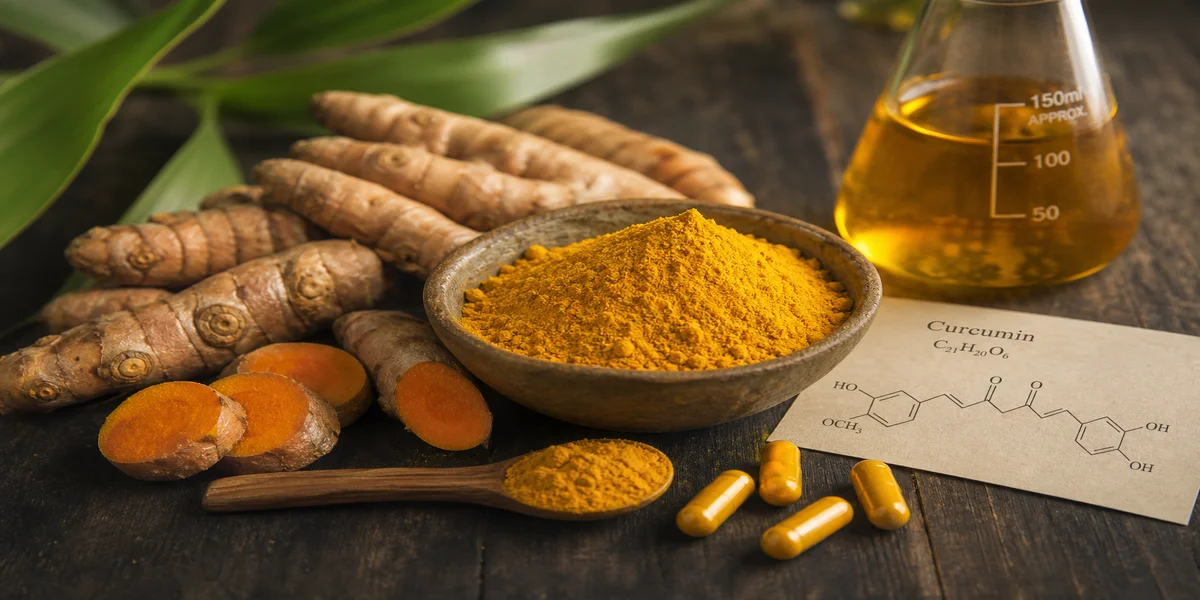
Turmeric is a spice. Curcumin is a compound found in turmeric. Most of what you’ve heard about the health benefits of turmeric is actually about curcumin - and most of what you’ve heard about curcumin comes from studies using doses you can’t get from cooking.
This distinction matters more than most supplement marketing lets on. It’s the difference between a kitchen staple that’s good for you and a concentrated extract with real-but-modest clinical effects. And somewhere between the “miracle spice” headlines and the dismissive “it’s all hype” rebuttals, there’s an actual evidence base worth understanding.
The distinction that matters#
Turmeric root contains about 2-5 percent curcumin by weight. A teaspoon of turmeric powder - the amount you’d use in a curry - gives you roughly 30-50 mg of curcumin. Most clinical trials showing anti-inflammatory effects use 500-2,000 mg per day. That’s not a cooking quantity. You can’t eat your way to a clinical dose.
And even if you could, your body wouldn’t absorb much of it. Curcumin is notoriously poorly bioavailable. It’s fat-soluble, so taking it with a meal helps some. But on its own, curcumin is rapidly metabolized in the liver and intestinal wall and eliminated before much reaches your bloodstream.
This is where piperine - the compound that gives black pepper its bite - comes in. A 1998 study by Shoba et al., still the foundational reference on this, found that adding 20 mg of piperine to a 2,000 mg dose of curcumin increased bioavailability by 2,000 percent in humans. That number gets cited everywhere, and for good reason: it’s not a subtle effect. Piperine inhibits the enzymes that break curcumin down and increases gut permeability enough to let more of it through.
Modern supplement formulations have gotten more sophisticated. Some use liposomal delivery (wrapping curcumin in fat bubbles), others use nanoparticle formulations, and some combine curcumin with turmeric essential oils that naturally enhance absorption. These approaches aren’t just marketing - bioavailability improvements of 10-20 fold over plain curcumin powder are well documented. But they also cost more, and the research comparing different formulations head-to-head is thin.
So when you’re looking at a curcumin supplement, the formulation matters as much as the dose. A 500 mg capsule of plain curcumin powder without any absorption enhancer is mostly an exercise in paying for compounds your body will never use. The same dose in a liposomal or piperine-enhanced formulation might actually deliver a meaningful amount.
What the evidence shows - and doesn’t#
Osteoarthritis. This is where the evidence is strongest. A 2021 meta-analysis published in Bioscience Reports examined 15 randomized controlled trials and found that curcumin supplementation reduced pain and improved physical function in people with knee osteoarthritis. The effect size was comparable to NSAIDs like ibuprofen in some head-to-head studies, but with fewer gastrointestinal side effects. The typical dose was 500 mg of curcuminoids twice daily.
A more recent 2025 network meta-analysis in BMC Complementary Medicine and Therapies broke things down by formulation type. The bioavailability-enhanced (BE) curcumin preparations produced a 30 percent reduction in WOMAC pain scores compared to placebo - enough to cross the threshold for a clinically meaningful difference. Conventional curcuminoid preparations without bioavailability enhancement still beat placebo, but the effect was smaller and didn’t always reach that clinically meaningful cutoff.
The Cochrane collaboration reviewed the evidence for herbal therapies in osteoarthritis, and while their reviews are appropriately cautious, turmeric/curcumin is among the few herbal interventions with data strong enough to take seriously. The most recent Cochrane review on herbal medicine for osteoarthritis found moderate-quality evidence for curcumin’s effects on pain, putting it ahead of most other herbal interventions they evaluated - many of which rated as low or very low quality. That’s not a ringing endorsement, but it’s as good as herbal evidence tends to get in a Cochrane assessment.
Not a cure. Not a replacement for medical management. But a reasonable option to discuss with a doctor, especially for people who can’t tolerate NSAIDs. Some of the 2021 trials even tracked reduced use of rescue pain medication: in one study of a bioavailability-enhanced curcumin extract, 37 percent of the curcumin group reduced their use of pain relievers compared to 13 percent in the placebo group. That’s a secondary outcome, not proof of anything on its own - but it’s the kind of signal that makes the evidence worth paying attention to.
Inflammatory conditions. Curcumin consistently reduces inflammatory markers - C-reactive protein, TNF-alpha, interleukin-6 - in people with existing inflammatory conditions. A 2020 umbrella review of meta-analyses found significant effects across multiple inflammatory diseases. But the authors also noted that many of the included studies were small, of variable quality, and short in duration. The signal is real; the precision isn’t great.
Cardiovascular risk factors. A 2019 meta-analysis found that curcumin modestly improves lipid profiles (small reductions in LDL and triglycerides) and endothelial function (how well your blood vessels dilate). The effects are statistically significant but small - meaningful at a population level, unlikely to be noticeable for any individual who takes it.
Depression. Several trials have found curcumin reduces depression scores, particularly in people with elevated baseline inflammation. A 2017 meta-analysis of six trials found a significant effect, but the studies were small and most lasted only 8-12 weeks. It’s preliminary evidence, not a replacement for standard treatment.
Where the evidence runs out#
Claims that turmeric “cures cancer,” “reverses Alzheimer’s,” or “detoxifies the liver” don’t have clinical evidence behind them. Curcumin does interesting things in laboratory studies - it modulates hundreds of molecular targets, suppresses cancer cell growth in petri dishes, reduces amyloid plaques in animal models. But “interesting in a lab” and “works in humans” are separated by a gap that most compounds never cross.
There’s a term for this: the curcumin conundrum. Curcumin is what medicinal chemists call a PAINS compound - a pan-assay interference compound that shows up as a hit in nearly every screening test because of its chemical properties, not because it’s a genuinely promising drug. It binds to proteins nonspecifically, fluoresces under assay conditions, and can produce false positives across dozens of test systems. That doesn’t mean all curcumin research is invalid, but it does mean you should be skeptical of any claim that starts with “curcumin has been shown to…” and ends with a disease endpoint that’s never been tested in a human trial.
Safety and interactions#
Turmeric as a spice is safe - billions of people eat it daily. Curcumin supplements at typical doses (500-2,000 mg/day) are generally well tolerated, though high doses can cause gastrointestinal upset, diarrhea, and nausea.
The more serious concerns involve interactions. Curcumin has mild anticoagulant effects and may increase bleeding risk when combined with blood thinners like warfarin, clopidogrel, or aspirin. It can also reduce iron absorption - relevant for people with iron deficiency. It may lower blood sugar, which matters if you’re on diabetes medication. And it can reduce the effectiveness of some chemotherapy drugs (while potentially enhancing others, depending on the drug and mechanism - not something to experiment with).
Pregnant women should avoid high-dose curcumin supplements. Turmeric has been traditionally used to stimulate menstruation, and the safety data for concentrated doses during pregnancy is essentially nonexistent. If you’re cooking with it, that’s fine. If you’re taking capsules, that’s a conversation with your obstetrician.
The turmeric supplement market, briefly#
Walk into any health food store and you’ll find turmeric supplements at wildly different price points and formulations. Some are just powdered turmeric root in a capsule - effectively a spice jar with extra packaging and a 10x markup over the bulk spice aisle. Others are sophisticated extracts with patented delivery systems and clinical trial data behind them, and they’re priced accordingly - often $30-50 per month at clinical doses.
The formulation gap isn’t just academic. A 2022 pharmacokinetic study comparing 12 different commercial curcumin products found a 100-fold range in peak blood levels between the best and worst performers. The plain powder products barely registered. The liposomal and phytosome formulations (like Meriva) produced levels high enough to plausibly explain their clinical trial results.
If you’re going to take a curcumin supplement, look for one with a bioavailability strategy - piperine (sometimes listed as BioPerine), liposomal delivery, or a branded formulation like Meriva or BCM-95 that has published human pharmacokinetic data. Skip the plain turmeric powder capsules. You’re not getting much for your money, and you’re almost certainly not getting the effects claimed by the research the brand is citing.
Bottom line#
Turmeric is a healthy spice - use it in cooking, where it belongs. The curcumin inside it has real but modest clinical effects at concentrated doses, particularly for osteoarthritis and inflammatory conditions at 500-1,000 mg per day with bioavailability enhancement. It’s not a miracle. It’s not useless. It’s an intervention with a medium-strength evidence base, significant absorption challenges, and enough safety considerations to warrant a conversation with a doctor before starting - especially if you’re on other medications.