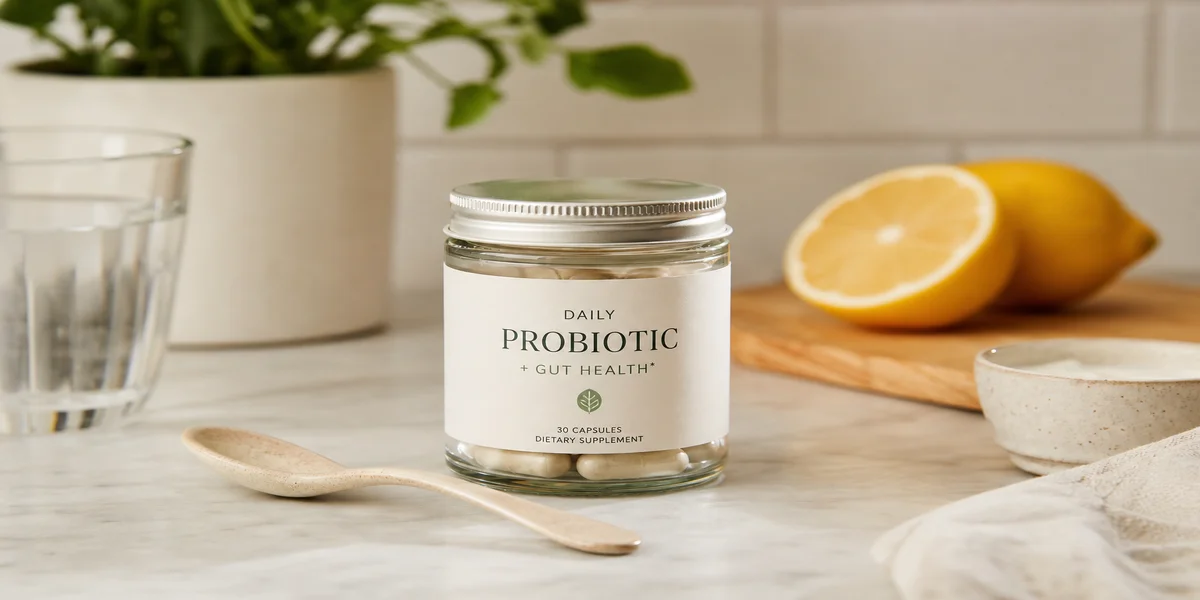
Probiotics are a roughly $7 billion market in the United States and climbing. Walk into any pharmacy or health food store and you will find dozens of products making claims about digestive health, immune support, mood, metabolism, and more. The problem is that probiotics are not a single thing, and the strain that helps with one condition may do nothing for another. The difference between an effective probiotic and an expensive placebo often comes down to details most labels don’t make clear.
This guide is about closing that gap - explaining what probiotics can actually do, where the evidence is solid, where it is thin, and how to find a product worth buying.
What a probiotic actually is#
The World Health Organization defines a probiotic as “live microorganisms which, when administered in adequate amounts, confer a health benefit on the host.” That definition has teeth. It means three things have to be true: the organisms must be alive when you take them, you have to take enough of them, and they have to provide a specific health benefit that has been demonstrated in human research.
A product that lists “Lactobacillus acidophilus” without specifying the strain is not really a probiotic in the scientific sense - because different strains of the same species can have completely different effects. One strain of L. acidophilus has been studied for cholesterol reduction. Another has been studied for lactose digestion. They are not interchangeable. If you do not know the strain, you do not know what you are buying.
Most probiotic supplements contain bacteria from two genera: Lactobacillus and Bifidobacterium. Some also include Saccharomyces boulardii, which is actually a yeast - not a bacterium - and has its own distinct evidence base. Within each genus, individual strains are designated by alphanumeric codes. Lactobacillus rhamnosus GG (often written as LGG) is a specific strain discovered in 1983 and studied in hundreds of clinical trials. Lactobacillus rhamnosus GR-1 is a different strain, studied primarily for vaginal health. Same species, different job.
How to read a probiotic label#
Most probiotic labels bury the useful information in fine print, if they provide it at all. Here is what to look for and what to ignore.
Genus, species, strain. This is the single most important piece of information on the bottle. If the label says “Lactobacillus acidophilus” with no strain designation, that is incomplete. Look for the full three-part name: Lactobacillus acidophilus NCFM, for example, or Bifidobacterium lactis HN019. The strain designation is what connects the product to the clinical research. Without it, you are guessing.
CFU count. CFU stands for colony-forming units - the number of viable microorganisms per dose. Most products list CFU count at the time of manufacture, which is misleading because probiotics die over time. A bottle manufactured six months ago with 50 billion CFU might contain 5 billion by the time you take it, depending on storage conditions and formulation. Quality products guarantee CFU at expiry, not at manufacture. If the label doesn’t specify, assume the number is the manufacturing count and reality is lower.
What dose do you need? Most clinical trials showing benefit have used doses in the 1-50 billion CFU per day range. More is not necessarily better - different strains have different effective doses, and higher CFU counts are sometimes a marketing gimmick rather than a meaningful advantage. For antibiotic-associated diarrhea, effective doses start around 5-10 billion CFU. For IBS, studied doses range from 10-100 billion CFU depending on the strain.
Expiration date and storage instructions. Probiotics are live organisms, and they die. Refrigerated products generally maintain viability longer than shelf-stable ones, but some shelf-stable formulations - particularly those using freeze-dried bacteria in sealed blister packs - can survive reasonably well at room temperature. If a product says “refrigerate” and you find it on a room-temperature shelf at the store, assume the CFU count is not what the label says.
Capsule technology. Enteric-coated capsules are designed to survive stomach acid and release bacteria in the small intestine. The logic is sound: stomach acid kills many probiotic organisms before they reach the colon. However, the clinical evidence that enteric coating improves outcomes is mixed. Some studies show better survival through the GI tract; others show no difference in clinical endpoints. It is a nice-to-have feature, not a make-or-break one.
Condition-specific evidence: what probiotics actually help#
Antibiotic-associated diarrhea#
This is the strongest indication for probiotics and the one backed by the largest body of evidence. Antibiotics kill bacteria indiscriminately - the pathogens causing your infection, but also the beneficial bacteria in your gut. The result, in roughly 5-35 percent of people taking antibiotics, is diarrhea ranging from mild to severe. In rare cases, antibiotic use allows Clostridioides difficile to proliferate, causing a serious and sometimes life-threatening colitis.
A 2019 Cochrane review - the gold standard of evidence synthesis - analyzed 82 randomized controlled trials involving more than 12,000 participants and found that probiotics reduced the risk of antibiotic-associated diarrhea by about 50 percent. The effect was consistent across adults and children. The strains with the strongest evidence are Lactobacillus rhamnosus GG and Saccharomyces boulardii.
For C. difficile specifically, a 2017 meta-analysis in Gastroenterology found that probiotics reduced the risk of C. difficile-associated diarrhea by about 60 percent in hospitalized patients on antibiotics, with the strongest effect when probiotics were started within two days of beginning antibiotics.
The critical detail: timing. Probiotics should be taken at least two hours apart from antibiotics. If you take them simultaneously, the antibiotic kills the probiotic organisms before they can do anything. A practical schedule is antibiotics with breakfast and dinner, and probiotics with lunch.
Irritable bowel syndrome#
The evidence for probiotics in IBS is real but more nuanced than the marketing suggests. Several meta-analyses have found that specific strains improve global IBS symptoms, abdominal pain, bloating, and flatulence. The effects are modest - most trials show improvement, not resolution - and vary significantly by strain.
Bifidobacterium infantis 35624 (marketed as Align in North America) is the most extensively studied single strain for IBS. A 2006 randomized trial published in Gastroenterology found that it significantly reduced abdominal pain, bloating, and bowel movement difficulty compared to placebo. Replication studies have been largely positive but the effect sizes are smaller than the original trial suggested.
Lactobacillus plantarum 299v has shown benefit for IBS symptoms in several trials, particularly for bloating and pain. A multi-strain product called VSL#3 (now marketed as Visbiome) - containing eight different bacterial strains - has shown benefit in several IBS trials, though the evidence for multi-strain products in general is less consistent than for single strains.
What doesn’t work as well: products that combine half a dozen strains at low doses without clear evidence for the combination. More strains are not necessarily better, and in some cases the strains may compete with each other rather than work synergistically.
Infectious diarrhea in children#
The evidence here is strong and consistent. Multiple meta-analyses have found that Lactobacillus rhamnosus GG and Saccharomyces boulardii reduce the duration of acute infectious diarrhea in children by approximately one day. The effect is most pronounced when probiotics are started early in the course of illness and when the diarrhea is caused by rotavirus. The effective dose is at least 10 billion CFU per day.
Atopic dermatitis and eczema#
Early studies generated excitement about probiotics for preventing eczema in high-risk infants - those with a family history of allergic disease. A 2018 comprehensive review by the World Allergy Organization, however, concluded that the evidence is insufficient to recommend probiotics for allergy prevention. Some individual trials have shown benefit when probiotics were given to pregnant women in the third trimester and to infants for the first six months of life, but the results have not been consistently replicated across populations.
For treatment of existing eczema, the evidence is similarly mixed. The American Academy of Dermatology does not recommend probiotics for atopic dermatitis treatment, noting that the quality of evidence is low and results are inconsistent.
General immune support and cold prevention#
Despite heavy marketing around “immune-boosting” probiotics, the evidence for preventing colds or flu in otherwise healthy adults is thin. A 2015 Cochrane review found that probiotics may reduce the number of people who experience an upper respiratory infection and may shorten the duration, but the effect sizes were small and the quality of evidence was rated low to moderate. A 2021 meta-analysis in the British Journal of Nutrition found a modest reduction in the incidence of respiratory tract infections with probiotic supplementation, but again emphasized heterogeneity across studies and strains.
If you are taking a probiotic specifically for immune support, there are worse things you could do, but the evidence is not strong enough to recommend it over more established interventions - good sleep, adequate nutrition, regular exercise, and hand washing.
Weight loss#
This is where the marketing has most clearly outpaced the science. Observational studies have found associations between gut microbiome composition and body weight, and animal studies have shown intriguing metabolic effects from certain probiotic strains. But randomized controlled trials in humans have been largely negative. A 2020 systematic review and meta-analysis published in Obesity Reviews found no significant effect of probiotic supplementation on body weight or body fat in adults. Small effects on waist circumference were reported in some trials, but the clinical significance is questionable. Probiotics are not a weight loss intervention, and anyone selling them as one is stretching the evidence.
Shelf stability, refrigeration, and what actually keeps probiotics alive#
Probiotics die over time - this is unavoidable. The rate at which they die depends on strain, formulation, packaging, temperature, and humidity. Refrigeration slows the die-off. Desiccants and oxygen-barrier packaging help. Freeze-drying (lyophilization) is the most common method for stabilizing bacteria in shelf-stable products, but even freeze-dried organisms degrade.
A 2014 investigation by ConsumerLab found that some probiotic supplements contained far fewer viable organisms than their labels claimed - in some cases, less than 10 percent of the stated CFU count. Products that had been stored improperly during shipping or at retail were particularly likely to fall short.
The practical takeaway: buy from reputable manufacturers that guarantee CFU at expiry, store according to the label, and check the expiration date. If you are buying online, consider whether the product will sit in a hot delivery truck. Summer shipping is not a friend to live bacteria.
Prebiotics and synbiotics: the supporting cast#
Prebiotics are non-digestible food ingredients that promote the growth of beneficial bacteria in the gut. Common prebiotics include inulin, fructooligosaccharides (FOS), and galactooligosaccharides (GOS), which are found naturally in foods like garlic, onions, leeks, asparagus, and bananas.
Some probiotic products include prebiotics in the same capsule - a combination called a synbiotic. The theory is that the prebiotic feeds the probiotic, improving its survival and colonization. The clinical evidence for synbiotics is still developing. Some trials have shown benefit for IBS and metabolic health, but it is not yet clear whether synbiotics outperform probiotics alone.
A practical note: prebiotics are fermentable fibers, and they can cause gas and bloating - particularly in people with IBS who are sensitive to FODMAPs. If a probiotic makes you feel worse rather than better, check the label. It might be the prebiotic, not the probiotic.
Bottom line#
Probiotics are not a catch-all wellness intervention. They are specific tools for specific jobs, and their effectiveness depends on matching the right strain at the right dose to the right condition.
For antibiotic-associated diarrhea: the evidence is strongest. Lactobacillus rhamnosus GG or Saccharomyces boulardii, 10-50 billion CFU per day, started within 48 hours of beginning antibiotics and taken at least two hours apart from antibiotic doses. Continue for at least a week after finishing the antibiotic course.
For IBS: Bifidobacterium infantis 35624 or Lactobacillus plantarum 299v have the most consistent evidence. Expect improvement, not resolution.
For general wellness or immune support in healthy people: the evidence does not justify the cost for most people. A diet rich in fermented foods - yogurt, kefir, kimchi, sauerkraut, miso - provides a diversity of live microorganisms and comes with the nutritional benefits of whole foods that probiotic supplements cannot replicate.
And when you do buy: check for the full strain name, confirm CFU at expiry, and store it properly. A probiotic is only as good as what actually survives to reach your gut.