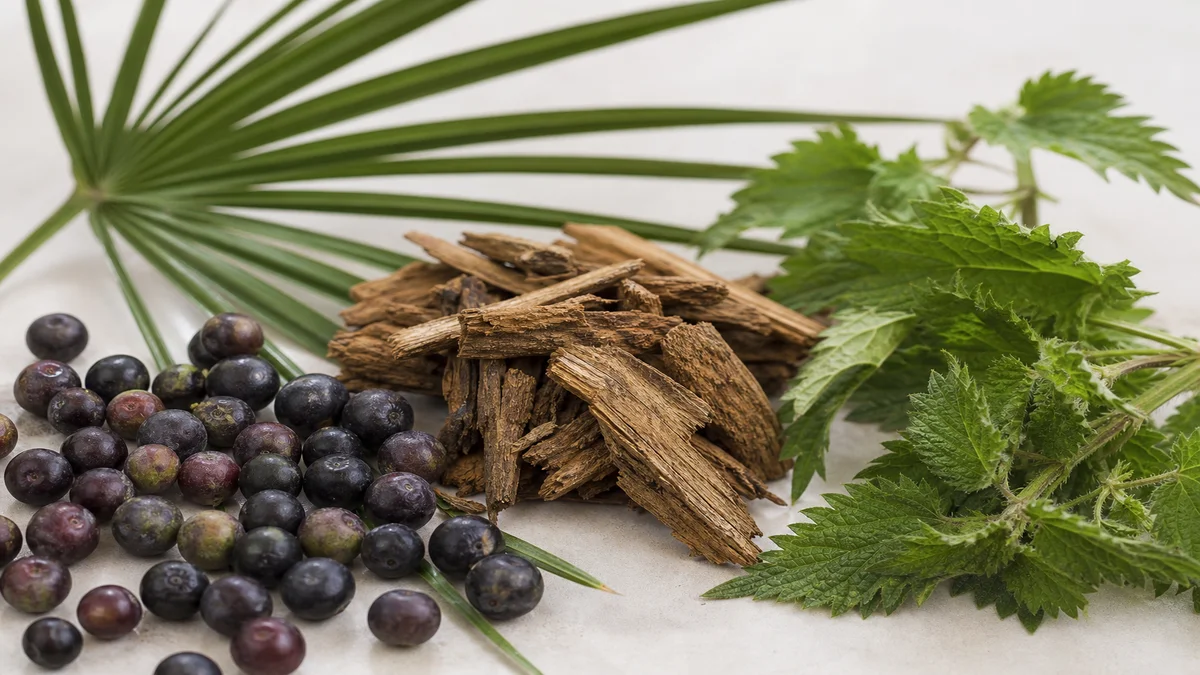
Saw palmetto is probably the prostate supplement most men have heard of. It sits on pharmacy shelves, shows up in “prostate health” blends, and gets sold with the quiet promise that nighttime bathroom trips are somehow a supplement problem.
But the evidence has moved in an awkward direction. The best current reviews suggest saw palmetto, by itself, does little to nothing for urinary symptoms linked to benign prostatic hyperplasia, or BPH. Pygeum and nettle look a bit more interesting, but not in the clean, “this works” way supplement labels would prefer. Their evidence is older, thinner, and often tied to specific extracts or combination products.
So the honest answer isn’t “natural remedies for enlarged prostate.” It’s messier than that. Some plant extracts have been studied. Some have signals worth knowing about. None should be treated like a diagnosis, a cure, or a reason to ignore urinary symptoms that are getting worse.
First: urinary symptoms aren’t always BPH#
An enlarged prostate is common with age, and urinary symptoms from BPH affect a lot of men. A 2023 American Family Physician rapid evidence review says lower urinary tract symptoms from BPH affect about 25% of U.S. men, with nearly half of those having at least moderate symptoms.
Still, “I’m peeing more often” doesn’t automatically mean “my prostate is enlarged.” Similar symptoms can come from a urinary tract infection, prostatitis, bladder problems, medication effects, or prostate cancer. That’s why NHS and NIDDK patient guidance both point men toward medical evaluation rather than self-diagnosis.
And this is the part that should be near the top, not buried after the supplement talk.
Red flags: don’t supplement-shop these symptoms#
Get urgent medical advice if you can’t urinate, see blood in your urine, have pain when urinating, have painful/frequent/urgent urination with fever or chills, or have severe pain in the lower abdomen or urinary tract area.
Those are not “try saw palmetto for a month” symptoms. They need a clinician.
If symptoms are new, worsening, or interfering with sleep and daily life, that’s also a reason to get checked. Not because every symptom is scary - most aren’t - but because guessing wrong can delay the care you actually need.
Saw palmetto: popular, but probably not helpful by itself#
Saw palmetto is the awkward one, because it’s the supplement people expect to work.
NCCIH, the NIH center that covers complementary and integrative health, says saw palmetto is promoted for urinary symptoms associated with BPH, but is “probably not helpful.” An updated review published in 2024 looked at 27 randomized studies with 4,656 participants and found that saw palmetto alone made little to no difference in urinary symptoms or quality of life compared with placebo or no treatment in the short term.
That doesn’t mean every man who says he felt better is lying. Symptoms fluctuate. Placebo effects are real. Some older or product-specific studies have been more positive. And combination formulas are their own problem, because a trial of one fixed extract doesn’t validate every “prostate blend” on the shelf.
But if we’re talking about saw palmetto by itself, the current high-quality evidence is not flattering. It’s not a strong “natural option.” It’s a famous one with weak results.
Safety-wise, saw palmetto was not linked to a clear increase in adverse events in that updated review, and NCCIH says it has generally been well tolerated in research. Reported side effects can include digestive symptoms, dizziness, and headache. Still, “well tolerated in trials” is not the same as “safe for every person with every medication.” NCCIH also warns that saw palmetto may be unsafe during pregnancy or breastfeeding, and people using medicines or other herbs should talk with a health professional.
Pygeum: more promising than saw palmetto, but the evidence is old#
Pygeum comes from the bark of Prunus africana, often called African plum. It has a history of use for urinary and prostate symptoms, especially in European phytotherapy. That traditional use is worth noting, but it’s not proof that a supplement on a modern store shelf will help.
The human evidence for pygeum is more encouraging than saw palmetto’s, but also less satisfying. A 2000 meta-analysis in the American Journal of Medicine reviewed 18 randomized trials with 1,562 men and found that men taking pygeum were more than twice as likely to report general symptom improvement. Nocturia - waking at night to urinate - also improved in the analysis.
Sounds good. But there’s a catch, and it’s a big one: the average trial lasted only 64 days, and trial quality was limited. A Cochrane review from 2002 reached a similar “possibly useful, but limited evidence” place. The studies were short, older, and not the kind of long, independently replicated evidence base you’d want before getting confident.
So where does that leave pygeum? Maybe useful for some urinary symptoms linked to BPH, based on older trials. Not proven to shrink the prostate. Not a substitute for evaluation. And not something AMZ should frame as a treatment.
That may sound like fence-sitting. It is, a little. But it’s the kind of fence-sitting the evidence forces.
Nettle root: interesting signals, not a clean answer#
Stinging nettle root is another common ingredient in prostate supplements. It’s not the same as drinking nettle tea and assuming it reaches the prostate in some meaningful way (different preparation, different claim). Most of the BPH discussion is about root extracts.
Some nettle studies are genuinely interesting. One older randomized, double-blind, placebo-controlled trial with 620 patients reported improvements in symptom scores, urinary flow, and residual urine measures. A small 2020 trial in 60 men also reported improvement in symptom scores and some inflammatory/oxidative markers over 12 weeks, with no side effects observed in that study.
But again, the evidence is thinner than the marketing. We’re dealing with older trials, smaller trials, and product-specific results. One positive nettle root extract study doesn’t prove that every nettle supplement works. And it definitely doesn’t prove that nettle “treats enlarged prostate.” Most of these studies measure symptom scores, urinary flow, and related markers - not actual prostate shrinkage.
And combination products muddy the water further. A fixed saw palmetto plus nettle product showed more symptom-score improvement than placebo in one 257-patient trial. But a small pygeum plus nettle trial found no significant advantage over placebo. So, no, “nettle plus something” isn’t automatically better.
Combination formulas are where consumers can get misled#
A lot of prostate supplements don’t contain one ingredient. They contain saw palmetto, nettle, pygeum, beta-sitosterol, zinc, pumpkin seed oil, lycopene, and whatever else fits on the label.
That creates a tempting shortcut: if one study found benefit from one standardized extract, surely a bigger blend should work too. But that’s not how evidence works.
Extract type matters. Dose matters, even though this article isn’t giving dosing advice. Manufacturing quality matters. The exact combination matters. A trial on a specific European extract doesn’t prove a different U.S. supplement blend has the same active compounds, absorption, or clinical effect.
One more thing: dietary supplements are not FDA-approved for safety and effectiveness before marketing in the same way drugs are. The FDA advises consumers to talk with a doctor or pharmacist before using supplements because they can interact with medicines or other supplements. That matters especially for older men, who may already be taking blood pressure medication, blood thinners, diabetes drugs, alpha blockers, 5-alpha reductase inhibitors, tadalafil, or other prescriptions.
The label is not a medical workup. And it’s not premarket proof.
What about lifestyle steps?#
This is less glamorous, but it may be the more useful first conversation.
The 2023 American Family Physician review notes that self-management and lifestyle methods can improve symptoms. That can include limiting evening fluids, reducing caffeine and alcohol, bladder or toilet training, pelvic floor exercises, and mindfulness approaches where appropriate.
These aren’t magic either. But they’re low-risk, they fit alongside medical evaluation, and they don’t depend on whether a supplement bottle matches a decades-old trial extract. For mild symptoms, they’re worth discussing with a clinician before assuming a prostate supplement is the missing piece.
Guideline-based treatments also exist. Depending on symptom severity, prostate size, and medical history, clinicians may consider alpha blockers, 5-alpha reductase inhibitors, tadalafil/PDE-5 inhibitors, procedures, or watchful waiting. That’s not anti-natural framing. It’s just the reality that urinary blockage can cause complications, and moderate or worsening symptoms deserve more than trial-and-error shopping.
A practical way to sort the three herbs#
If you’re trying to rank the evidence, here’s the plain version.
Saw palmetto alone has the strongest modern evidence base, but the result is mostly negative. That’s inconvenient, but useful. It means the best-known prostate supplement may be one of the least convincing when used by itself.
Pygeum has older evidence suggesting symptom improvement, especially for broad symptom scores and nighttime urination, but the trials were short and not strong enough for confident claims. “May help some men” is about as far as the wording should go.
Nettle root has some positive human trial evidence and a long supplement history, but it’s not definitive. Product-specific results and combination formulas make it easy to overstate.
So if a label says “clinically proven prostate support,” read that with your eyebrows up. The real question is: proven for what symptom, in which extract, in what kind of study, for how long, and in men with what diagnosis?
That’s the question supplement marketing hopes you won’t ask.
Bottom line#
Saw palmetto, pygeum, and nettle aren’t all the same. Saw palmetto is popular but currently looks unimpressive when used alone for urinary symptoms linked to BPH. Pygeum and nettle have more suggestive signals, but the evidence is older, smaller, and too product-specific to turn into broad treatment claims.
If you’re dealing with mild urinary symptoms and you’re curious about supplements, bring the bottle - or the ingredient list - to a doctor or pharmacist, especially if you already take prescription medicine. Don’t use supplements to self-diagnose BPH, don’t expect herbs to shrink the prostate, and don’t ignore red flags.
The most useful “natural” move may not be a capsule at all. It may be getting properly evaluated, tracking symptoms honestly, trying low-risk lifestyle changes, and being much more skeptical about what prostate supplement labels imply.