Most people spend more time reading the back of a cereal box than they spend reading a supplement label. That asymmetry is a problem. The front of a supplement bottle is advertising. The back - specifically the Supplement Facts panel - is a regulated document that tells you what you are actually buying. If you understand how to read it, you can spot quality products, avoid worthless ones, and stop paying for marketing claims that have no substance behind them.
This is a walkthrough of what each section of a supplement label means, what terms like “standardized” and “clinically studied” actually indicate (and what they don’t), and the red flags that should make you put a bottle back on the shelf.
The anatomy of a supplement label#
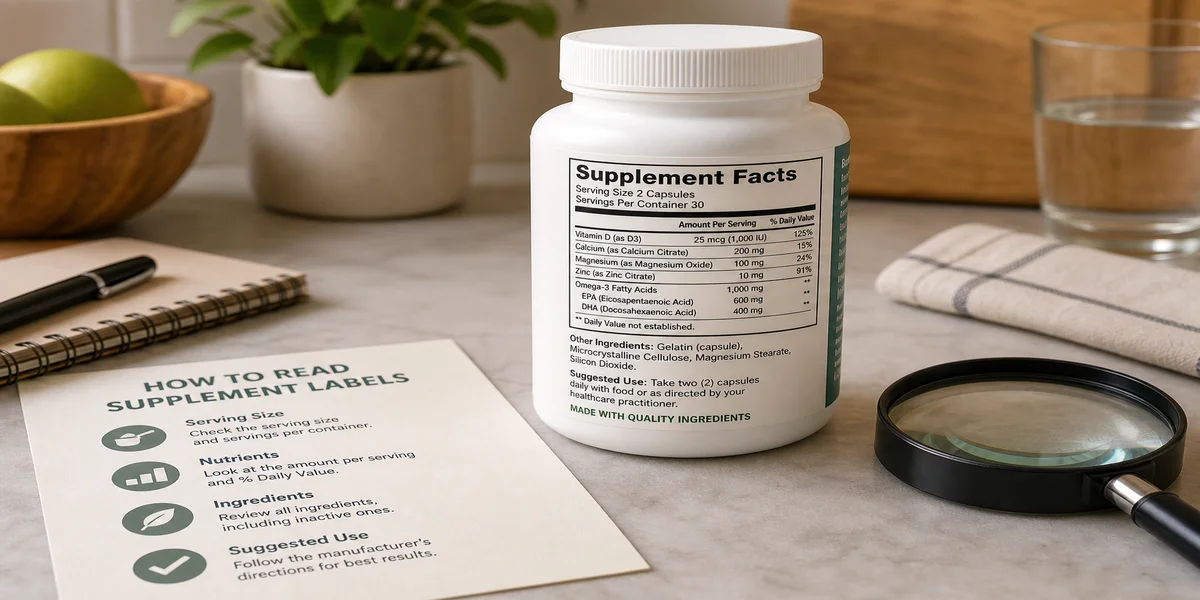
Let’s walk through a real-world example. Imagine you pick up a bottle of magnesium - one of those combination formulas marketed for sleep. Here is what you will see from top to bottom.
Statement of identity#
At the top of the Supplement Facts panel, you will see something like “Magnesium Sleep Support Formula” or “Dietary Supplement.” The statement of identity tells you what the product is. It is required by the FDA, and it must be accurate - but it can also be creative. “Sleep Support Formula” is a marketing phrase. It tells you what the manufacturer wants you to believe the product does. It does not tell you what it actually does or whether the ingredients inside it have been shown to do anything for sleep.
Serving size#
This line tells you how many capsules, tablets, softgels, gummies, or milliliters equal one dose. Many people miss this entirely and assume the number on the front is the per-pill amount. It isn’t. If the serving size is two capsules and the label lists 200 mg of magnesium per serving, each capsule contains 100 mg. If you take one capsule, you are getting half the dose.
Conversely, if a product looks cheap but the serving size is four capsules, the per-capsule cost is lower than it appears. Divide the bottle price by the number of servings - not the number of capsules - to get the real per-dose cost.
Amount per serving and percent Daily Value#
This is the core of the Supplement Facts panel. For each ingredient, the label lists the amount per serving and, for vitamins and minerals with an established Daily Value, the percentage that amount represents.
Daily Values are based on the FDA’s reference intake for a 2,000-calorie diet. They are designed to help consumers compare products, not to represent individual requirements - your actual need may be higher or lower. A DV of 100 percent means the product provides the full recommended intake for a typical adult. A DV above 100 percent is common for water-soluble vitamins like B12 and vitamin C because the safety margin is wide and absorption rates vary.
For botanical ingredients, amino acids, enzymes, and other compounds without an established Daily Value, the label will show the amount but no percentage. This is where you need external knowledge. The fact that a product contains 50 mg of ashwagandha root powder tells you nothing about whether that is an effective dose unless you know what the clinical trials used. For ashwagandha, most studies showing benefit for stress and anxiety used 300-600 mg of a standardized extract taken twice daily. A product with 50 mg is vastly underdosed. The company is not lying - it is just selling water with a hint of herb.
The ingredients list: what else is in there#
Below the Supplement Facts panel, manufacturers must list “Other Ingredients” - the fillers, binders, flow agents, disintegrants, coatings, and capsule materials that are not active ingredients but are necessary to manufacture the product.
Common ones include:
- Magnesium stearate and stearic acid: flow agents that prevent ingredients from sticking to manufacturing equipment. They are generally recognized as safe, though some people report digestive sensitivity.
- Silicon dioxide and rice flour: anti-caking agents and fillers. Inert and harmless for most people.
- Microcrystalline cellulose: a plant-derived filler and binder. Also used as a dietary fiber supplement on its own. Generally benign.
- Gelatin: the most common capsule material, derived from animal collagen. If you avoid animal products, look for “vegetable capsule” or “cellulose capsule” on the label.
- Titanium dioxide: a whitening agent used to make capsules look uniform. The European Union banned it as a food additive in 2022 over genotoxicity concerns. The FDA still permits it. If you want to avoid it, look for products that specify “no titanium dioxide” or use clear capsules.
For most people, other ingredients are not a major concern. If you have food sensitivities, celiac disease, or specific allergens, this section is where you verify that the product is actually free of what you are avoiding. Phrases like “free of gluten, dairy, and soy” on the front are marketing. The ingredients list is verification.
Proprietary blends: the hidden amounts problem#
This is arguably the most important concept in supplement label literacy. A proprietary blend is a mixture of ingredients whose individual amounts the manufacturer does not disclose. The label lists the total weight of the blend and the ingredients in it, in descending order by weight - but not the amount of each ingredient.
Here is why that matters. Suppose a product contains a “Sleep Proprietary Blend, 500 mg” consisting of magnesium glycinate, L-theanine, chamomile extract, and melatonin. You know the total is 500 mg. You know magnesium glycinate is the first ingredient, so there is more of it than anything else. But you do not know how much. If the blend is 490 mg of magnesium glycinate, 5 mg of L-theanine, 3 mg of chamomile, and 2 mg of melatonin, the L-theanine is effectively decorative - clinical trials showing benefit for sleep used 200-400 mg, not 5.
This is legal. The FDA allows proprietary blends to protect “trade secrets,” but the practical effect is that consumers cannot evaluate dosing. A 2013 study published in BMC Medicine found that some herbal supplements contained none of the advertised botanical and were composed entirely of fillers and substitute plant species. Proprietary blends make this kind of fraud harder to detect because the label never committed to a specific amount in the first place.
The rule of thumb: avoid proprietary blends when the ingredients in them are the reason you are buying the product. If a supplement contains a blend with eleven ingredients at a total of 200 mg, the math does not work. Each ingredient averages 18 mg - likely below the effective dose for any of them. Transparency is a quality signal. If a manufacturer won’t tell you what’s in the product, there is usually a reason.
Claims on the label: what the FDA allows and what it doesn’t#
Supplement labels can make three categories of claims, and understanding the difference between them is essential.
Nutrient content claims#
These describe the level of a nutrient in the product - “high in calcium,” “excellent source of vitamin C,” “low sodium.” These claims are defined by the FDA with specific thresholds. A product labeled “excellent source of magnesium” must contain at least 20 percent of the Daily Value per serving. These claims are generally reliable because the thresholds are clear and enforceable.
Structure-function claims#
This is where most supplement marketing lives. Structure-function claims describe how a nutrient or ingredient affects the structure or function of the human body - “supports immune health,” “promotes relaxation,” “maintains healthy cholesterol levels.” These claims do not require FDA pre-approval. The manufacturer is responsible for ensuring they are truthful and not misleading, but the FDA does not verify them before the product reaches the market.
Structure-function claims must be accompanied by the disclaimer: “These statements have not been evaluated by the Food and Drug Administration. This product is not intended to diagnose, treat, cure, or prevent any disease.” If you see that disclaimer, the claims on the bottle are structure-function claims - not health claims - and the evidence behind them has not been independently reviewed by the FDA.
The phrase “supports” is a good linguistic tell. It is deliberately vague. “Supports immune health” can mean almost anything, including things the product does not actually do. It is not the same as “reduces the incidence of upper respiratory infections,” which would be a specific claim requiring disease-treatment-level evidence that most supplements do not have.
Health claims#
Health claims describe a relationship between a substance and a disease or health condition - for example, “calcium may reduce the risk of osteoporosis” or “adequate folic acid may reduce the risk of neural tube defects.” These claims require FDA authorization based on significant scientific agreement, or they must carry a qualifying statement indicating that the evidence is limited and not conclusive.
If a supplement makes an explicit disease claim without an FDA disclaimer, it is either a drug (and should be regulated as one) or it is mislabeled. Supplements cannot legally claim to treat, cure, or prevent disease. If the bottle says a product “cures” anything, it is either making an illegal claim or is not being marketed as a supplement - and either way, you should be skeptical.
Quality signals: what third-party certifications actually mean#
Several organizations provide independent quality verification for supplements. Here is what each one’s seal means in practice.
USP (United States Pharmacopeia). The USP Verified mark means the product has been tested and confirmed to contain the ingredients listed on the label, in the declared amounts, without harmful levels of contaminants. It also verifies that the product will break down and release its ingredients in the body within a specified time - meaning it is absorbable, not just present. USP does not evaluate whether the product works for its intended use. It only verifies quality, purity, and manufacturing practices.
NSF International. Similar to USP, NSF verifies label accuracy and contaminant screening. NSF also offers a “Certified for Sport” program that screens for more than 270 substances banned by major athletic organizations. If you are an athlete subject to drug testing, NSF Certified for Sport is the gold standard.
ConsumerLab.com. ConsumerLab is a for-profit company that tests supplements and publishes reviews. Products that pass testing can license the ConsumerLab seal. The testing is rigorous, but unlike USP and NSF, ConsumerLab is not an independent standards organization - it operates on a subscription model for its reviews, which creates a different incentive structure.
GMP (Good Manufacturing Practices). You will see “GMP certified” or “manufactured in a GMP-compliant facility” on many supplement labels. This means the facility follows FDA-mandated manufacturing standards for cleanliness, documentation, and quality control. It does not mean the product has been tested for purity or potency by an independent third party. GMP compliance is the floor, not the ceiling. It should be expected, not celebrated.
Marketing terms that sound meaningful but aren’t#
“Clinically studied.” This can mean almost anything. A single ingredient in the formula might have been studied once, in a small trial, at a different dose, in a different population, with a different delivery form. The product you are holding was almost certainly not the one studied. The term is not regulated and should not be taken at face value.
“Standardized.” For herbal extracts, standardization means the product is manufactured to contain a specified percentage of a marker compound - for example, St. John’s wort standardized to 0.3 percent hypericin. This is genuinely useful because it ensures batch-to-batch consistency, which is otherwise a significant problem with botanical supplements. However, standardization to one marker compound does not guarantee that other active compounds are present or that the product will be effective. It is a quality control tool, not a proof of efficacy.
“Pharmaceutical grade.” This term has no legal definition in the supplement industry. Pharmaceutical-grade substances are manufactured to purity standards suitable for use in drugs. Unless a manufacturer can produce a certificate of analysis from an independent lab confirming those standards, “pharmaceutical grade” is marketing.
“Doctor formulated” or “recommended by doctors.” These terms are unregulated. The “doctor” could be anyone with a doctoral degree, including a PhD in an unrelated field. The “recommendation” could be from a paid consultant. These phrases are designed to borrow authority, and they should be ignored unless accompanied by specific, verifiable credentials.
A practical checklist for reading any supplement label#
When you pick up a supplement bottle, here is the order of operations:
Skip the front entirely. Go straight to the Supplement Facts panel.
Check the serving size. Make sure you understand how many pills equal one dose and that the amounts listed are per serving, not per pill.
Read the ingredient forms. Look for specific forms with established bioavailability - magnesium citrate, not “magnesium”; methylcobalamin, not “vitamin B12.” Generic ingredient names are often the cheapest, least absorbable versions.
Compare the dose to the research. For any ingredient you are buying the product for, verify that the amount per serving is in the range shown to be effective in clinical trials. If you don’t know the research dose, look it up. A product that contains one-tenth the effective dose is a waste of money even if it costs one-tenth the price.
Watch for proprietary blends. If a blend contains ingredients whose individual amounts matter, and the total blend weight doesn’t accommodate reasonable doses for all of them, put it back.
Check for third-party seals. USP or NSF certification is a strong quality signal. Its absence is not necessarily a red flag - many quality products do not pay for certification - but its presence is reassuring.
Read the other ingredients. If you have allergies or sensitivities, this is where you confirm the product is safe for you.
Ignore the marketing copy on the front. “Clinically studied,” “maximum strength,” and similar phrases are noise. The Supplement Facts panel is signal.
Bottom line#
The front of a supplement bottle is designed to get you to buy it. The Supplement Facts panel is designed to tell you what is actually inside. One is marketing. The other is regulated.
If you only learn one skill from this guide, make it this: when evaluating a supplement, start at the back. Every time. The information you need is there. The information you want to believe is on the front. Keep them separate.