If you’ve ever taken a joint supplement that worked surprisingly fast - the kind where the pain faded in hours and you thought, “wow, this natural stuff actually works” - there’s a chance you were reacting to something that wasn’t on the label.
And I don’t mean because natural ingredients can’t help. Some can. But the FDA keeps finding prescription and prescription-strength drugs inside products marketed as natural supplements for joint pain and arthritis.
And here’s the thing: in 2026, they’re still finding them.
What keeps showing up#
The FDA maintains a public notification page specifically for pain and arthritis products found to contain hidden drug ingredients. As of June 1, 2026, it listed 61 entries - and the agency is upfront that this is only a fraction of what’s actually out there (which, if you think about it, is kind of the worrying part). The Health Fraud Product Database, which collects warning letters, recalls, and public notifications, holds 2,176 entries as of June 5, 2026, and FDA explicitly warns that it “includes only a small fraction of potentially hazardous products marketed to consumers online and in stores” (FDA, Pain and Arthritis Products Containing Hidden Ingredients; FDA, Health Fraud Product Database).
That’s the big picture. But two product lines make the pattern concrete.
Curcuflex, promoted and sold for joint pain on sites including eBay and possibly in some retail stores. On April 7, 2026, FDA laboratory analysis confirmed it contained two undeclared drugs: dexamethasone, a corticosteroid, and diclofenac, a prescription-strength nonsteroidal anti-inflammatory drug. Neither was on the label (FDA, Curcuflex Public Notification, April 7, 2026).
Umary is the more complicated story - because it keeps getting caught, over and over. The FDA first warned about Umary on June 14, 2024 after finding undeclared diclofenac and omeprazole, a stomach acid drug. Then more versions showed up. July 23, 2024: additional Umary products from a different seller, same hidden drugs. February 2, 2026: more Umary on eBay, still containing undeclared diclofenac. April 7, 2026: yet another batch, this time from ibeautistore.com, containing diclofenac, dexamethasone, and omeprazole - all three at once. FDA also issued a broader consumer warning not to purchase or use Umary and Amazy products after receiving increased adverse event reports - gastrointestinal, cardiovascular, and serious skin reactions consistent with the known side effects of the drugs being found (FDA, Umary Public Notification, multiple updates through April 7, 2026; FDA Drug Safety Communication, 2024).
So no, this isn’t a one-off contamination issue or a single bad batch. It’s a recurring pattern across sellers, websites, and years - and the products keep finding new ways back onto the market.
Why hidden drugs in supplements are dangerous - not just “unregulated”#
A person taking these products is taking medicine they didn’t consent to. That’s the headline problem. But the risks go deeper than that, and they’re different for each drug FDA keeps finding.
Undeclared diclofenac. Diclofenac is an NSAID, and NSAIDs come with well-documented risks even when prescribed - risks most people taking a “natural supplement” wouldn’t know to watch for. The Mayo Clinic notes that NSAIDs - including diclofenac - can increase the risk of heart attack and stroke, and the risk exists even in people without known heart disease (Mayo Clinic, “NSAIDs: Do they increase my risk of heart attack and stroke?”). NSAIDs can also cause serious gastrointestinal bleeding, ulcers, and kidney problems. A large Danish observational study published in the BMJ found that diclofenac initiation was associated with higher 30-day cardiovascular risk and upper-GI bleeding risk compared with non-use and some alternatives (Schmidt et al., BMJ, 2018).
And here’s where it gets worse in the real world: someone taking a hidden NSAID might also be taking ibuprofen for a headache, aspirin for heart protection, or another pain product. They’re unknowingly stacking drugs with overlapping risks, and there’s no clinician monitoring any of it.
Undeclared dexamethasone. Corticosteroids are powerful drugs - the kind where you don’t mess around with the dose or the timing. FDA warnings for both Curcuflex and Umary note that dexamethasone can impair the body’s ability to fight infection, raise blood sugar, cause muscle injuries and psychiatric problems, and suppress adrenal function. The withdrawal risk is serious enough that FDA specifically tells consumers already taking these products to consult a health care professional about safe discontinuation - this isn’t a “throw the bottle out and you’re fine” situation. Abruptly stopping a corticosteroid after prolonged or high-dose exposure can cause withdrawal symptoms because the adrenal glands may need time to recover normal cortisol production (FDA, Curcuflex and Umary Public Notifications).
Undeclared omeprazole. Omeprazole reduces stomach acid - which might sound benign if you’ve ever taken something for heartburn, but the FDA notes it can cause serious skin reactions, abdominal pain, diarrhea, nausea, and headache, and may interact with other medications or mask serious stomach problems - including erosions, ulcers, or stomach cancer (FDA, Umary Public Notification).
When these three drugs appear together in the same product - which FDA found in the April 7, 2026 Umary samples - a consumer is unknowingly taking a corticosteroid, an NSAID, and an acid-suppressing drug with no dosing information, no monitoring, and no way to tell what else they’re combining with them.
“But it’s sold as a supplement - isn’t that regulated?”#
This is where things get confusing for reasonable consumers - and it’s worth being direct about what the regulatory reality actually is.
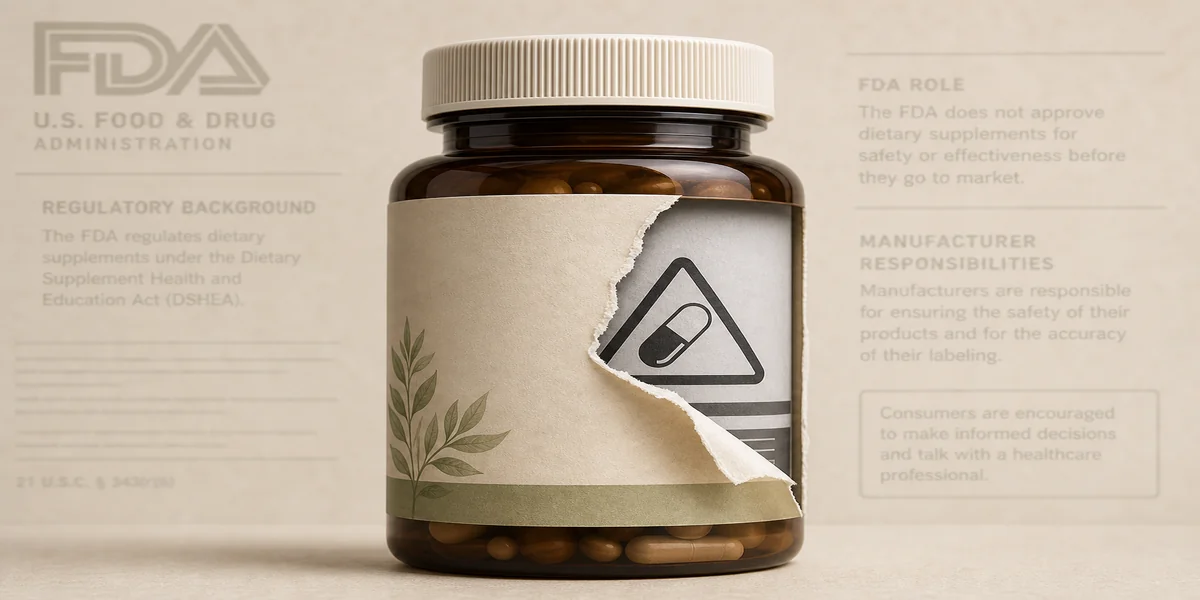
The FDA does not review dietary supplements for safety and effectiveness before they reach the market in the same way it reviews drugs. Manufacturers are responsible for ensuring their products are safe and that label claims are truthful - but there’s no mandatory pre-market approval process for supplements (NCCIH, “Using Dietary Supplements Wisely”).
The FDA acts after problems emerge: warning letters, import alerts, product alerts, recalls. The Health Fraud Product Database is the public-facing record of those actions. But - and FDA is explicit about this - the database is not a complete list of dangerous products. Absence from the database doesn’t mean a product is safe (FDA, Health Fraud Product Database).
This is why the Umary pattern matters. The same product name kept appearing in FDA alerts across two years and multiple sellers. A consumer who checked the database in early 2024 might have found nothing on Umary. By mid-2024, it was flagged. By 2026, it had been flagged repeatedly with evolving drug combinations. The system catches products, sure - but it catches them after they’ve been sold, sometimes for extended periods.
A broader pattern, not just two product lines#
This isn’t limited to Curcuflex and Umary, either. A 2018 analysis published in JAMA Network Open examined FDA-identified adulterated dietary supplements from 2007 through 2016 and found 776 products containing unapproved pharmaceutical ingredients, with 157 products containing more than one undeclared drug (Tucker et al., JAMA Network Open, 2018).
Most of the products in that dataset were marketed for sexual enhancement, weight loss, or muscle building - not joint pain. So no, the data doesn’t tell us how prevalent adulteration is across the broader supplement market, and it’d be wrong to imply most joint supplements are tainted. But it does tell us that FDA keeps finding pharmaceuticals in supplements across categories, year after year, and that the pain and arthritis category has enough entries to justify its own FDA notification page.
How to protect yourself - a practical approach#
None of this means you should panic about every supplement in your cabinet. (Please don’t.) But it does mean a few specific habits are worth adopting, especially if you’re shopping for pain or joint products.
So what should you actually do?
Check the FDA before you buy. If a product name sounds unfamiliar or the claims sound too good - fast relief, drug-like results, “works when nothing else did” - spend two minutes on the FDA’s pain and arthritis hidden-ingredient page and the Health Fraud Product Database. It won’t catch everything, but it catches what the FDA has confirmed.
Be skeptical of fast, drug-like effects from “natural” products. This isn’t proof of adulteration - some natural compounds do have genuine effects. But if a supplement works with the speed and intensity you’d expect from a prescription drug, it’s worth asking why. FDA labelling says consumers should be cautious of products that claim to be “natural alternatives” to approved drugs or that promise results similar to prescription medications (FDA, “Avoiding Products Contaminated with Hidden Ingredients”).
Don’t assume “not in the database” means “safe.” FDA’s own language on this is blunt: the database is a small sample, not a complete safety certification.
If you’re already taking Curcuflex or Umary. Do not just stop. FDA’s instructions are specific: consult a health care professional immediately about safe discontinuation, especially because of the corticosteroid withdrawal risk. If you experience chest pain, shortness of breath, sudden weakness or slurred speech, signs of gastrointestinal bleeding, severe abdominal pain, or severe skin reactions - seek medical attention. These are known warning signs for the drug classes found in these products. And on that note: chest pain, trouble breathing, sudden weakness on one side of the body, or slurred speech while using an NSAID-containing product should be treated as an emergency - not a “wait and see” situation. Severe allergic reactions, signs of GI bleeding, or symptoms after stopping a corticosteroid-containing product also warrant prompt medical care (FDA Curcuflex/Umary alerts; Mayo Clinic NSAID guidance).
Report problems. If you or someone you know had a serious reaction to a dietary supplement, FDA’s MedWatch system accepts reports from consumers, patients, and health care professionals. You can file online through the FDA’s MedWatch portal (FDA, MedWatch Safety Information and Adverse Event Reporting Program).
Talk to your doctor - for real. If you’re taking supplements for joint pain alongside prescription medications, or if you have heart disease, a history of ulcers or GI bleeding, kidney disease, diabetes, or are pregnant or breastfeeding, the hidden-drug risk is higher because the potential interactions and contraindications are more serious. NCCIH recommends consulting a health care professional about any supplement you’re considering, and that advice applies doubly to pain products making strong claims (NCCIH, “Using Dietary Supplements Wisely”).
The bottom line#
The issue isn’t that natural approaches to joint health don’t have value. Plenty of people get genuine benefit from turmeric, glucosamine, omega-3s, and other approaches with at least some evidence behind them. I’m not here to tell you to throw out your supplements.
The supplement category’s regulatory structure means there’s a gap between what’s on the label and what’s in the bottle - and FDA keeps finding that gap filled with drugs that should require a prescription and a doctor’s supervision. Curcuflex and Umary are the named examples because they’re the ones FDA caught and publicly flagged. The broader lesson - and it’s not a subtle one - is that the supplement aisle contains real products and real risks, and the line between them isn’t always printed on the package.