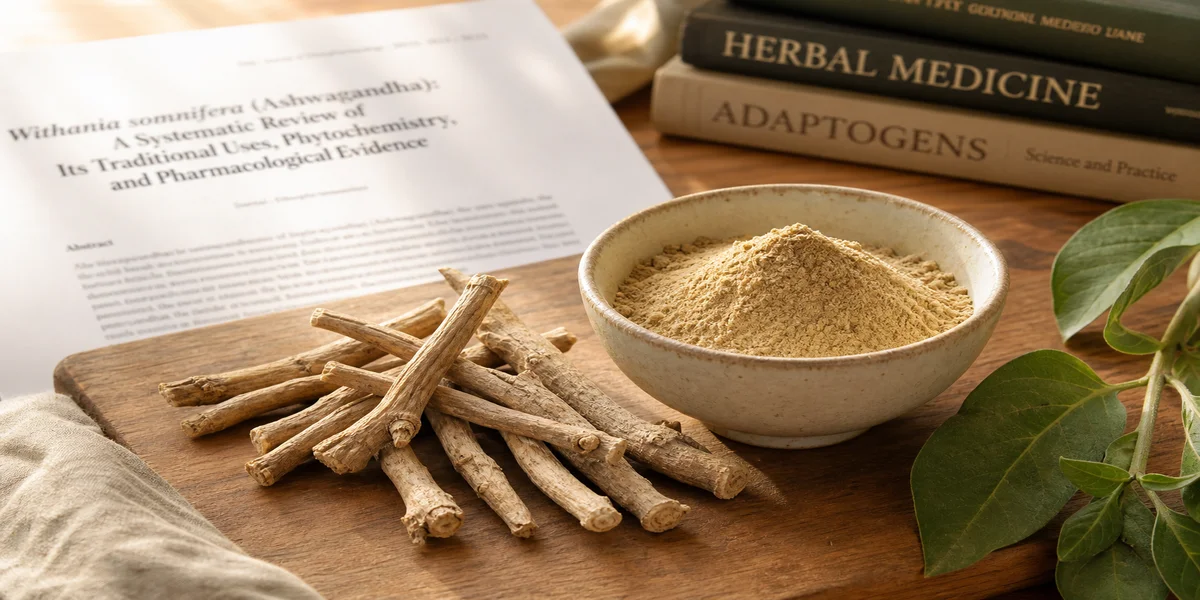
Ashwagandha (Withania somnifera) is one of the most researched herbs in the Ayurvedic tradition. It’s classified as an adaptogen - a term that gets thrown around a lot but deserves some scrutiny. The clinical research on ashwagandha has grown substantially over the past decade, enough that we can say more than “it might help with stress.” Here’s what the trials actually show.
Adaptogens: what the term means and where the evidence stands#
“Adaptogen” was coined in the 1940s by Soviet scientist Nikolai Lazarev. The concept: a substance that increases the body’s nonspecific resistance to stress, normalizing function regardless of whether the stress pushes systems too high or too low. Think of it as a thermostat rather than a dimmer switch - it’s supposed to bring things back toward baseline rather than pushing them in one direction.
It’s an elegant idea. The problem is that the evidence for adaptogens as a class is inconsistent. Different herbs have different mechanisms, different levels of evidence, and different safety profiles. Rhodiola and ashwagandha both get called adaptogens, but their pharmacology and clinical data don’t look particularly similar. The term is more of a marketing category than a pharmacological one at this point.
That said, ashwagandha has one of the stronger evidence bases among adaptogenic herbs. And the mechanism that makes it interesting is reasonably well characterized: withanolides - steroidal lactones that appear to be the primary active compounds - modulate the hypothalamic-pituitary-adrenal (HPA) axis, which is the body’s central stress-response system. In animal studies, ashwagandha reduces cortisol and oxidative stress markers and appears to have GABA-mimetic effects (meaning it may influence the same neurotransmitter system targeted by anti-anxiety medications like benzodiazepines, though through a different and milder mechanism).
What the trials found: cortisol, anxiety, and stress#
A 2022 systematic review and meta-analysis of 12 randomized controlled trials, covering 1,002 participants, found that ashwagandha significantly reduced stress and anxiety scores compared to placebo. The effect was moderate - real but not dramatic. And a 2024 meta-analysis of 9 studies with 558 patients, published in Explore, confirmed the pattern: significant reductions in stress, anxiety, and serum cortisol.
Let’s get specific about what “significant” means here. A 2019 double-blind trial of 60 adults taking 240 mg of standardized ashwagandha extract daily for 60 days found a reduction in morning cortisol of about 28 percent compared to placebo. The Perceived Stress Scale scores dropped by roughly 44 percent in the ashwagandha group versus about 6 percent in the placebo group. Those are solid numbers - not homeopathic-level effects, not drug-level effects either.
Another trial, from 2012, used 300 mg twice daily (600 mg total) of a high-concentration root extract and found a 28 percent reduction in cortisol and a 56 percent reduction in anxiety scores on the Hamilton Anxiety Rating Scale after 60 days. The effect on cortisol appeared within 30 days and held through the end of the study.
The consistent dose across most stress and anxiety trials is 300-600 mg per day of a root extract standardized to at least 5 percent withanolides. Lower-quality products - raw root powder in capsules - don’t reliably deliver enough withanolides to match the trial doses.
Sleep quality#
Several trials have found improvements in sleep, and the effect size is worth noting. A 2021 trial of 150 participants taking 120 mg of a standardized ashwagandha extract daily for six weeks found about a 30 percent improvement in sleep quality as measured by the Pittsburgh Sleep Quality Index. Sleep onset latency - how long it takes to fall asleep - decreased, and total sleep time increased modestly.
A smaller 2020 study in 60 participants with insomnia found that 300 mg of ashwagandha root extract twice daily for 10 weeks improved sleep efficiency by about 8 percent and reduced the time to fall asleep by roughly 10 minutes compared to placebo. Modest effects, but consistent across multiple trials.
Athletic performance and strength#
A 2021 meta-analysis of five studies found that ashwagandha improved VO2 max and muscle strength in both trained and untrained individuals. The strength effect was the most consistent finding - several trials showed increases in bench press and leg press strength of 5-10 percent over 8-12 weeks. The mechanism isn’t fully clear. Increased testosterone (see below) probably plays a role, as does reduced exercise-induced muscle damage, which ashwagandha appears to mitigate through its antioxidant and anti-inflammatory effects.
One 2015 study of 57 young men who took 300 mg of ashwagandha root extract twice daily for 8 weeks alongside resistance training found significantly greater increases in muscle strength, muscle size, and testosterone compared to the placebo-plus-training group. The ashwagandha group gained about 2 kg more lean body mass over the study period.
Testosterone in men#
Multiple trials have found that ashwagandha increases testosterone, particularly in men with baseline low-normal levels or higher stress. A 2019 study of men aged 40-70 found that 600 mg of ashwagandha extract daily for eight weeks increased testosterone by about 15 percent. The effect was strongest in men with higher baseline stress - consistent with the idea that ashwagandha’s testosterone effect operates partly through cortisol reduction (cortisol and testosterone have an inverse relationship).
For younger men with normal testosterone, the effect is smaller or absent. A 2022 trial in healthy young men found no significant testosterone increase, suggesting the effect is context-dependent - it may help normalize low levels rather than boost already-normal levels.
Safety: the parts the marketing skips#
Ashwagandha is generally well tolerated at typical doses. Reported side effects include gastrointestinal upset, mild drowsiness, and headache. Most resolve with continued use or dose reduction.
The more important concerns:
Thyroid effects. Ashwagandha can stimulate thyroid hormone production. There are case reports of both hyperthyroid symptoms (in people with normal baseline thyroid function who took high doses) and changes in TSH levels. If you have a thyroid condition - hypothyroidism, Hashimoto’s, Graves’, or even subclinical thyroid issues - ashwagandha could affect your levels in ways that matter. At minimum, anyone with a thyroid condition should discuss this with their doctor and monitor labs if they decide to take it.
Autoimmune conditions. Ashwagandha has immunomodulatory effects, which means it can stimulate aspects of immune function. For people with autoimmune conditions (rheumatoid arthritis, lupus, multiple sclerosis, Hashimoto’s), immune stimulation can theoretically trigger flares. The evidence here is theoretical rather than clinical, but the precaution is standard.
Pregnancy. Ashwagandha is contraindicated in pregnancy. Animal studies suggest it may trigger uterine contractions, and some Ayurvedic texts classify it as potentially abortifacient. There are no human safety studies in pregnancy, which on its own is reason enough to avoid it.
Medication interactions. Ashwagandha may interact with thyroid medications (by amplifying their effects), sedatives and anti-anxiety medications (by adding to their sedative effects), blood pressure medications (by lowering blood pressure further), and immunosuppressants (by counteracting their intended effect). It may also affect blood sugar, which matters for people on diabetes medication.
Liver injury. There are rare case reports of liver injury associated with ashwagandha supplementation. The incidence appears very low, and causality hasn’t been firmly established - many cases involved multi-ingredient supplements. But it’s something to be aware of, particularly with high-dose or prolonged use.
The limitations worth knowing#
Most ashwagandha trials are small - 50 to 150 participants. Many are conducted in India, where the research culture around Ayurvedic herbs is different from Western pharmaceutical research, and some are funded by supplement manufacturers. Industry funding doesn’t make results invalid, but it’s correlated with more favorable outcomes across all supplement research, not just ashwagandha.
The extracts used vary in standardization (some are 5 percent withanolides, some are 10 percent, some come from different parts of the plant), making dose comparisons across studies difficult. And most trials last 8-12 weeks, so long-term safety data is limited. We know ashwagandha appears safe at moderate doses for a few months. We don’t have much data on what happens when people take it for years.
Bottom line#
The evidence for ashwagandha is better than for most herbal supplements - particularly for stress and anxiety at doses of 300-600 mg of a standardized root extract per day. For sleep, the data is promising but thinner. For athletic performance, there’s a real signal in the strength data.
Look for extracts standardized to withanolide content (ideally 5 percent or higher), not raw root powder. The two most studied formulations are KSM-66 (a full-spectrum root extract at 5 percent withanolides) and Sensoril (a root-and-leaf extract at 10 percent withanolides). Both have published clinical trial data - different studies, different doses, both showing effects in roughly the same ballpark.
And talk to your doctor before starting, especially if you’re pregnant, have a thyroid condition, an autoimmune disease, or take prescription medications. Ashwagandha affects multiple physiological systems. That’s why it works - and why it needs that conversation.