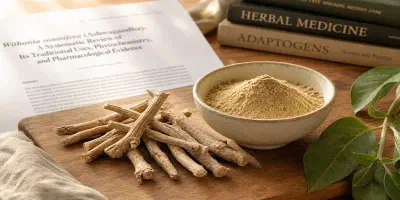
Ashwagandha is having a moment. It’s in the supplement aisle, it’s in the wellness influencer’s morning routine video, and it’s increasingly in the “my doctor actually recommended this” conversation - which, honestly, is a good sign for an herb that’s been used in Ayurvedic medicine for thousands of years. The root of the Withania somnifera plant has been a rasayana - a rejuvenative tonic - for stress, sleep, and vitality since long before randomised controlled trials existed.
And those trials? They’re starting to accumulate. Multiple meta-analyses from 2022 to 2025 have found that ashwagandha root extract, typically at 300–600 mg per day, reduces perceived stress scores, anxiety scores, and serum cortisol compared to placebo over 8–12 weeks. The signal is consistent enough that Mayo Clinic’s Dr. Denise Millstine has described it as a reasonable option for stress relief - with some important caveats (Mayo Clinic Q&A). The meta-analytic evidence backs this up: a 2022 dose-response meta-analysis of 12 trials and 1,002 participants (PubMed), a 2025 BJPsych Open meta-analysis of 15 RCTs (PubMed Central), and a 2025 systematic review (PubMed) all converge on the same basic signal.
But here’s the thing: the safety conversation hasn’t kept up with the popularity. And for certain groups of people, pausing before taking ashwagandha isn’t just prudent - it’s the difference between a useful supplement and a real clinical risk.
This isn’t about whether ashwagandha “works.” It’s about who needs to hit pause before trying it.
Six Groups Who Should Think Twice#
1. If You’re Pregnant, Trying to Conceive, or Breastfeeding#
This one is clear and there’s no hedging required. Both the National Center for Complementary and Integrative Health (NCCIH) - the NIH’s official voice on supplements - and Mayo Clinic state that ashwagandha should not be used during pregnancy. The concern is miscarriage risk.
Breastfeeding is a murkier picture: the safety data simply isn’t there. WebMD and NCCIH both flag it as unknown, which means the default should be avoidance.
If you could be pregnant or you’re actively trying to conceive, the same caution applies. This isn’t a “maybe ask your doctor” situation - it’s a don’t-take-it situation.
2. If You Have a Thyroid Condition#
This is where things get genuinely interesting - and genuinely tricky.
Ashwagandha stimulates the thyroid. Specifically, it increases production of T3 and T4 (the thyroid hormones) and suppresses TSH (thyroid-stimulating hormone). A small 2017 double-blind RCT of 50 people with subclinical hypothyroidism found that 600 mg/day of ashwagandha root extract significantly improved T3 and T4 levels over 8 weeks, with a lower adverse event rate than placebo (PubMed).
So - if you have an underactive thyroid, isn’t that a good thing?
For some people, maybe. But the same mechanism that helps an underactive thyroid can push someone who is borderline hyperthyroid - or someone with autoimmune thyroiditis whose hormone levels are unstable - into genuine thyrotoxicosis. And that’s not a theoretical risk.
A 2022 case report in the journal Cureus documented a 73-year-old woman with Hashimoto’s thyroiditis who substituted her prescribed levothyroxine with ashwagandha. She showed up at the hospital with supraventricular tachycardia - a heart rate of 173 beats per minute - triggered by ashwagandha-induced thyrotoxicosis. Her symptoms resolved after stopping the supplement and resuming her medication (PubMed Central).
The takeaway isn’t that ashwagandha is dangerous for everyone with a thyroid condition. It’s that if you’re on thyroid medication - levothyroxine, methimazole, PTU, or anything else - adding ashwagandha without monitoring could destabilise levels that are currently controlled. And if you have hyperthyroidism or Graves’ disease, the direction ashwagandha pushes your thyroid is the wrong one.
NCCIH lists thyroid hormone medications as a known interaction concern.
3. If You Have Liver Issues - or a History of Them#
Liver injury from ashwagandha is rare. But it’s documented.
By 2023, at least 23 global case reports of ashwagandha-associated liver injury had been published. A systematic review in the journal Pharmaceuticals applied the RUCAM causality scoring system - a standardised tool for assessing whether a drug or herb caused a liver injury - and found 8 cases with “probable” or “definite” causality (DOI 10.3390/ph16081129).
NCCIH’s consumer fact sheet now warns explicitly that “cases of liver injury have been reported in people taking ashwagandha supplements,” including cases severe enough to require liver transplantation.
We don’t fully understand why. A 2025 AI-driven safety analysis predicted that ashwagandha root molecules are safe for the liver - QSAR modelling flagged zero root compounds for liver toxicity (Frontiers in Nutrition, PubMed). But real-world cases exist. Possible explanations: some products contain leaf or stem material (which the same AI analysis flagged as potentially problematic), some cases may be idiosyncratic reactions that computational models can’t predict, and some products may be adulterated or mislabelled - a known problem in the supplement industry.
The practical bottom line: if you have existing liver disease, elevated liver enzymes, or a history of drug-induced liver injury, ashwagandha isn’t worth the gamble without a hepatologist’s sign-off. And if you’re taking it and notice yellowing of the skin or eyes, dark urine, severe fatigue, or upper-right abdominal pain - stop and get checked.
4. If You’re on Sedatives, Thyroid Meds, or Immunosuppressants#
Ashwagandha doesn’t just act on its own - it changes how other drugs behave.
Because ashwagandha has sedative properties (it acts on GABA-A receptors), it can amplify the effects of benzodiazepines, sleep medications, barbiturates, and alcohol. NCCIH flags this additive drowsiness interaction directly.
Thyroid medication interactions we’ve covered. But it’s also worth noting that ashwagandha has immunomodulatory effects - it can theoretically interfere with immunosuppressant drugs like tacrolimus, cyclosporine, and corticosteroids. NCCIH advises caution for people on these medications.
There are also theoretical interactions with blood pressure medications and diabetes medications - ashwagandha may lower both blood pressure and blood sugar, though the evidence is less direct.
5. If You Have an Autoimmune Condition#
This follows from the immunosuppressant interaction. Ashwagandha modulates the immune system - in some contexts it stimulates immune activity, in others it suppresses it. For someone with lupus, rheumatoid arthritis, multiple sclerosis, or another autoimmune condition, the direction of that modulation is unpredictable and could theoretically worsen symptoms or interfere with treatment.
NCCIH specifically notes that people with autoimmune diseases should consult their healthcare provider before using ashwagandha.
There’s also a prostate cancer note worth mentioning: Mayo Clinic Connect and WebMD flag that ashwagandha may be unsafe for people with hormone-sensitive prostate cancer.
6. If You Have Surgery Coming Up#
NCCIH recommends stopping ashwagandha at least two weeks before scheduled surgery because of its central nervous system effects and the potential for interaction with anaesthesia. This is a standard precaution for any herb with sedative properties - same reason you’d stop valerian or kava before a procedure.
So What Does Ashwagandha Actually Do?#
For people who aren’t in any of the caution groups above, the evidence picture is modest but real.
The 2025 BJPsych Open meta-analysis - 15 randomised controlled trials, 873 participants - is the most current synthesis. It found that ashwagandha produced statistically significant reductions in anxiety scores (HAM-A dropped by 3.52 points at 8 weeks), perceived stress (PSS dropped by 4.88 points at 8 weeks), and serum cortisol (down 2.36 µg/dL) (PubMed Central).
But - and this matters - it found zero improvement in quality of life measures. People felt less stressed on paper, their cortisol dropped, but when asked “how’s your life going?” the numbers didn’t move. That gap between biomarker change and lived experience is worth sitting with.
The evidence certainty is also rated low. A 2022 dose-response meta-analysis of 12 trials and 1,002 participants found large effect sizes for both anxiety and stress reduction, but heterogeneity between studies was very high - I² over 80% - meaning the studies don’t agree with each other as much as you’d like. The authors explicitly rated the certainty of evidence as low (PubMed).
For sleep specifically, the benefit appears tied to anxiety-driven insomnia - ashwagandha seems to quiet a racing brain at bedtime rather than acting as a direct sedative. Mayo Clinic’s Dr. Millstine describes it this way: helpful for people whose sleep problems are connected to anxiety, not a general-purpose sleep aid (Mayo Clinic Q&A).
So the profile is: probably helps with stress and anxiety, probably lowers cortisol, might help you sleep if anxiety is what’s keeping you up, but we’re working with low-certainty evidence from small, short trials - nearly all of them 12 weeks or less. Long-term safety beyond three months is genuinely unknown.
The Root vs. Leaf Problem Nobody Talks About#
Here’s a consumer-facing detail that most ashwagandha coverage skips: the plant part matters.
A 2025 AI-driven meta-analysis published in Frontiers in Nutrition analysed 1,396 PubMed articles on ashwagandha. The finding: 97% of studies using root extract reported no safety concerns, and QSAR toxicity modelling predicted zero root molecules would cause liver or reproductive toxicity. But aerial parts - leaves, stems - told a different story. Compounds found in non-root parts (tropine, theophyllin) were flagged as potentially problematic (Frontiers in Nutrition, PubMed).
The report concluded that ashwagandha root should be considered a “first-choice ingredient” among herbal supplements, but that whole-plant or leaf-containing products carry additional safety questions.
This is actionable: if you’re buying ashwagandha, look for root-only extracts. The label should specify Withania somnifera root extract, not “whole plant” or “aerial parts.” Standardised extracts - with a known withanolide percentage - are preferred. Mayo Clinic recommends 0.3% to 1.5% withanolides (Mayo Clinic Q&A).
Supplement quality is uneven. The FDA doesn’t review or approve dietary supplements for safety and effectiveness before they reach store shelves (NCCIH), which means the burden of checking what you’re actually buying falls on you. Third-party testing certifications (USP, NSF, ConsumerLab) are a reasonable screen, though they’re not a guarantee.
If You’re in the Clear: How to Think About Trying It#
So you’ve run through the caution list and none of it applies. You don’t have a thyroid condition, your liver is fine, you’re not pregnant, you’re not on interacting medications, you don’t have an autoimmune condition, and surgery isn’t on the calendar. Now what?
A few sensible starting points.
Dose-wise, the most-studied range is 300 to 600 mg per day of root extract, with Mayo Clinic putting the upper limit at 1,000 mg per day. (The 2022 dose-response meta-analysis oddly found favourable anxiety effects up to 12,000 mg per day, but that outlier should absolutely not be used as a dosing guide - studied safety caps at about 1,000 mg.) (PubMed; Mayo Clinic Q&A) On duration: almost all studies run 8 to 12 weeks, and safety data beyond three months is thin. If you’re going to take it longer, periodic check-ins with a healthcare provider make sense.
For the product itself, root-only, standardised extract with 0.3% to 1.5% withanolides and third-party testing. Skip the proprietary blends that don’t disclose plant parts or withanolide content. As for side effects, the common ones are digestive upset, drowsiness, and headache - manageable stuff. The rare-but-serious ones - liver injury, thyrotoxicosis - warrant a simple rule of thumb: if something feels off after starting ashwagandha, don’t write it off as a coincidence (NCCIH). And if someone takes too much, Poison Control is at 1-800-222-1222, or emergency services for anything that looks severe.
The mandatory caveat that applies to all of this: none of it is medical advice. Talk to a qualified health professional before starting, stopping, or changing any supplement or medication. If you’re in any of the caution groups above, that conversation isn’t optional. It genuinely matters.
Bottom Line#
Ashwagandha is one of the better-studied herbal supplements - multiple meta-analyses converge on a real stress and anxiety benefit, the cortisol signal is consistent, and for people whose sleep problems are anxiety-driven, it may help.
But “better-studied” isn’t the same as “safe for everyone.” The liver injury cases are rare but real. The thyroid interaction is bidirectional - potentially helpful for subclinical hypothyroidism, potentially dangerous for hyperthyroidism or anyone on thyroid medication. Pregnancy is an absolute no. And the product you buy matters: root-only, standardised extracts are the safer bet; leaf and whole-plant products carry additional unknowns.
The sensible question isn’t “does ashwagandha work?” It’s “am I in the group of people for whom the risk-benefit calculation makes sense?” If you’re not sure, the answer is to ask someone qualified - not the internet, and not the supplement label.